
What happened
State Bank of India (SBI), the country’s largest bank, is due to declare its September-quarter results on 3 November 2026. Consensus estimates from broking firms point to about 45% year-on-year growth in standalone net profit, according to a BusinessLine report.
Estimates vary widely, from growth of 16.6% to 50.5%. The expected lift comes from growth in net interest income and other income, including gains from selling shares in SBI Mutual Fund and NSE.
What the brokerages expect
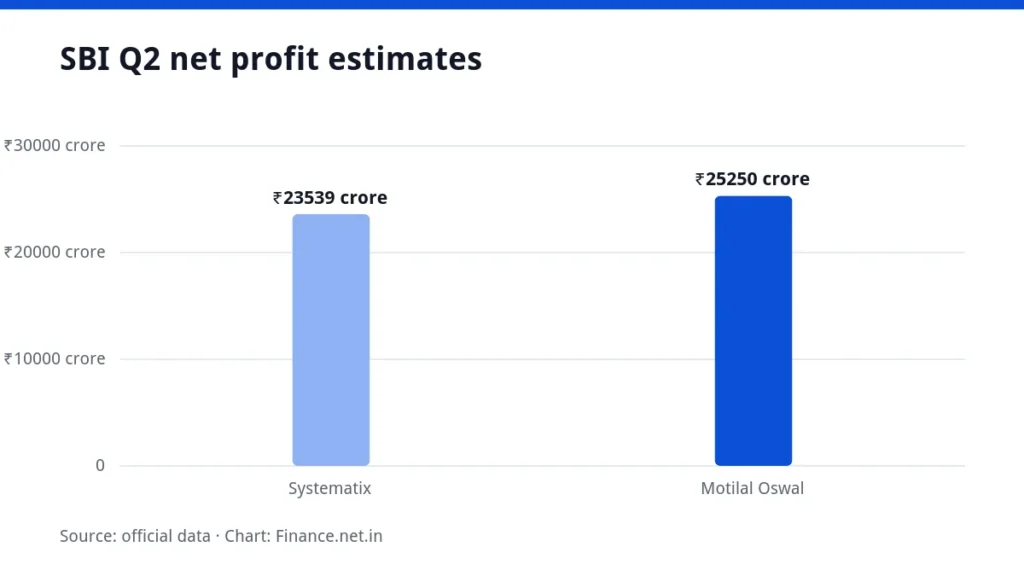
- Motilal Oswal Financial Services: net profit up 50.5% to ₹25,250 crore. It sees net interest income (NII, the gap between interest earned on loans and interest paid on deposits) up 11.3% to ₹47,847 crore.
- Systematix Shares and Stocks (India): net profit up 16.6% to ₹23,539 crore, with NII up 9.6% to ₹47,122 crore and other income up 49% to ₹22,833 crore.
Motilal Oswal projects advances (loans) growth of 18.9%, against 13.1% in the first quarter of FY26, and deposit growth of 12.1%, against 9.3%. It expects net interest margin (NIM, the profit earned on lending as a share of earning assets) at 2.83%, down 14 basis points from 2.97% a year ago. A basis point is one-hundredth of a percentage point.
Systematix said SBI’s other income would include a one-off gain of ₹1,020 crore from selling SBI Funds Management and NSE shares. It added that the bank could face higher credit costs, since it might use the one-off gains to build provision buffers, meaning money set aside for possible loan losses.
What it means for you
These are analyst estimates, not reported numbers. The actual figures may differ once SBI publishes its results. If you hold SBI shares or follow the bank, the split between core earnings and one-off gains is worth watching, since one-off gains do not repeat every quarter.
Our guide on how to read bank results explains NII, NIM and NPA, and the explainer on gross NPA covers asset quality.
Background
Bank results are usually judged on net interest income, margins, loan and deposit growth and asset quality. Recent industry data showed bank credit growing faster than deposits, as covered in our report on bank credit growth.