
What an IPO employee quota is
When a company sells shares to the public for the first time in an initial public offering (IPO), it does not put every share into one pool. It splits the offer into categories, such as anchor investors, large institutions, wealthy individuals and retail investors. It can also set aside a slice for its own employees and, in some cases, for shareholders of a listed parent or group company.
These slices are called reservations or quotas. An IPO employee quota is the portion reserved for eligible staff, often with a discount on the issue price. A shareholder quota does the same for existing shareholders of a listed parent. The idea is to give people with a link to the business a fair chance to own a piece of it, without competing against everyone else for the same shares.
The Securities and Exchange Board of India (SEBI) sets the limits on these quotas in its Issue of Capital and Disclosure Requirements (ICDR) Regulations, 2018. Each company then sets out the exact sizes and rules in its offer document.
Why companies offer quotas
For the company, an employee reservation is a way to give staff a stake in the business they help build, which can strengthen loyalty and align their interests with shareholders’. For a listed parent spinning off a subsidiary, a shareholder reservation rewards the investors who have backed the group, and helps the new company start life with a broad, familiar shareholder base. Both also generate goodwill around a large listing. For employees and shareholders, the attraction is a dedicated pool, where they compete only with each other rather than with every investor in the country.
How an IPO is divided
To see where the quotas fit, start with the main categories. In a typical book-built IPO in India, the shares left after any reservations (called the net offer) are divided among three groups, and SEBI’s rules fix the shares depending on the company’s track record:
| Category | Who | Company meeting profitability tests | Company not meeting them |
|---|---|---|---|
| Qualified institutional buyers (QIBs) | Mutual funds, insurers, banks, foreign portfolio investors and similar institutions | Not more than 50% | At least 75% |
| Non-institutional investors (NIIs) | Individuals and others bidding above ₹2 lakh | At least 15% | Not more than 15% |
| Retail individual investors | Individuals bidding up to ₹2 lakh | At least 35% | Not more than 10% |
Within the QIB portion, up to 60% can be offered to anchor investors, large institutions that commit a day before the issue opens. The non-institutional portion is itself split, with one-third for bids between ₹2 lakh and ₹10 lakh and two-thirds for bids above ₹10 lakh.
Employee and shareholder reservations sit outside these three groups. They are carved out first, and each has its own allotment pool, so bids in one category do not use up shares meant for another.
The employee reservation in detail
SEBI’s rules put clear limits on an IPO employee quota:
- Overall size: the employee reservation cannot be more than 5% of the company’s post-issue capital.
- Per employee: an eligible employee’s allotment in the quota is capped at ₹2 lakh in value.
- If the quota is not fully taken up: the unsubscribed part can be allotted to employees who bid for more, but no employee can receive more than ₹5 lakh in total from the employee portion.
Who counts as an eligible employee is spelt out in the offer document. It usually covers permanent employees, and sometimes directors, of the company or specified group companies, as on a stated date. Promoters and members of the promoter group are not eligible.
The employee discount
Companies often offer employees a discount on the issue price, and the amount is fixed in the offer document. As an illustration, a 5% discount on a ₹1,000 share is ₹50, so an eligible employee would pay ₹950. At that price, the ₹2 lakh limit would buy about 210 shares; the exact number depends on lot sizes and the final price.
A discount lowers your cost per share. It does not protect you if the share falls after listing. A share bought at ₹950 that lists and then trades at ₹900 is still a loss.
A worked example of an IPO employee quota
Here is how the limits work with round, made-up numbers. Suppose the issue price is ₹500, eligible employees get a ₹25 discount, and one lot is 30 shares. An employee pays ₹475 a share, or ₹14,250 a lot.
- Within the ₹2 lakh limit, the employee can bid for 14 lots: 420 shares costing ₹1,99,500. A 15th lot would take the total to ₹2,13,750, above the limit.
- If the offer document allows bids up to ₹5 lakh and the employee pool ends up undersubscribed, the same employee could bid for up to 35 lots, costing ₹4,98,750, and receive more than the first 14 lots only if shares are left over after everyone else’s first ₹2 lakh is met.
Whether the limits are measured at the issue price or the discounted price is stated in each offer document, so check the exact wording before you calculate.
The shareholder reservation
A shareholder quota is narrower than its name suggests. SEBI allows it only for shareholders, other than promoters and the promoter group, of a listed promoter company or listed subsidiary of the company going public. In plain terms: if a listed parent spins off a business through an IPO, the parent’s ordinary shareholders can be given a reserved slice.
The reservation for shareholders cannot be more than 10% of the issue size. The offer document fixes a record date, and only those who held the parent’s shares on that date can apply in this category. Buying the parent’s shares after the record date does not make you eligible.
How allotment works in each pool
Each category is allotted separately, according to its own demand:
- Retail: when the retail portion is oversubscribed, the aim is to give as many applicants as possible at least one lot, so allotment is often decided by a computerised draw. Applying for more lots does not guarantee more shares.
- Employee and shareholder quotas: allotment in these pools follows the rules set out in the offer document, usually proportionate to the bids received when the pool is oversubscribed.
- Unused shares: if a reserved pool is not fully subscribed, the offer document explains how the unsubscribed shares can be added to other categories.
Offer documents also state whether an eligible employee or shareholder may bid in more than one category, for example in both the employee quota and the retail category. Read that section before you apply, because the rules on multiple bids vary.
Why it is in the news
Jio Platforms, the telecom and digital services arm of Reliance Industries, is selling shares in an IPO that is on track to be the biggest in India. Our explainer on Jio Platforms covers the company itself.
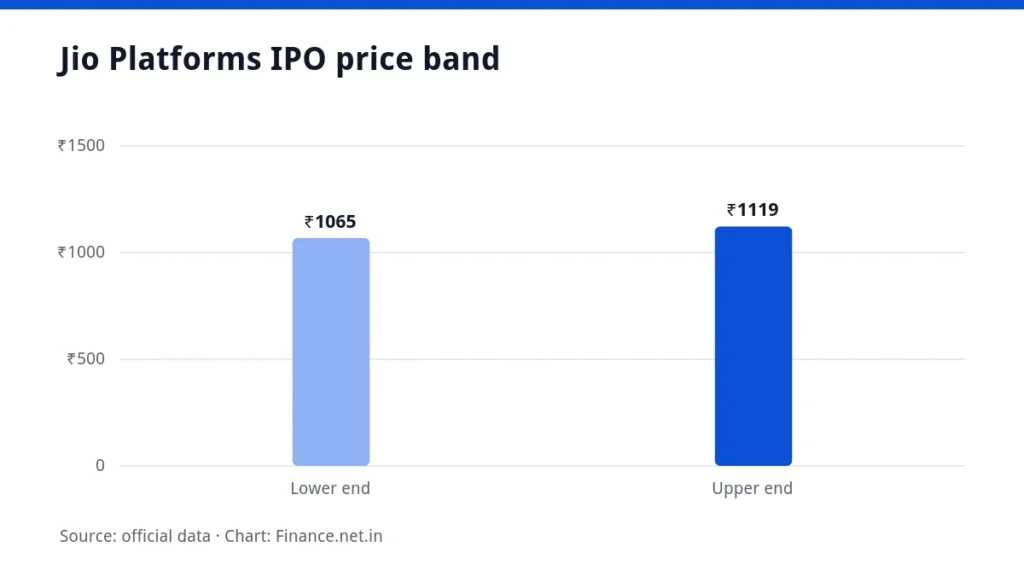
Mint and BusinessLine, carrying a Bloomberg report, said the company is targeting a valuation of as much as ₹10.3 lakh crore ($108 billion). It hopes to raise up to ₹30,200 crore by selling as many as 270 million shares, priced between ₹1,065 and ₹1,119 apiece. Subscription was slated to begin on 21 October and end on 23 October, with the anchor book due to open on 19 October.
Company filings, as reported, show the quotas. Up to ₹500 crore of shares are set aside for eligible employees, who are offered a 5% discount. Up to ₹2,500 crore is reserved for eligible Reliance Industries shareholders. Because Reliance is the listed parent of Jio Platforms, its shareholders qualify for the kind of shareholder reservation described above, and the ₹2,500 crore is within the 10% ceiling on a ₹30,200 crore issue.
For scale, Bloomberg data cited in the reports shows Reliance had 419,911 employees as of 30 June, the second-largest workforce among India’s listed companies after Tata Consultancy Services. Of these, 74,822 work at Jio, according to its website. See also our report on Reliance’s outreach to staff.
Demand on the opening day was heavy. Mint, BusinessLine and ThePrint reported on 21 October that bids exceeded the 197.5 million shares on offer within the first two hours. Read more in our day-one subscription report.
How to apply through a quota
Applying in a reserved category works much like any IPO application:
- Make sure you have a demat account (an account that holds shares in electronic form) and a bank account linked to your PAN.
- Check your eligibility in the offer document: for employees, your status on the stated date; for shareholders, your holding in the parent on the record date.
- Apply through your bank’s net banking or your broker’s app using ASBA (Application Supported by Blocked Amount), which blocks the money in your account until allotment instead of debiting it.
- Choose the correct category, such as “Employee” or “Shareholder”, when you fill in the bid. Bidding in the wrong category can get the application rejected.
- Approve the mandate in your UPI app or banking app before the cut-off time on the last day.
If you are not allotted shares, the blocked money is released. If you are, the shares are credited to your demat account before listing.
Common mistakes
Applications in reserved categories are rejected more often than people expect. The usual reasons are:
- not being eligible on the date the offer document specifies, for example joining the company after that date or buying the parent’s shares after the record date;
- choosing the wrong category in the application form;
- making more than one application in the same category with the same PAN;
- bidding above the limit allowed for the category;
- not approving the payment mandate in time, or not having enough balance in the account.
Things to weigh before you bid
A quota is an opportunity, not a recommendation. Before using an IPO employee quota or a shareholder quota, think about:
- Concentration: if you work for the company, your salary already depends on it. Putting a large part of your savings into its shares as well increases your exposure to one business.
- Price: a discount helps, but the issue price itself may already value the company richly. Read the offer document’s sections on risks and valuation.
- Liquidity needs: money blocked for an IPO is not available until allotment, and the shares may fall after listing.
- Tax: gains or losses when you sell are taxed as capital gains, at rates that depend on how long you hold the shares.
What it means for you
If you work for a company that lists, or hold shares in its listed parent, check the offer document for three things: whether you are eligible, how large the quota is and whether a discount applies. A discount lowers your cost per share but does not remove market risk after listing.
If you do not qualify for any quota, you can still bid in the category meant for you, subject to its limits. A quota guarantees nothing by itself: shares are allotted according to the issue’s rules and the level of demand. This article is explanatory and does not suggest buying or selling any share.