You open your demat account one morning and find twice as many shares of a company as you owned last week, yet the value of your holding has barely changed. That is a bonus issue at work. Bonus issues, stock splits, buybacks and rights issues are called corporate actions, and each one changes your shareholding in a different way. Some give you nothing of real value, some hand you cash, and one asks you to put in more money or sell your right to someone else.
This guide explains what each corporate action means for an ordinary shareholder, how record date and ex-date decide who qualifies, how your holding and the share price adjust, how buybacks are taxed after the changes of October 2024 and April 2026, and how rights entitlements and renunciation work. No company is named and nothing here is a recommendation to buy or sell any share.
What a bonus issue means for you
In a bonus issue the company gives existing shareholders free extra shares out of its reserves, in a fixed ratio. A 1:1 bonus means one new share for every share you hold; a 1:2 bonus means one new share for every two. No money changes hands. The company’s total value does not change either, so the share price adjusts downwards in proportion on the ex-date.
Say you own 100 shares trading at ₹900, worth ₹90,000. After a 1:1 bonus you hold 200 shares, and the price should settle near ₹450. Your holding is still worth about ₹90,000. Companies often announce a bonus issue to make the share look more affordable, to bring more small investors in, or to signal confidence, but on the day itself you are not richer.
For tax, the cost of bonus shares you receive free is taken as nil, and their holding period starts from the date they are allotted. Your original shares keep their original cost and purchase date. So if you sell the bonus shares, the entire sale price is your capital gain, and if you sell them within 12 months, the gain is short-term.
Stock splits: same cake, smaller slices
A stock split divides each share into smaller units by reducing its face value. If a share with a face value of ₹10 is split into five shares of ₹2 each, your 100 shares become 500, and a ₹2,500 share price should become about ₹500. Again, your total holding value does not change.
The difference from a bonus issue is in the company’s books. A bonus moves money from reserves to share capital; a split only changes the face value and number of shares. For you as a shareholder, the result looks almost the same: more shares, lower price, same value. Your purchase cost is simply spread over the larger number of shares, and the original purchase date still counts for the holding period.
Splits and bonus issues are usually neutral for a long-term investor. If a share is cheap only because it was split, it is not a bargain; look at the business and the valuation, not the price tag.
Record date and ex-date: who qualifies
Every corporate action has a record date: the date on which the company checks its register of members to decide who gets the benefit. To be on that register, the shares must be in your demat account by the record date.
The ex-date is the first trading day on which the share trades without the benefit. If you buy on or after the ex-date, you do not get the bonus, split shares, dividend or rights. Indian shares now settle on a T+1 basis, which means a trade reaches your demat account one working day after you buy. A share bought on the record date itself arrives too late, so in practice the ex-date and the record date now usually fall on the same day. In practice, to qualify you need to buy at least one trading day before the record date, and holidays can shift this. Always check the dates the company announces to the stock exchanges rather than assuming.
Selling on the ex-date is fine: you still get the benefit, because you were on the register on the record date.
How holdings and price adjust: a side-by-side view
The table below takes an illustration of an investor holding 100 shares at ₹1,000 each (₹1 lakh) before each action. Real prices move with the market, so treat these as the arithmetic starting point only.
| Corporate action | Shares after | Theoretical price after | Cash in or out | Value of holding |
|---|---|---|---|---|
| 1:1 bonus issue | 200 | ₹500 | None | ₹1 lakh |
| Split, face value ₹10 to ₹2 | 500 | ₹200 | None | ₹1 lakh |
| Rights issue 1 for 4 at ₹800, fully subscribed | 125 | about ₹960 | You pay ₹20,000 | about ₹1.2 lakh |
| Buyback at ₹1,200, 10 shares accepted | 90 | Market decides | You receive ₹12,000 | ₹12,000 cash plus 90 shares |
In the rights example, the ₹960 is the “theoretical ex-rights price”: (100 × ₹1,000 + 25 × ₹800) ÷ 125. If you neither subscribe nor sell your rights, your 100 shares would be worth about ₹96,000 at that price, which is why ignoring a rights issue can cost you money.
Buybacks: the company buys its own shares
In a buyback, the company offers to purchase some of its own shares from shareholders, usually at a price above the market price. The most common route for small investors is a tender offer: you receive a letter of offer, choose how many shares to tender through your broker, and the company accepts shares in proportion if more are offered than it wants to buy. The share of your tendered shares that is accepted is called the acceptance ratio, and it can be low in popular offers. Shares that are not accepted come back to your demat account.
Before tendering, compare the buyback price with the current market price, think about how many shares are likely to be accepted, and, from April 2026, work out your capital gain, because tax now depends on your purchase cost.
How buybacks are taxed: the 2024 change and the 2026 reversal
Buyback tax has changed twice in two years, so the date of the buyback matters.
Buybacks from 1 October 2024 to 31 March 2026: taxed as dividend
For buybacks in this period, the whole amount paid by the company to you was treated as dividend and taxed at your slab rate. At the same time, the sale value of the shares for capital gains was deemed to be nil, so the cost of the shares you tendered became a capital loss that you could set off against other capital gains under the usual rules. A shareholder in the 30% slab who tendered shares bought at ₹600 for ₹1,000 paid tax on the full ₹1,000 as dividend and was left with a ₹600 capital loss.
Buybacks from 1 April 2026: back to capital gains
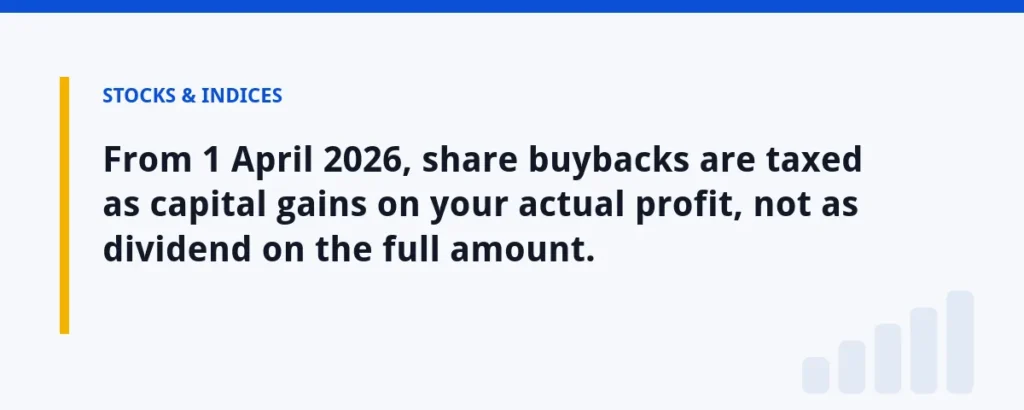
The Budget for 2026-27 said the dividend treatment had been brought in to stop promoters from misusing buybacks, and proposed to tax buybacks for all shareholders as capital gains instead. The Finance Act, 2026 made this law from 1 April 2026, which means tax year 2026-27 onwards. Section 69 of the Income-tax Act, 2025 now says the difference between what the company pays you and your cost of acquisition is a capital gain, and it is short-term or long-term depending on how long you held the shares.
Taking the same illustration, if you bought shares at ₹600 and the company buys them back at ₹1,000, only ₹400 per share is your gain, not ₹1,000. For most minority shareholders this is a big improvement.
Promoters pay more. On top of normal capital gains tax, a promoter pays an additional income-tax on buyback gains: 2% on short-term and 9.5% on long-term gains where the promoter is a domestic company, and 10% and 17.5% for other promoters. Added to the normal 20% short-term and 12.5% long-term rates on listed shares, that works out to 22% for domestic company promoters and 30% for others, before surcharge and cess. Ordinary shareholders are not affected by this extra tax.
Rights issues and rights entitlements
A rights issue lets existing shareholders buy new shares, usually at a discount to the market price, in proportion to what they already hold on the record date. The right to apply is called a rights entitlement (RE). SEBI’s framework requires REs to be issued in demat form under a separate ISIN, and they are credited to your demat account.
According to SEBI’s FAQ, you have five choices:
- Apply for shares to the full extent of your REs.
- Apply for your full entitlement and also apply for additional shares.
- Apply for part of your entitlement without renouncing the rest.
- Apply for part and renounce the rest.
- Renounce all your REs.
Renunciation: selling your right
If you do not want to invest more, you can renounce your REs in two ways. On-market, you sell them on the stock exchange through your broker, just like shares, during the RE trading period. Off-market, you transfer them through your depository participant, and they must reach the buyer’s demat account on or before the issue closing date.
REs that are neither used nor renounced by the issue closing date lapse and are extinguished. If you buy REs and do not apply for shares, they also lapse, and you lose the price you paid for them. Payment for rights shares can be made only from a bank account in your own name.
Tax on rights
The cost of rights shares you subscribe to is what you pay the company. If you renounce your entitlement, its cost is taken as nil, so the money you receive is a capital gain, and the holding period of a renounced right runs from the date of the offer. Someone who buys your REs takes as cost both the price paid to you and the amount paid to the company.
A shareholder’s checklist
- Note the record date for every corporate action on shares you hold, and remember that with T+1 settlement the ex-date is usually the same day.
- For a bonus issue or split, expect the price to adjust; do not treat the lower price as a fall in value.
- Keep records of original purchase cost and dates; bonus shares carry nil cost for tax.
- For a buyback, compare the offer price with the market, expect a partial acceptance, and calculate the capital gain on your cost from April 2026.
- For a rights issue, decide well before the closing date: apply, sell your REs on the exchange, or transfer them off-market. Doing nothing lets them lapse.
- Read the letter of offer for rights and buybacks; it has the timetable and terms.
If you want to see how reinvesting cash from a buyback might grow over time, the lumpsum calculator gives a rough picture, and the income tax calculator helps you estimate the overall tax for the year.