Your nephew has just landed his first job and wants to buy shares of a company he likes. The first thing any broker will ask him to open is a demat account, and most people sign the forms without knowing what they are agreeing to. That is a pity, because this account holds your shares, bonds, ETFs and often mutual fund units, and a few minutes of understanding can save you charges and protect you from fraud.
This guide explains what a demat account and a trading account each do, who NSDL, CDSL and depository participants are, the low-cost Basic Services option, the charges you will see, the consolidated account statement that lands in your inbox, and the simple habits that keep your holdings safe. Every rule below is taken from SEBI circulars and SEBI investor material.
What a demat account and a trading account actually do
Think of three accounts working together. SEBI’s own investor FAQ lists them plainly. A demat account is opened with a SEBI-registered depository participant in your name to hold and transfer securities. A trading account is opened by a SEBI-registered stock broker so that you can buy and sell. A bank account in your name is where money goes out when you buy and comes back when you sell.
The easiest comparison is with a bank. Your demat account is like a savings account, except that it holds shares and bonds instead of rupees. Your trading account is like a cheque book: it lets you place orders, but it does not hold anything itself. Many brokers open both together, so people treat them as one thing. They are not. If you change brokers, your shares stay where they are, and you can link the account to a new trading account.
- Demat account: holds securities in electronic form, with a depository participant.
- Trading account: places buy and sell orders on the exchange, with a stock broker.
- Bank account: pays for purchases and receives sale proceeds and dividends.
NSDL, CDSL and depository participants
India has two depositories, National Securities Depository Ltd (NSDL) and Central Depository Services (India) Ltd (CDSL). The depository is where your holdings are actually recorded. You never deal with it directly for day-to-day work. Instead you go through a depository participant, or DP, which SEBI describes as the agent of the depository that opens demat accounts for clients on its behalf. Banks and stock brokers commonly act as DPs.
You can usually tell which depository holds your account from the account number. SEBI’s investor presentation explains that a CDSL demat number is a 16-digit number, while an NSDL number starts with the letters “IN” followed by digits. In both cases the number combines the DP ID and your client ID.
Opening the account needs proof of identity, proof of address and your PAN. Nomination is the other part people skip. Under a SEBI circular dated 29 May 2026, which takes effect from 1 September 2026, anyone opening a single-name demat account must either name a nominee or submit an opt-out declaration. Nomination is optional for joint accounts. You can name up to three nominees, and if you do not specify each nominee’s share, the holdings are split equally. You can submit the nomination online, validated by e-sign, a digital signature or two-factor authentication with an OTP, or on paper with your signature and no witness, unless you use a thumb impression.
Basic Services Demat Account: the low-cost option
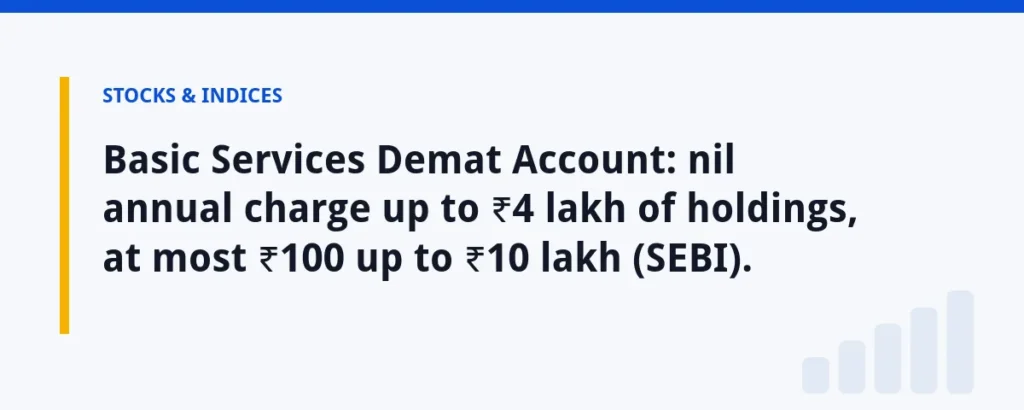
If you hold a modest portfolio, the Basic Services Demat Account, or BSDA, can bring your annual maintenance charge (AMC) down to zero. SEBI reworked the rules in a circular of 28 June 2024, effective 1 September 2024. You are eligible if you have, or propose to have, only one such account where you are the sole or first holder, you have only one BSDA across both depositories, and the value of your holdings does not exceed ₹10 lakh at any time, counting debt and other securities together.
| Value of holdings in the account | Maximum annual maintenance charge |
|---|---|
| Up to ₹4 lakh | Nil |
| More than ₹4 lakh, up to ₹10 lakh | ₹100 |
| More than ₹10 lakh | Not a BSDA; regular AMC may apply |
A few details matter. DPs must open a BSDA by default for an eligible person unless you email them, from your registered email ID, asking for a regular account. DPs check eligibility at the end of every billing cycle. The value is worked out using the daily closing price or NAV, and if your holdings cross ₹10 lakh on any date, regular charges can apply from that date. Electronic statements are free, and a physical statement can cost no more than ₹25. Apart from AMC, a DP cannot charge a BSDA holder more than a regular account holder for other services.
As an illustration, say you hold shares and ETFs worth ₹3 lakh. Your maximum AMC is nil. If a rally lifts the value to ₹6 lakh, the cap becomes ₹100 a year. If it reaches ₹12 lakh, the account stops being a BSDA and the DP’s regular tariff applies.
What a demat account costs
Charges differ from one DP to another, so read the tariff sheet before you sign. Most charges fall into a few groups:
- Account opening: many DPs charge nothing, some charge a one-time fee.
- Annual maintenance charge: a yearly or quarterly fee for keeping the account, capped for a BSDA as shown above.
- Transaction or debit charges: a fee when securities leave your account, usually when you sell.
- Pledge and unpledge charges: if you pledge holdings as margin.
- Physical statements and other services: such as dematerialising old share certificates or courier fees.
Two habits help. First, keep only the number of demat accounts you actually use, because each one can carry its own AMC. Second, compare the tariff sheet with your annual charges and ask your DP about anything you cannot explain.
Your consolidated account statement
The consolidated account statement, or CAS, is the single best check on your holdings. It pulls together your demat accounts and mutual fund folios linked to your PAN. Under SEBI’s circular of 14 February 2025, the CAS is sent by email every month if there was any transaction in any of your demat accounts or mutual fund folios. If there was no transaction, you get a CAS with holding details by email every six months.
The timelines are also fixed. Depositories must send the monthly e-CAS within 12 days of the month end, or within 15 days if you have opted for a physical copy. The half-yearly e-CAS goes out by 18 April and 18 October, and the physical version by 21 April and 21 October.
Open it every time. Check that every holding is yours, that no share has left your account without your instruction, and that your contact details are current. A CAS showing a sale you did not make is your earliest warning of misuse.
How your shares reach your demat account
Two SEBI changes have made the plumbing safer. From 14 October 2024, securities you buy are credited directly to your own account by the clearing corporation, instead of passing through your broker’s account first. This was voluntary earlier and is now mandatory.
When you sell, someone has to move the shares out of your account. SEBI introduced the Demat Debit and Pledge Instruction, or DDPI, to curb misuse of the old power of attorney. A DDPI can be used for only four purposes: transferring securities to meet settlement obligations, pledging for margin, mutual fund transactions on exchange platforms, and tendering shares in open offers. Neither a DDPI nor a power of attorney is compulsory. You can instead approve each sale yourself through an electronic delivery instruction (eDIS) or a physical delivery instruction slip.
Pledges also work differently now. When you pledge securities for margin, they stay in your own account with the pledge marked on them, and they do not move to the broker. That keeps a full trail of how your holdings are used.
Keeping your demat account safe
Most losses come from shared passwords, stale contact details and unread messages, not from the system itself. These steps cost nothing:
- Keep your mobile number and email updated with your DP and broker, so OTPs and alerts reach you and not someone else.
- Never share OTPs, login IDs or passwords, even with someone claiming to be from your broker, DP or SEBI.
- Read every CAS and transaction alert and question anything you did not authorise.
- Think before signing a DDPI. If you trade rarely, approving each sale yourself through eDIS keeps you in control.
- Use the freeze facility if something looks wrong. SEBI notes that voluntary freezing of demat accounts was already available, and since 1 July 2024 brokers must also let you freeze online access to your trading account when you see suspicious activity.
- Add nominees, so your family can claim the holdings without a long legal process.
- Close accounts you no longer use, after moving the holdings, so they are not forgotten.
If you have a complaint, raise it with your DP first. If that does not resolve it, the depositories list their current investor helplines on their websites, and SEBI runs a toll-free helpline on 1800 22 7575 and 1800 266 7575.
Where the demat account fits in your plans
A demat account is plumbing, not an investment. Opening one does not commit you to trading. Many families use it only to hold ETFs bought through a monthly plan, a few long-held shares, or government bonds. If that is you, a BSDA with eDIS and no DDPI is often all you need. If you trade often, a regular account with clear charges may suit you better. Either way, run your expected returns through the SIP calculator or the lumpsum calculator before you start, so the account serves a plan and not an impulse.
Key takeaways
- A demat account holds your securities with a depository participant; a trading account places orders through a broker.
- NSDL and CDSL are the two depositories, and DPs act as their agents.
- A BSDA has nil AMC up to ₹4 lakh and a maximum of ₹100 up to ₹10 lakh.
- Your CAS arrives monthly if you transact and every six months if you do not. Read it.
- Bought shares now go straight to your demat account; a DDPI is optional.
- Update contact details, add up to three nominees and never share an OTP.
This guide is general information based on SEBI rules as of October 2026, not personal advice. Check your DP’s current tariff before opening or changing an account.