Owning an office tower in Bengaluru or a toll road in Gujarat used to be out of reach for anyone without crores to spare. A REIT changes that. With a demat account and the price of a single unit, you can own a small slice of a portfolio of rent-paying buildings and receive your share of the rent.
Real Estate Investment Trusts (REITs) and their cousins, Infrastructure Investment Trusts (InvITs), are regulated by SEBI and listed on the stock exchanges. This guide explains how they make money, how much they must pay out, the SEBI rules on minimum investment and lot size, how each kind of payout is taxed and the risks you take on. Examples use round numbers for illustration only.
What a REIT is, and what an InvIT is
SEBI describes a REIT as a trust registered with it that raises money by issuing units and invests mainly in real estate, either directly or through special purpose vehicles (SPVs) or a holding company. The people who hold units are called unit holders, and the income from the underlying assets is regularly distributed to them. In SEBI’s investor material, REITs are “like mutual funds”, except that the pool owns property instead of shares.
An InvIT works the same way but owns operational infrastructure: highways, power transmission lines, pipelines, warehouses and similar assets. A REIT, by contrast, cannot invest in assets classed as infrastructure, except hotels, hospitals, convention centres or common infrastructure that is part of a real estate project.
Each trust has three key parties. The sponsor sets it up and transfers assets in. The trustee holds the assets for the benefit of unit holders. The manager (called the investment manager for an InvIT) decides what to buy and sell, and when to distribute cash.
How a REIT earns money and pays it out
A REIT earns mostly rent from completed offices, malls, hotels, warehouses and similar properties. SEBI’s investor presentation says at least 80% of a REIT’s assets must be completed and income-producing, with at most 20% in under-construction projects. Agricultural land and speculative land banks are not allowed.
The rule that makes these products attractive to income seekers is the payout requirement. A REIT must distribute at least 90% of its net distributable cash flows to unit holders, at least once every six months. The money reaches you as a mix of interest (on loans the trust has given its SPVs), dividends (from SPV profits), rent from properties the trust owns directly, and sometimes repayment of capital. Your statement will show the break-up, and that break-up decides your tax.
REIT borrowing is capped too. SEBI’s REIT FAQ puts the leverage limit at 49% of REIT assets, and the investor presentation notes that unit holder approval is needed for debt above 25% of capitalisation.
InvITs: roads, power lines and pipelines
Listed InvITs follow similar logic. SEBI’s investor material says at least 80% of a public InvIT’s value must be in completed, revenue-generating infrastructure projects. The rest can include under-construction projects, infrastructure company debt, certain listed shares, government securities and liquid funds.
Distribution rules depend on the type of InvIT. A publicly offered InvIT that holds completed, revenue-generating assets must distribute at least 90% of net distributable cash flows at least once every six months; privately placed InvITs must do so at least once a year. Privately placed InvITs are mainly for institutions and body corporates, with high minimum investments, so most retail investors will meet only listed public InvITs.
Because highway and power InvIT income often comes from tolls or long-term contracts, the cash flows can look different from a REIT’s rent. Read the trust’s offer document to see where the money actually comes from and how long the contracts run.
SEBI minimum investment and lot size rules
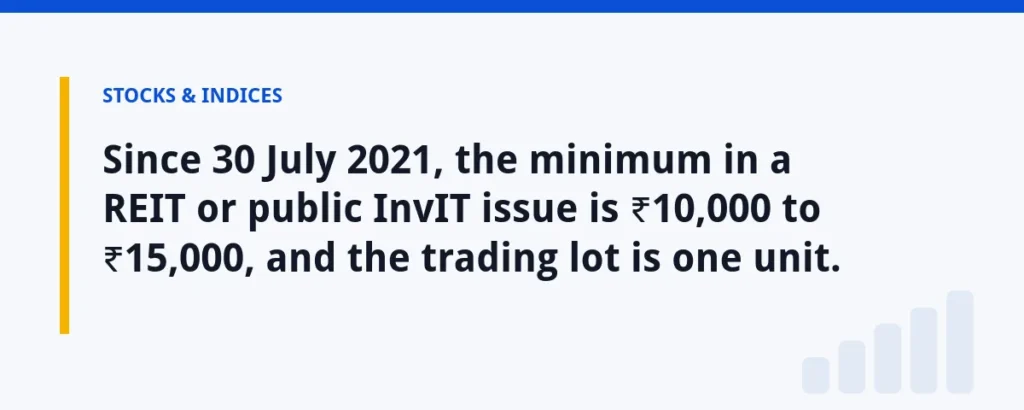
Until 2021, these trusts were effectively for wealthy investors. That changed when SEBI cut the entry ticket. From 30 July 2021, the minimum subscription in a public issue of a REIT or a public InvIT is in the range of ₹10,000 to ₹15,000, and once listed the trading lot is one unit.
| Product | Minimum in public issue | Trading lot after listing | Earlier rule |
|---|---|---|---|
| REIT | ₹10,000 to ₹15,000 | 1 unit | ₹50,000 and 100 units |
| Public InvIT | ₹10,000 to ₹15,000 | 1 unit | ₹1 lakh and 100 units |
| Privately placed InvIT | ₹25 lakh, since September 2025 | ₹25 lakh | ₹1 crore or ₹25 crore; not for retail investors |
| Small and Medium REIT scheme | Minimum price of each unit ₹10 lakh | As per scheme | Framework notified in 2024 |
Small and Medium REITs (SM REITs) are a separate category for smaller property pools, with assets of at least ₹50 crore and less than ₹500 crore per scheme. With a ₹10 lakh minimum per unit, they are aimed at investors with larger tickets, and the risks of a single small property are higher.
How to buy REIT and InvIT units
You need a demat account, exactly as for shares. There are two ways in:
- In a public issue: the price is set by book building, and you apply through ASBA, where your bank blocks the amount. SEBI’s material says UPI can be used for bids up to ₹5 lakh, and allotment is only in demat form.
- On the stock exchange: buy listed units through your broker at the market price, one unit at a time if you wish.
Your rights as a unit holder include receiving distributions, attending and voting at unit holder meetings, and voting on matters such as large acquisitions or borrowing, related party deals and a change of manager. A REIT must also publish a valuation of its assets every half year, which is worth reading before you buy. To see how a one-time investment could grow at a rate you assume, try the lumpsum calculator; remember that distributions and prices are not guaranteed.
How REIT distributions are taxed
REITs and InvITs are treated as pass-through vehicles for much of their income. Under the Income-tax Act, 2025, distributed income is treated as being of the same nature in your hands as it was when the trust received it. In practice, each part of the payout is taxed differently:
| Part of the distribution | Tax in your hands |
|---|---|
| Interest from SPVs | Taxable at your slab rate |
| Dividend from SPVs | Exempt if the SPV has not opted for the lower corporate tax regime; taxable if it has |
| Rent from property the REIT owns directly | Taxable |
| Repayment of capital (for example, SPV loan repayment) | First reduces your cost of the units; taxable as income once total such receipts exceed the issue price |
As an illustration, say you invested ₹1,00,000 in a REIT at its issue price and received ₹7,000 in a year: ₹3,000 as interest, ₹2,500 as dividend from SPVs that have not opted for the lower tax regime, and ₹1,500 as repayment of capital. The ₹3,000 is added to your income. The ₹2,500 is exempt. The ₹1,500 is not taxed now but reduces your cost to ₹98,500, which raises your capital gain when you sell. Your REIT will send a statement showing the break-up each year, so use it when you file.
Tax when you sell units
Listed REIT and InvIT units are treated like listed shares for holding period. The CBDT’s FAQ on the 2024 changes says units of listed business trusts became long-term after 12 months instead of 36. Short-term gains on units sold on the exchange with securities transaction tax are taxed at 20%. Long-term gains are taxed at 12.5% on the amount above ₹1.25 lakh a year, and that exemption is shared with your gains on listed shares and equity funds.
For example, if you sell units after 18 months with a gain of ₹2,00,000 and have no other equity gains that year, tax applies to ₹75,000 at 12.5%, which is ₹9,375 plus cess. Run your full numbers through the income tax calculator.
REIT units compared with buying property
Many families compare a REIT with buying a flat or a shop to rent out. SEBI’s investor presentation lays out the contrast. Direct commercial property typically starts at around ₹25 lakh even for strata units, the market is illiquid and not very transparent, and you deal with tenants, repairs and transaction costs yourself. REIT units start at one unit, are freely transferable listed securities, are professionally managed and carry no entry or exit load.
The trade-off is control. With your own shop you choose the tenant and decide when to sell. With a REIT, the manager makes those calls, and the unit price moves every trading day, sometimes for reasons unrelated to the buildings. You also get far more information than a landlord usually has: SEBI’s material notes that REITs publish earnings material and hold earnings calls every quarter, issue half-yearly reports and valuations, and hold an annual meeting of unit holders.
Compared with shares, the difference is the payout rule. A listed company may or may not pay a dividend, while a REIT must distribute at least 90% of its distributable cash. That makes a REIT more of a hybrid between fixed income and equity: a regular cash yield plus any change in property values.
Risks to weigh before investing
- Income can fall: SEBI’s material reminds investors that the stability of a trust’s income depends on the stability of income from its assets. Vacancies, lower rents or weaker toll collections cut payouts.
- Price risk: units trade on the exchange, so prices can fall below what you paid, and in a rising interest rate period income products often come under pressure.
- Concentration: a REIT may own a handful of buildings in a few cities; an InvIT may depend on a few roads or contracts.
- Debt: borrowing within the SEBI caps still adds risk if rates rise or income drops.
- Capital repayment is not profit: part of a high payout may be your own money coming back, which is why it reduces your cost.
- Thin trading: some units trade in low volumes, which can make exits slow.
None of this makes REIT units unsafe by default, but they are market-linked products, not fixed deposits.
Key takeaways
- A REIT owns rent-yielding real estate; an InvIT owns operational infrastructure. Both are SEBI-regulated trusts.
- Both must distribute at least 90% of net distributable cash flows; listed REITs and public InvITs at least every six months.
- Since 30 July 2021, the minimum in a public issue is ₹10,000 to ₹15,000 and the trading lot is one unit.
- Interest and rent portions are taxable; SPV dividends are exempt unless the SPV opted for the lower tax regime; capital repayments reduce your cost.
- Listed units turn long-term after 12 months: 20% on short-term gains, 12.5% on long-term gains above ₹1.25 lakh.
This guide is general information, not a recommendation to buy any REIT or InvIT. Read the offer document and the latest SEBI rules, or speak to a SEBI-registered adviser, before investing.