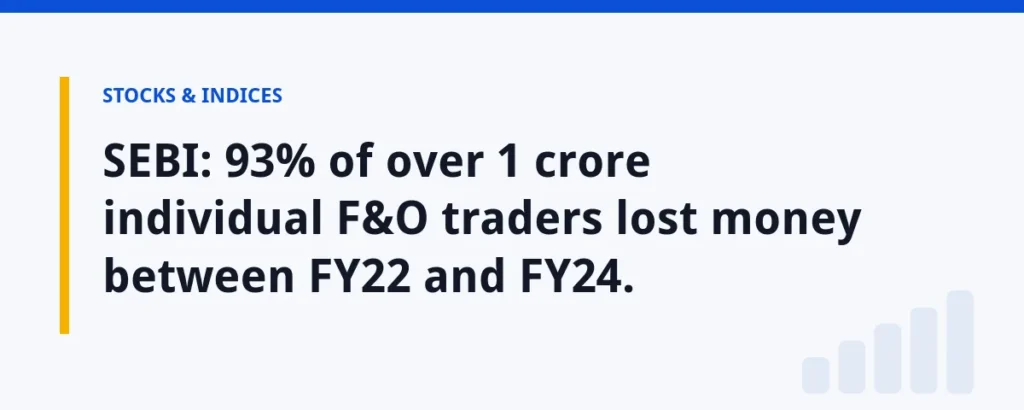
Your cousin shows you a screenshot: ₹40,000 made in one afternoon on index options, starting with a few thousand rupees. He says anyone can do it. Before you open a derivatives account, look at what the market regulator found when it studied traders like him. Between FY2022 and FY2024, 93% of individual traders in equity futures and options lost money, according to SEBI’s own study.
This guide explains what futures and options actually are, how lot size, margin and expiry work, what SEBI changed in 2024 and 2025 to cool down expiry-day speculation, and how the income-tax law treats an F&O profit or loss. It is an explainer, not a trading call. Nothing here suggests that you should trade, or which way a market will move.
What are futures and options?
Both are derivatives. SEBI’s investor FAQ describes a derivative as a contract with no independent value: its value is derived from something else, called the underlying. The underlying can be a share, a stock index such as the Nifty 50 or the Sensex, a commodity or a currency. Most individual traders in India deal in equity derivatives on NSE and BSE, and most of that activity is in index options.
Futures
A futures contract is a legally binding agreement to buy or sell the underlying on a fixed future date at a price agreed today. Both sides are bound. If you buy an index futures contract and the index rises, you gain; if it falls, you lose, rupee for rupee, on the full size of the contract. Because an index cannot be delivered, index futures are settled in cash.
Options
An option gives the buyer a right, but not an obligation, to buy the underlying (a call option) or sell it (a put option) at a fixed price called the strike price. The buyer pays a premium to the seller, also called the writer. The seller must honour the contract if the buyer exercises it. SEBI’s FAQ notes that index options in India are generally European style, which means they are exercised only on the expiry date.
As an illustration, say an index stands at 25,000. You buy a call option with a strike of 25,200 and pay a premium of ₹100 per unit. If the index closes at 25,500 on expiry, the option is worth ₹300 per unit and you are ahead by ₹200 per unit before costs. If the index ends at or below 25,200, the option expires worthless and you lose the whole ₹100 per unit. The seller’s best case is keeping the premium; the seller’s possible loss has no fixed ceiling.
Lot size and contract value: why this is not a small bet
You cannot buy a single unit of a derivative. Contracts trade in lots, and the lot size is the number of units of the underlying in one contract. The exchange sets it so that one contract has a minimum value.
SEBI’s circular of 1 October 2024 raised that minimum for index derivatives. Earlier, an index contract had to be worth between ₹5 lakh and ₹10 lakh, a band last set in 2015. Since then, SEBI noted, market values had grown about three times. Now a new index derivative contract must be worth at least ₹15 lakh when it is introduced, and the lot size is fixed so that the contract value on the day of review stays between ₹15 lakh and ₹20 lakh. This applied to new index contracts introduced after 20 November 2024.
Put simply, say one lot gives you exposure of ₹16 lakh to an index. A 1% move in the index then means a gain or loss of about ₹16,000 on that single lot. Small price moves turn into large rupee amounts very quickly.
| Point | Futures (buyer or seller) | Option buyer | Option seller |
|---|---|---|---|
| Obligation | Both sides bound to settle | Right, no obligation | Must settle if exercised |
| Money paid upfront | Margin | Full premium | Margin; receives premium |
| Largest possible loss | Large; grows with the move against you | Premium paid | No fixed ceiling |
| Largest possible gain | Large; grows with the move in your favour | Open-ended for a call | Premium received |
Margin, leverage and daily settlement
When you buy futures or sell options, you do not pay the full contract value. Your broker collects margin, a deposit meant to cover the losses the position could suffer. SEBI’s FAQ describes two main parts: an initial margin based on a 99% value-at-risk estimate and a worst-case loss, and mark-to-market settlement, in which futures gains and losses are settled in cash every day. Exchanges also levy an extreme loss margin to cover tail risk.
Margin is what creates leverage. As an illustration, if you put up ₹2.5 lakh of margin to hold a contract worth ₹16 lakh, a 5% move against you costs ₹80,000, close to a third of your money, in what may be a few sessions. If losses eat into the margin, your broker asks you to top up. If you cannot, the position is closed at the market price, and the loss is yours.
Option buyers pay the full premium, so they cannot lose more than that. Since 1 February 2025, SEBI requires brokers to collect the net option premium upfront from buyers, which ended the practice of letting clients take option positions beyond the money they had deposited.
Expiry: weekly, monthly and the expiry-day rush
Every derivative contract has an expiry date, after which it ceases to exist. For years, different exchanges ran weekly index contracts expiring on almost every day of the week. SEBI’s October 2024 circular said expiry-day trading in index options, when premiums are low, is largely speculative, with average holding periods measured in minutes. From 20 November 2024, each exchange may offer weekly contracts on only one of its benchmark indices.
A SEBI circular of 26 May 2025 went further. All equity derivatives expiries of an exchange are limited to either Tuesday or Thursday. Each exchange keeps one weekly benchmark index options contract on its chosen day. All other equity derivatives, including benchmark index futures and single-stock futures and options, have a minimum tenor of one month and expire in the last week of the month.
The expiry day also carries extra safeguards under the 2024 circular:
- An additional extreme loss margin of 2% on short options that expire that day, from 20 November 2024.
- No calendar spread margin benefit on expiry day for contracts expiring that day, from 1 February 2025.
- Intraday monitoring of index derivative position limits, with at least four snapshots a day, from 1 April 2025.
The habit is hard to break. SEBI’s study published in August 2026 found that 70% of index options turnover in FY25 happened on the expiry day itself. In FY26 that share eased to 59%, still more than half.
What SEBI’s studies say about losses in futures and options
SEBI has studied individual traders’ profit and loss several times. Its January 2023 study found that 89% of individual equity F&O traders lost money in FY22. The follow-up, released on 23 September 2024 (press release No. 22/2024), covered FY22 to FY24. Its main findings:
- 93% of over 1 crore individual F&O traders incurred losses, averaging around ₹2 lakh per trader including transaction costs, over the three years.
- Aggregate losses of individual traders exceeded ₹1.8 lakh crore over the three years.
- The top 3.5% of loss-makers, about 4 lakh traders, lost an average of ₹28 lakh each.
- Only 1% of individual traders earned profits of more than ₹1 lakh after transaction costs.
- Individuals spent about ₹50,000 crore on transaction costs over the three years.
- More than 75% of loss-making traders kept trading despite consecutive years of losses, and over 75% of individual traders in FY24 had declared an annual income below ₹5 lakh.
In July 2025, SEBI said nearly 91% of individual traders incurred a net loss in the equity derivatives segment in FY25. Its August 2026 study, covering FY25 and FY26, found aggregate net losses of individuals fell to ₹91,685 crore in FY26 from a revised ₹1.12 lakh crore in FY25. The share of loss-makers dipped to 87.7% from 90.9%, but the average loss per person rose to ₹1.17 lakh. Options accounted for 92% of individuals’ losses.
Who is on the winning side? The same study found proprietary traders made gross trading profits of about ₹44,000 crore in FY26, and 99% of the profits of foreign portfolio investors and proprietary traders came from entities using algorithmic trading.
Why most individual traders lose
There is no single reason, but the studies and the way these contracts work point to a few repeat causes:
- Costs add up. Brokerage, exchange charges and securities transaction tax are paid on every trade, win or lose. Individuals paid about ₹25,000 crore in transaction costs in each of FY25 and FY26, SEBI found.
- Time works against option buyers. An option’s value shrinks as expiry nears if the price does not move enough. Cheap, near-expiry options often expire worthless.
- Leverage cuts both ways. A margin that controls a contract many times its size turns a small market move into a large loss.
- You are up against machines. Large firms trade with algorithms, faster data and deep pockets.
- Behaviour. Trying to win back losses with bigger positions is a common pattern; SEBI found most loss-makers kept trading.
None of this means every trade loses. It means the odds for an individual, on SEBI’s numbers, are poor.
How futures and options income is taxed
Many first-time traders assume F&O gains are capital gains, like profits on shares. They are not. Under income-tax law, a derivatives trade carried out on a recognised stock exchange through a registered broker is kept out of the meaning of a speculative transaction. The result is that profit or loss from futures and options is generally treated as non-speculative business income.
That has practical effects:
- You usually file ITR-3, the return for business income. Its trading account schedule has separate lines for turnover from futures and options and for income from futures and options, as the e-filing validation rules for AY 2026-27 show.
- The net income is added to your other income and taxed at your slab rate, not at a special capital gains rate.
- Expenses incurred wholly for the trading activity can be claimed against it, subject to the rules for business income.
- A loss has to be reported in a return filed on time if you hope to carry it forward. Depending on your turnover and profit, the tax audit rules may also apply. A chartered accountant can confirm both for your case.
Tax year 2026-27 is the first under the Income-tax Act, 2025, which renumbered many sections. If your adviser cites an old section number, ask for the new one. You can estimate the tax on your total income, including business income, with the income tax calculator.
Before you trade: key takeaways
- Read SEBI’s study findings once more. Nine out of ten individual traders lost money in recent years.
- Know the contract: lot size, current contract value, expiry day and how it settles.
- As an option seller, accept that your loss has no fixed limit. As a buyer, expect to lose the full premium on many trades.
- Count every cost: brokerage, exchange fees, securities transaction tax, GST on charges and income tax.
- Use only money you can afford to lose completely, never borrowed money or your emergency fund.
- Keep trade records and file ITR-3 on time.
If your real goal is to build wealth over years, regular investing tends to be a calmer route. The SIP calculator shows how steady monthly sums can grow, with no lot sizes or expiry dates. This guide is general information, not personal investment advice.