You get a text saying ₹4,999 has left your account and you do not remember spending it. Or the balance looks ₹590 lower than you expected and nobody can tell you why. In both cases the answer sits in one document you probably scroll past every month. Learning how to read a bank statement turns that wall of dates and codes into something you can check in ten minutes.
A statement is a running diary of your account: every rupee that came in, every rupee that went out, and the balance after each entry. Most errors, wrong charges and even fraud show up there first. This guide explains each column, the codes that confuse people, the mistakes worth hunting for, and what the RBI rules let you do when something is wrong.
What a bank statement is and where you get it
A bank statement is the bank’s record of all transactions in your account over a period, usually a month, a quarter or a financial year. It is not a legal summary of your wealth. It is a ledger, and like any ledger it can contain mistakes in either direction.
The RBI’s customer service guidelines say banks should offer a passbook facility to all individual savings account holders. If you choose a statement instead, the bank is expected to issue it monthly, and the cost of the passbook or statement should not be charged to you. So you are entitled to a regular record without paying for it.
In practice you can get one in several ways:
- Net banking or the mobile app, where you can download a PDF for any date range.
- An emailed monthly e-statement, if you opted for it.
- A printed passbook, updated at a branch or a passbook kiosk.
Extra copies of an older bank statement may carry a fee under the bank’s published tariff. Banks must display service charges on their websites and branches, and under the Code of Bank’s Commitment to Customers they should tell you about a change in charges one month before it applies.
The columns, one by one
Layouts differ between banks, but nearly every statement has the same building blocks. Once you recognise them, any statement becomes readable.
| Column | What it tells you | What to check |
|---|---|---|
| Transaction date | The day the entry was recorded | Does it match when you actually paid or received? |
| Value date | The day interest or availability starts for that entry | Large gaps on cheque deposits or reversals are worth asking about |
| Narration or description | Mode, counterparty and a reference number | Do you recognise the name or merchant? |
| Cheque or reference number | Cheque number, UPI ID, UTR or card reference | Keep it handy for any dispute |
| Withdrawal or debit | Money that left the account | Is every debit yours? |
| Deposit or credit | Money that came in | Salary, refunds and interest where you expect them? |
| Balance | Account balance after that entry | Does the arithmetic hold from line to line? |
Many a bank statement also prints an opening balance, a closing balance and totals of debits and credits. Those totals give you a quick sanity test: opening balance plus total credits minus total debits should equal the closing balance.
How to read a bank statement in six steps
You do not need to study every line the same way. A routine keeps it quick.
- Check the header of the bank statement. The account number, name, branch, period and IFSC should be yours and the period should be the one you asked for.
- Check the opening balance against last month’s closing balance. They must match.
- Run the totals test described above. If it fails, the statement or your reading is off.
- Tick off big entries first: salary, EMIs, rent, SIP debits, insurance premiums. These are easy to recognise and they make up most of the money.
- Scan the small entries. Charges of ₹5 to ₹500 hide most surprises: SMS fees, ATM fees, annual card charges, minimum balance penalties and GST on them.
- Match every unfamiliar narration with an SMS alert, an app notification or a UPI history entry.
Say your salary comes on the 1st and your EMI goes out on the 5th. If the EMI shows up twice on the 5th, that is not a reading problem. That is a duplicate debit, and it is worth a call the same day.
Decoding the codes in the narration column
A few patterns appear everywhere.
- UPI: usually shows the payer or payee name or UPI ID, a 12-digit reference number and sometimes the app used. The reference number is what you quote in a dispute.
- NEFT, RTGS or IMPS: shows the mode, the other bank’s code and a UTR number that both banks can trace. Our guide on NEFT, RTGS and IMPS covers how they differ.
- ACH, NACH or ECS: a standing instruction. It is how EMIs, SIPs, insurance premiums and utility bills are pulled from your account.
- POS or ECOM: card payments at a shop or online.
- ATM or NFS: a cash withdrawal, at your own bank or another bank’s machine.
- INT or INT.PD: interest paid by the bank on your balance.
- TDS or TAX: tax deducted at source, mainly on interest.
- CHG, FEE or GST: a service charge or tax on a charge.
If a narration is cryptic, the bank’s own app often expands it. If it does not, ask the branch. A bank cannot treat a debit as valid just because you could not decode it.
Charges that deserve a second look
Many unwelcome debits are legitimate. The skill is in telling which ones are.
ATM fees are a good example. As per the RBI’s notice on ATM usage, you get five free transactions a month at your own bank’s ATMs, counting financial and non-financial ones together. At other banks’ ATMs you get three free in metro centres and five in non-metro centres. Beyond that, a bank may charge up to ₹23 per transaction, plus applicable taxes, from 1 May 2025. If your statement shows a charge of around that size after a month of heavy ATM use, it is probably correct. If it shows up when you used the ATM twice, ask.
Errors to look for and what they usually mean
| What you see | Possible cause | What to do |
|---|---|---|
| Same debit twice, same day | Duplicate processing of an EMI, bill or UPI payment | Note both reference numbers and raise a complaint with the bank |
| Debit with no credit at the other end | Failed transfer where the money was not returned | Ask the bank for the reversal timeline, quote the UTR |
| Charge you do not recognise | A fee, a subscription mandate or an unauthorised transaction | Compare with the tariff and your active mandates, then raise it |
| Salary or refund missing | Credited under a different narration or not yet processed | Search the statement by amount before escalating |
| Interest not credited | Wrong date window or account type | Check the quarter-end entries and your interest terms |
| Cheque deposit credited late | Clearing delay | Check the value date and ask for the clearing record |
| Balance does not add up | Reading mistake or a genuine ledger error | Redo the arithmetic, then ask for a corrected statement |
If a transaction is not yours: the time limits that matter
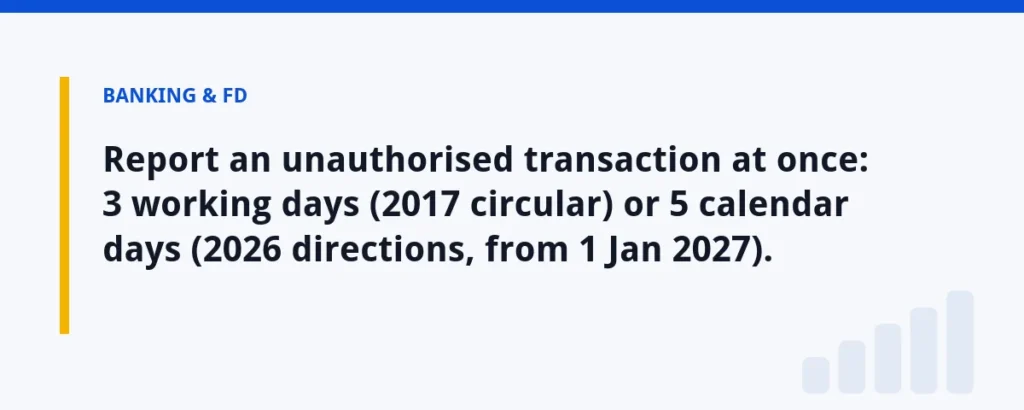
This is the part of reading a bank statement where speed pays. On 24 June 2026 the RBI issued the Commercial Banks (Responsible Business Conduct) Third Amendment Directions, 2026, which revise the liability rules for fraudulent electronic banking transactions. They apply to transactions made on or after 1 January 2027. Earlier transactions fall under the RBI’s 2017 circular on limiting customer liability. Small finance banks and payments banks have their own directions on the same lines, so read the current text on rbi.org.in.
Under the 2026 directions, from 1 January 2027:
- If the fault lies with the bank, you have zero liability and a reversal, whether or not you report it.
- If a third party breaches the system and the fault is neither yours nor the bank’s, you have zero liability if you report within five calendar days of the transaction. Later reports fall under the bank’s policy.
- If you were negligent, you bear the loss until you report it, except for amounts covered by the compensation scheme. Losses after you report fall on the bank.
- The bank must resolve the complaint within its policy timeline, capped at 45 days for domestic fraud and 60 for cross-border fraud.
- A small-value scheme covers an individual with a gross loss up to ₹50,000. It pays 85% of the net loss or ₹25,000, whichever is less, once in a lifetime. You must report to the National Cyber Crime Reporting Portal or helpline 1930, and to the bank, within five calendar days.
For transactions before that date, the 2017 circular applies. If the fault is the bank’s, you have zero liability. In third-party fraud, you have zero liability if you report within three working days of the bank’s message. If you report in four to seven working days, liability is capped at the transaction value or ₹5,000 for basic savings bank deposit accounts and ₹10,000 for other savings accounts, among others, whichever is lower. After seven working days, the bank’s board-approved policy decides. The bank must credit the disputed amount within ten working days of your notification and resolve the complaint within its policy, not exceeding 90 days.
Under both versions the burden of proving that you are liable lies on the bank. Banks must also send SMS alerts for electronic transactions, and the lesson is simple. A suspicious entry found on day 2 costs you nothing. The same entry found a month later may cost you a fight.
How to raise a complaint about a statement entry
Follow the order that RBI’s complaint system expects.
- Report fast through the bank’s 24×7 channel: the app, the customer care number or a branch. If it is an unauthorised transaction, ask for the card or net banking to be blocked.
- Get an acknowledgement with a complaint number. Banks are expected to provide one.
- Send the details in writing as well: date, amount, reference number, narration and a screenshot or statement extract.
- Escalate inside the bank to the nodal or principal nodal officer if the first reply is weak.
- If the bank does not reply within 30 days, or you are not happy with the reply, file with the RBI Ombudsman at cms.rbi.org.in. The RBI notes that you must file within 90 days of the bank’s deadline or last reply, and that filing is free. The RBI contact centre toll free number is 14448.
A monthly habit that catches almost everything
Most people read a bank statement only when they need it for a loan or a visa, and then it is too late to fix old mistakes cleanly. Build a short routine instead.
Pick a fixed day after the month ends. Download the bank statement, run the totals test, tick off the big items and scan the small ones. If you use more than one account, do the same for each, especially the dormant-looking ones, since forgotten accounts are where fees pile up unnoticed. Our guide on dormant accounts explains what happens when an account sits idle. Check loan debits with our EMI calculator at https://finance.net.in/tools/emi-calculator/.
Key takeaways
- Your bank must offer a passbook, or a monthly statement if you choose one, at no charge to you.
- Check the opening balance, the totals and the large entries of your bank statement first, then the small charges.
- Learn the common narration codes: UPI, NEFT, NACH, POS, ATM, INT, TDS and CHG.
- Report an entry that is not yours at once: the window is three working days for older transactions and five calendar days from 1 January 2027.
- Quote the reference number, get a complaint ID and put the complaint in writing.
- If the bank has not solved it in 30 days, the RBI Ombudsman is free to approach.
This guide is general information, not personal advice.