
What the India Bullion and Jewellers Association is
The India Bullion and Jewellers Association Ltd (IBJA) is the trade body whose published gold prices the Reserve Bank of India (RBI) uses when it fixes the price of Sovereign Gold Bonds (SGBs). The RBI’s notices refer to one figure in particular: IBJA’s closing price for gold of 999 purity, which means gold that is 99.9% pure.
IBJA says on its own website that it was founded in 1919 to deal with problems bullion traders faced. Today it publishes daily gold and silver rates, a morning rate and an afternoon rate, which traders, jewellers and lenders across India watch. For SGB holders, though, only one use matters: its closing price for 999 gold feeds directly into what the bonds are worth when they are issued and when they are repaid.
A Sovereign Gold Bond is a government security denominated in grams of gold. The RBI issues it on behalf of the Government of India. You pay for it in rupees and, when it is redeemed, you are paid back in rupees based on the gold price at that time, not in physical gold.
How it works
IBJA’s prices are used at both ends of a bond’s life.
At issue
According to the RBI’s frequently asked questions on the scheme, the issue price of each tranche was fixed in rupees on the basis of the simple average of IBJA’s closing price for 999 gold over the last three business days of the week before the subscription period. The RBI published that price on its website two days before the issue opened.
At redemption
The redemption price is not the price on a single day either. It is the simple average of IBJA’s closing price for 999 purity gold over the three business days before the redemption date. A simple average means the three prices are added up and divided by three.
Here is how the arithmetic works, using made-up numbers. Say the three closing prices were ₹14,300, ₹14,450 and ₹14,520 per gram. Added together they come to ₹43,270. Divided by three, the redemption price would be about ₹14,423 per gram. Averaging over three days reduces the effect of a sharp one-day jump or dip on the amount paid out.
There are two ways a bond can be redeemed:
- Premature redemption: allowed after the fifth year from the issue date, but only on a date when interest is due.
- Final redemption: the bond is repaid when eight years have passed from its issue date.
The RBI announces the price for each tranche (a separate issue of bonds) in a press release shortly before the redemption date.
Why it is in the news
Two recent RBI notices show the method at work.
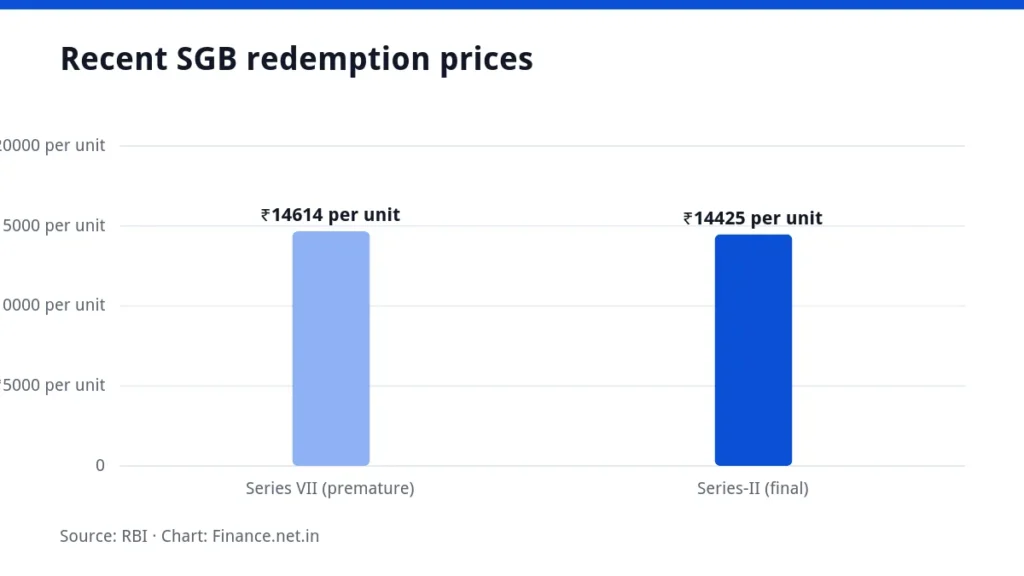
On 16 October 2026, the RBI set the premature redemption price of SGB 2020-21 Series VII, issued on 20 October 2020, at ₹14,614 per unit. The redemption was due on 19 October 2026 because 20 October was a holiday. The price was the average of IBJA closing prices for 14, 15 and 16 October 2026. See our coverage of the Series VII price.
On 22 October 2026, the RBI set the final redemption price of SGB 2018-19 Series-II, issued on 23 October 2018, at ₹14,425 per unit, for redemption on 23 October 2026. It used the average of IBJA closing prices for 19, 21 and 22 October 2026. Read more in our report on the Series-II price.
The two prices differ because each is based on a different set of three days.
How to redeem early
Final redemption needs no action beyond keeping your bank details up to date. The RBI’s FAQ says investors are told about one month before maturity, and both interest and redemption money are credited to the bank account given when the bond was bought.
Premature redemption works differently. The RBI’s FAQ says you can approach the bank, Stock Holding Corporation of India (SHCIL) office, post office or agent through which you hold the bond up to thirty days before the interest payment date. The request is accepted only if you make it at least one day before that date. The money then goes to your registered bank account.
If your bond is held in demat form, there is another way out: the bonds can be traded on stock exchanges. An exchange sale happens at whatever price buyers offer that day, which can be above or below the IBJA-based redemption price, so compare the two before you choose.
Interest and tax
SGBs pay interest at a fixed 2.50% a year on the amount you first invested, credited every six months. The last interest payment comes with the principal at maturity. This interest is separate from the gold price; the IBJA average only decides the value of the gold part.
The RBI’s FAQ says the interest is taxable, no tax is deducted at source, and capital gains arising to an individual on redemption of SGBs are exempt from tax. Those answers were written under the Income-tax Act, 1961, which the Income-tax Act, 2025 replaced from 1 April 2026, so confirm the current treatment with a tax adviser before you file. Gains from selling on an exchange before redemption are treated differently from redemption itself.
The RBI’s FAQ also says SGBs can be used as collateral for loans from banks, financial institutions and NBFCs, on the same loan-to-value terms as an ordinary gold loan, at the lender’s discretion.
What it means for you
If you hold SGBs, the amount you receive depends on the IBJA closing prices in the three business days before your redemption date, so the date matters. Your tranche’s issue date decides when premature and final redemption fall.
The RBI states the price per unit, so you can multiply it by the number of units you hold to see the gross redemption value. For example, with 10 units at ₹14,425 per unit, the figure would be ₹1,44,250. This is only an illustration of the arithmetic.
The IBJA price is a benchmark for bond redemption. If you also buy gold jewellery, retail prices can differ because of making charges and taxes, and our Gold Jewellery Price Calculator can help with estimates.
Background
The scheme’s rules come from Government of India notifications issued for each tranche. Those notifications set the redemption terms, while the RBI publishes the resulting price for each redemption date.
No new tranche has been issued since February 2024. In February 2025, the Finance Ministry said the bonds had become costly borrowing for the government and that it would not continue issuing them. Existing bonds are not affected: they run to their redemption dates, and their prices will keep being set from IBJA’s numbers.