
Lakshmi has ₹2 lakh from a matured bank deposit and two questions. Should she lock it away for five years and claim a tax deduction, or pick something that simply doubles her money with no fuss? At the post office, those two questions point to two certificates: NSC and KVP. The National Savings Certificate (VIII Issue) and the Kisan Vikas Patra are both government-backed, both sold at post offices, and both pay nothing until the end. That is where the similarity stops.
This guide explains how NSC and KVP each work: who can buy them, how interest compounds, when they mature, when you can cash them early, how transfer and pledging work, how they are taxed and which one suits whom. The rules come from the scheme notifications of 2019 and India Post’s own pages. Rates are reset every quarter, so check the current rate before you invest.
What NSC and KVP have in common
Both are small savings certificates issued under the Government Savings Promotion Act, 1873, and both carry the backing of the Government of India. The basic buying rules are identical:
- Minimum ₹1,000, then any amount in multiples of ₹100.
- No maximum. You can invest any amount and open any number of accounts.
- Who can buy: an adult for himself or herself, a guardian on behalf of a minor or a person of unsound mind, or a minor aged 10 or more in his or her own name.
- Joint holding: up to three adults. A Joint A account is payable to all holders jointly or to the survivors; a Joint B account is payable to any one of the holders or to the survivors.
- Interest at the end: neither pays a regular income. Interest is compounded yearly and paid with the principal at maturity.
- Pledging: both can be pledged as security for a loan.
How the National Savings Certificate works
An NSC matures exactly five years from the date of deposit. India Post lists the rate for certificates bought now at 7.7% a year, compounded annually but payable only at maturity. A Ministry of Finance office memorandum dated 30 September 2026 kept all small savings rates for October to December 2026 unchanged from the previous quarter.
The rate in force when you buy applies for the full five years. The scheme notification shows this clearly: it sets the maturity value and the interest for each year for a ₹1,000 certificate, based on the rate at the time of issue.
At 7.7% compounded yearly, ₹1,000 grows to about ₹1,449 in five years, by our own calculation. So Lakshmi’s ₹2 lakh would become roughly ₹2.9 lakh. Check your figures on the compound interest calculator.
A detail that matters for tax: under the scheme, the interest that accrues at the end of each of the first four years is treated as reinvested on your behalf and added to the certificate’s value. Only the fifth year’s interest is paid out without being reinvested. You can ask the post office for a certificate of annual accrued interest.
How Kisan Vikas Patra works
KVP has one simple promise: your money doubles. India Post lists the current rate at 7.5% a year, compounded yearly, and says the amount invested doubles in 115 months, or 9 years and 7 months. A ₹2 lakh KVP bought today would pay ₹4 lakh at maturity.
The maturity period is fixed by the rate on the day you buy. If the government changes the KVP rate later, it changes the doubling period for new certificates, not for yours. This is why older certificates have different maturity periods; when the scheme was notified in 2019 the doubling period was 9 years and 5 months.
KVP has no income tax deduction, and it is not linked to farming in any way despite its name. Anyone eligible can buy it.
Comparing NSC and KVP side by side
| Feature | NSC (VIII Issue) | Kisan Vikas Patra |
|---|---|---|
| Rate for Oct to Dec 2026 | 7.7% a year, compounded yearly | 7.5% a year, compounded yearly |
| Maturity | 5 years | 115 months (money doubles) |
| Minimum and maximum | ₹1,000, multiples of ₹100; no maximum | ₹1,000, multiples of ₹100; no maximum |
| Early encashment | Only on death, court order or forfeiture by a pledgee | After 2 years 6 months, or on death, court order or forfeiture |
| Tax deduction on deposit | Yes, under the old regime | No |
| Interest | Taxable | Taxable |
| Pledge as loan security | Yes | Yes |
Cashing NSC and KVP before maturity
NSC: very limited
An NSC cannot be closed early except in three cases: the death of the holder, or of any or all holders in a joint account; forfeiture by a pledgee who is a gazetted officer; or a court order. Even then the payout depends on timing. Within one year only the principal is paid. Between one and three years, you get the principal plus interest at the Post Office Savings Account rate for completed months. After three years, a reduced value set out in the scheme applies.
KVP: open after two and a half years
KVP is more flexible. Beyond the same three cases, you can encash it any time after two years and six months from the date of deposit. The amount paid rises in steps every six months under a table in the scheme. If a certificate is closed early on death, court order or forfeiture before two and a half years, you get the principal plus simple interest at the Post Office Savings Account rate for completed months.
This makes KVP a better fit if there is any chance you will need the money in three to five years.
Transfer, pledging and what happens on death
Neither certificate can be sold or gifted freely. A transfer from one person to another is allowed only in these cases, and only to someone eligible to hold it:
- on the death of the holder, to the nominee or legal heirs;
- on the death of one joint holder, to the surviving holders;
- on a court order;
- on pledging, to an approved pledgee.
A certificate can be pledged as security to the President or a State Governor, the Reserve Bank, a scheduled bank or co-operative society, a public or private corporation or government company, a local authority, or a housing finance company approved by the National Housing Bank and notified by the government. You apply with the pledgee’s acceptance letter. Many families use these certificates as collateral for a loan from a bank.
For KVP, if the holder dies, up to three surviving nominees or legal heirs can choose to keep the certificate running to maturity as if they had bought it, or close it. NSC is paid to the nominee or legal heirs on a claim.
How NSC and KVP are taxed
India Post’s scheme page states that NSC deposits qualify for the ₹1.5 lakh savings deduction long known as section 80C. From 1 April 2026 the Income-tax Act, 2025 replaced the 1961 Act, and the deduction continues under the new law. It is available only if you choose the old tax regime; the default new regime does not allow it.
NSC interest is taxable. Because the interest of the first four years is treated as reinvested, tax guides explain that old-regime taxpayers can also claim that accrued interest as part of their deduction, within the overall ₹1.5 lakh cap, while showing it as income. No such deduction applies to the fifth year’s interest.
KVP deposits do not qualify for any deduction, and the interest is taxable income. Ask a tax adviser whether to report it yearly as it accrues or at maturity, and stay consistent. Model your overall tax on the income tax calculator.
A worked example: Lakshmi’s ₹2 lakh
Let us put numbers on Lakshmi’s choice. These are illustrations using today’s listed rates, which stay fixed for a certificate once bought.
Option 1, NSC. She buys ₹2 lakh of NSC. In five years it grows to about ₹2.9 lakh. If she files under the old regime and has not used her ₹1.5 lakh deduction elsewhere, ₹1.5 lakh of the purchase counts towards it. Say her top tax rate is 30% plus 4% cess: that deduction cuts her tax by up to ₹46,800 in the year she buys. The interest is taxable along the way, so her real gain depends on her slab.
Option 2, KVP. She buys ₹2 lakh of KVP. It pays ₹4 lakh after 115 months. There is no deduction. If she needs the money after three years, she can encash it at the value in the scheme’s table, which she cannot do with NSC.
Comparing like with like. Over the same five years, ₹2 lakh compounding at KVP’s 7.5% would reach about ₹2.87 lakh, against roughly ₹2.9 lakh for NSC at 7.7%. The gap in interest is small. The real differences are the tax deduction, which favours NSC for old-regime filers, and the exit option, which favours KVP.
If Lakshmi files under the new regime, the deduction is worth nothing to her, and the choice comes down to how long she can leave the money alone. A split, part in each, is also perfectly reasonable.
Which suits whom
- Choose NSC if you file under the old regime, have room left in your ₹1.5 lakh deduction, and can leave the money untouched for five full years. It also pays a slightly higher rate today.
- Choose KVP if you do not need a deduction, like a clear target (double the money), and want the option to exit after two and a half years.
- Consider neither for an emergency fund. Both lock money in, and neither pays a regular income. Retirees wanting quarterly income may look at the Senior Citizens Savings Scheme instead.
Both are guaranteed by the government, which is their main attraction for cautious savers. Compare them with a bank deposit on the FD calculator, after tax, before deciding.
Key takeaways on NSC and KVP
- Both start at ₹1,000 with no upper limit, can be held singly, jointly by up to three adults or for a minor.
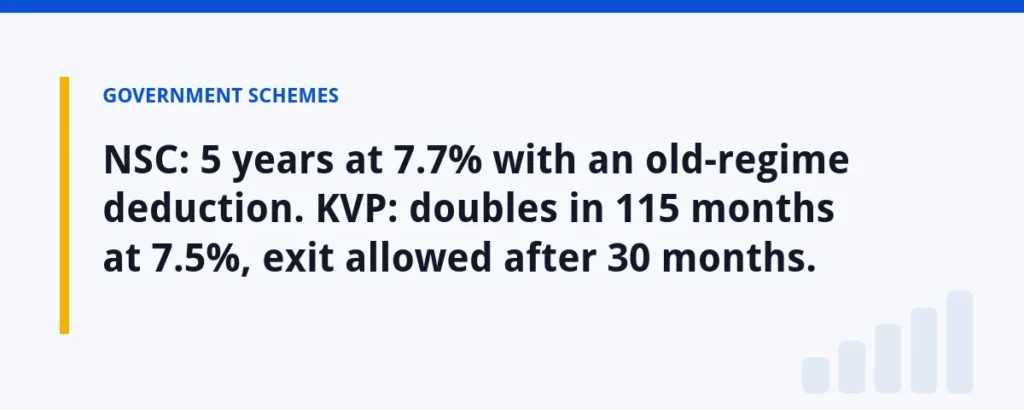
- NSC: 5 years, 7.7% compounded yearly for October to December 2026, deductible under the old regime, almost no early exit.
- KVP: doubles in 115 months at 7.5%, no deduction, can be encashed after 2 years 6 months.
- The rate on the purchase date stays fixed for the life of the certificate.
- Interest on both is taxable; keep a record of the yearly accrual.
This guide is general information, not personal advice. Confirm current rules and rates at your post office before you invest.