
A small business owner in Pune has ₹3 lakh of customer payments stuck for 45 days and a ₹1.2 lakh supplier bill due on Friday. She does not want a fresh loan with a fixed instalment for a gap that short. What she wants is a limit on her bank account that she can dip into and repay when the money arrives. That is what an overdraft facility is for.
An overdraft facility lets you spend more than the balance in your account, up to a limit the bank has agreed in advance. You pay interest only on the amount you actually use, and only for the days you use it. This guide explains how it works, the difference between a secured and an unsecured overdraft, how the interest is charged, how it differs from a loan, and the rules the Reserve Bank of India (RBI) has set around it.
How an overdraft facility works
The bank sanctions a limit, say ₹5 lakh, against your account. If your balance is ₹20,000 and you pay out ₹1 lakh, the account goes to minus ₹80,000. You have used ₹80,000 of the limit and have ₹4.2 lakh still available. When money comes in, it reduces the negative balance and frees up the limit again. The facility revolves for as long as it stays in force.
The RBI’s wording in its 2025 directions on cash credit, current and overdraft accounts is plain: an overdraft is a facility under which a customer is allowed to draw an agreed sum, the credit limit, in excess of the credit balance in the account. In practice banks grant it on current accounts and savings accounts, and some give a temporary overdraft on other credit accounts. Whether it is secured or unsecured depends on the bank’s terms, so read your sanction letter.
Two features set an overdraft apart. The limit is revolving, so you can borrow, repay and borrow again without applying each time. And the bank can review the limit, usually once a year, and may reduce or withdraw it. Keep that in mind before you treat it as permanent money.
Secured and unsecured overdraft
A “clean” overdraft is one with no security. The other kind is backed by something the bank can hold on to if you do not repay.
Secured overdraft
A secured overdraft is given against an asset such as a fixed deposit, shares or mutual fund units held under a pledge, a life insurance policy with a surrender value, or property. The bank lends only a part of the asset’s value, which is called the margin. As an illustration, if you pledge a ₹10 lakh deposit and the bank lends up to 90%, your limit is ₹9 lakh. Because the bank has security, the interest rate is usually lower than on an unsecured facility. Often the rate is a small spread above the rate your deposit earns, but the spread is the bank’s choice.
Your deposit keeps earning interest while it is pledged, and you do not have to break it. The bank can adjust the limit if the value of the security falls, which matters most when the pledged asset is a market-linked one.
Unsecured overdraft
An unsecured overdraft depends on your income, banking history and credit record. Salary accounts and well-run current accounts are the usual candidates. Limits are smaller and rates higher because the bank has nothing to fall back on. A good credit score helps you get a better limit and rate. Our guide on the credit score explains what lenders look at.
| Feature | Secured overdraft | Unsecured overdraft |
|---|---|---|
| Security | Deposit, securities, policy or property | None, based on income and record |
| Limit | A percentage of the asset value | Set by the bank from income and history |
| Interest rate | Usually lower | Usually higher |
| Risk if unpaid | Bank can adjust or recover from the pledged asset | Recovery through the normal process, credit score damage |
| Typical user | Anyone holding eligible deposits or investments | Salaried and business account holders with a good record |
How interest is charged on an overdraft
Interest accrues on the amount drawn, calculated on the daily balance, and is usually debited to the account at the end of the month or quarter. You are not charged on the unused part of the limit, though some banks charge a processing fee when the limit is set up or renewed. Check the sanction letter for these.
Take a worked example, with an assumed rate of 11% a year for illustration. You draw ₹2 lakh and repay it after 30 days. Interest is roughly ₹2,00,000 x 11% x 30 / 365, which is about ₹1,808. If you had taken a personal loan of ₹2 lakh for a year at the same rate, you would have paid far more, because the loan charges interest on a balance that falls slowly over twelve months.
The interest debited to the account also counts as a draw on the limit. If you never put any money in, the interest itself keeps pushing the balance down. That brings us to the rule that catches many borrowers out.
What happens if you stay overdrawn
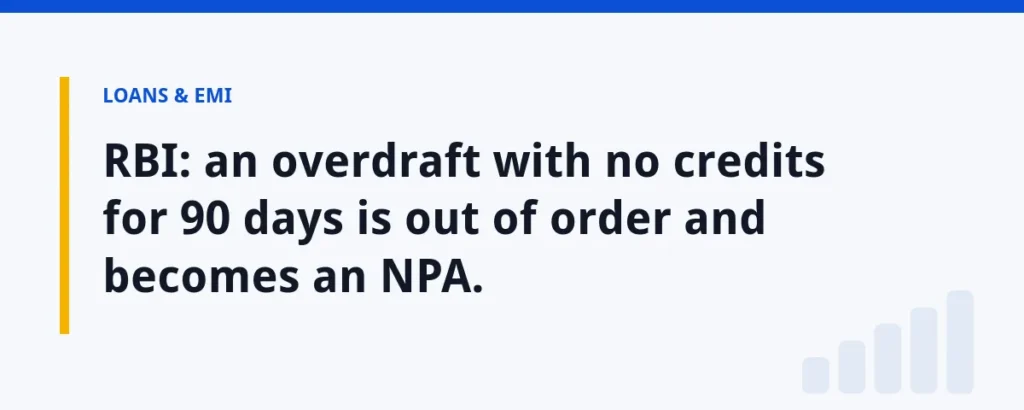
Under the RBI’s income recognition and asset classification directions of 28 November 2025, a cash credit or overdraft account is “out of order” if any one of three things is true: the outstanding balance stays above the sanctioned limit or drawing power continuously for 90 days; the balance is within the limit but there are no credits continuously for 90 days; or the balance is within the limit but the credits are not enough to cover the interest debited in the previous 90 days. An account that stays out of order is classified as a non-performing asset (NPA). The RBI says this test applies to every credit product offered as an overdraft facility.
In plain words, an overdraft is meant to move. If you park a balance at minus ₹2 lakh for months and deposit nothing, the bank has to classify the account as bad. That means a hit to your credit record and the bank is likely to recall the facility. Putting in even a small amount does not help unless the credits cover the interest, so treat the interest as a monthly payment you must meet.
Remember that a bank sanctions an overdraft limit on terms it can review, so read the sanction letter for how and when it can reduce or recall the facility.
Business overdrafts add one more idea, drawing power. For a cash credit style account, the amount you can draw depends on the value of eligible current assets such as stock and receivables, and the bank asks for stock statements to work it out. The RBI says stock statements relied on for drawing power should not be older than three months, and if drawing power rests on an older statement, the outstanding is treated as irregular. If you run a business account, keep the statements current, since a stale one can cut the amount you can actually use even when the sanctioned limit looks large.
Overdraft facility versus a loan
A term loan gives you the full amount on day one and you repay it in fixed instalments over a set period. An overdraft gives you a limit, and what you owe moves up and down with how you use it. The table below sets out the difference.
| Point | Overdraft | Term loan |
|---|---|---|
| Money received | Only as you draw it | Entire amount at the start |
| Interest paid on | The amount used, for the days used | The outstanding loan balance |
| Repayment | Flexible, any time within the limit | Fixed EMIs |
| Best for | Short gaps in cash flow | Large one-time needs |
| Review | Limit reviewed, often yearly | Fixed for the loan term |
If you need money for several years, a loan is usually the better fit, since an overdraft limit can be cut at review. If you need money for a few weeks, an overdraft costs less because you stop paying the moment you repay. You can check the cost of a term loan with the EMI calculator.
Charges, renewal and closing the facility
Besides interest, expect a processing fee at sanction and renewal, possibly a charge for documentation or valuation of the security, and GST on the fees. The RBI’s Pre-payment Charges on Loans Directions of 2 July 2025 apply to loans sanctioned or renewed on or after 1 January 2026. For cash credit and overdraft facilities, the rules say a borrower who gives notice of non-renewal within the period in the loan agreement, and closes on the due date, pays no pre-payment charge. If you close a facility earlier than the due date, any charge follows the lender’s approved policy and cannot be more than a charge on the sanctioned limit.
Pre-payment charges must be disclosed in the sanction letter and the loan agreement. A charge that was not disclosed cannot be levied later. A charge that was waived earlier cannot be revived when you close the account.
Always ask three questions at sanction: how often the limit is reviewed, what happens if the value of the security falls, and what notice the bank must give before it reduces or withdraws the facility.
Who should use an overdraft, and who should not
An overdraft suits people with uneven income: shopkeepers, freelancers, professionals, and salaried people who hold a large deposit and occasionally need cash. It also suits anyone who wants to avoid breaking a fixed deposit early, since the penalty on premature withdrawal and the lost interest often cost more than the overdraft interest for a short period. You can compare the two with the FD calculator.
It does not suit someone who tends to spend up to the limit. An overdraft that is never cleared turns into a permanent loan at a rate that moves, with the risk of going out of order. If you notice the balance staying negative month after month, convert the amount into a term loan with a fixed repayment plan.
A checklist before you take an overdraft
- Know the limit, the margin and the rate, and whether the rate is fixed or linked to a benchmark.
- Ask what fees apply at sanction, renewal and closure, and read the pre-payment clause.
- Put in regular credits so the account never stays overdrawn for ninety days.
- Make sure monthly credits cover the interest debited.
- Do not borrow against a deposit or investment you cannot afford to lose if you miss payments.
Key takeaways
An overdraft facility is a revolving credit limit on your account. You pay interest only on what you use, which makes it cheap for short gaps. Secured overdrafts cost less, unsecured ones need a strong record. The RBI treats an account with no credits, or credits too small to cover interest, for ninety days as out of order, which makes it an NPA. For fixed multi-year needs, a term loan is simpler. This is general information, not personal advice, and terms differ between banks.