
Your colleague says she has money in a flexi cap fund, your uncle swears by a gilt fund, and a relationship manager wants to sell you a multi asset fund. These sound like brand names, but they are not. They are among the types of mutual funds that SEBI, the markets regulator, has defined, and each label comes with rules on what the fund must hold.
Once you understand the categories, choosing becomes simpler. You stop comparing funds that were never meant to be compared, and you can match a fund’s job to your own goal. This guide walks through SEBI’s categories as revised in February 2026, explains the riskometer printed on every scheme, and shows in general terms which category tends to suit which kind of goal. It does not recommend any particular fund.
How SEBI sorts the types of mutual funds
Before 2017, fund houses could launch almost any scheme with any name. Several schemes from the same fund house often did the same thing under different labels. SEBI ended this with a circular in October 2017 that fixed a list of categories and the minimum portfolio rules for each.
That framework was rewritten by a SEBI circular dated 26 February 2026. Schemes now fall into five broad groups:
- Equity schemes, which invest mainly in shares.
- Debt schemes, which invest mainly in bonds and money market instruments.
- Hybrid schemes, which mix equity, debt and other permitted assets such as gold.
- Life cycle funds, a new group of target-date funds.
- Other schemes: fund of funds and passive schemes such as index funds and ETFs.
Two rules make life easier for investors. First, the scheme name must be the same as its category, so a “Mid Cap Fund” has to be a mid cap fund. Words that only highlight returns are not allowed in names. Second, existing schemes were given six months from the circular to align with the new rules, so by now fund names should match what they hold.
Equity funds: where most long-term money goes
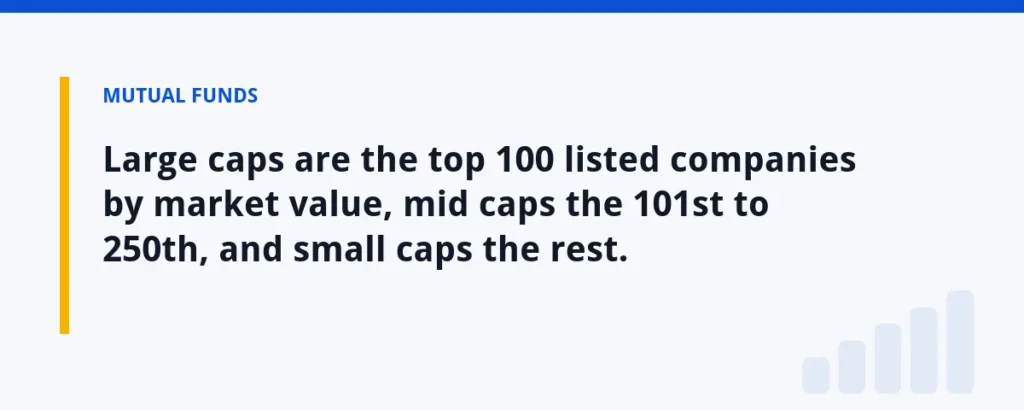
Equity funds buy shares of companies. SEBI defines company size by rank in full market value: the 1st to 100th companies are large caps, the 101st to 250th are mid caps, and the 251st onwards are small caps. AMFI publishes this list twice a year, and funds must use it.
| Equity category | Main rule |
|---|---|
| Large Cap Fund | At least 80% in large cap shares |
| Mid Cap Fund | At least 65% in mid cap shares |
| Small Cap Fund | At least 65% in small cap shares |
| Large & Mid Cap Fund | At least 35% each in large and mid caps |
| Multi Cap Fund | At least 75% in equity, with at least 25% each in large, mid and small caps |
| Flexi Cap Fund | At least 65% in equity, free to move across company sizes |
| Focused Fund | At most 30 stocks, at least 80% in equity |
| Value, Contra, Dividend Yield | Follow that style, at least 80% in equity |
| Sectoral and Thematic | At least 80% in one sector or theme |
| ELSS (Tax Saver) | At least 80% in equity, under the Equity Linked Saving Scheme, 2005 |
A few points from the 2026 rules are worth knowing. A fund house may now run both a value fund and a contra fund, but their portfolios cannot overlap by more than 50%. Sectoral and thematic funds also face a 50% overlap limit against the fund house’s other equity schemes, except large cap funds, so they cannot be a copy of a diversified fund under a fancy name. Existing sectoral and thematic schemes have three years to meet this limit.
In practice, large cap funds tend to swing less than mid and small cap funds, while small caps can rise and fall far more sharply. Sectoral and thematic funds carry the extra risk of betting on one part of the economy.
Debt funds: matching the fund to your time frame
Debt funds lend money to governments, banks and companies by buying their bonds and short-term papers. Two risks matter. Interest rate risk is higher when the portfolio’s average duration is longer, because bond prices fall when rates rise. Credit risk is higher when the fund lends to weaker borrowers.
| Debt category | Main rule |
|---|---|
| Overnight Fund | Securities maturing in 1 day |
| Liquid Fund | Debt and money market papers maturing within 91 days |
| Ultra Short Term Fund | Portfolio Macaulay duration of 3 to 6 months |
| Ultra Short to Short Term Fund | Portfolio Macaulay duration of 6 to 12 months |
| Money Market Fund | Money market instruments maturing within 1 year |
| Short, Medium, Medium to Long, Long Term Funds | Duration of 1 to 3 years, 3 to 4 years, 4 to 7 years and over 7 years |
| Dynamic Term Fund | Any duration, changed as the manager sees fit |
| Corporate Bond Fund | At least 80% in AA+ and above rated corporate bonds |
| Credit Risk Fund | At least 65% in AA and below rated corporate bonds |
| Banking and PSU Debt Fund | At least 80% in bonds of banks, PSUs, public financial institutions and municipal bodies |
| Gilt Fund and 10-year Constant Maturity Gilt | At least 80% in government securities |
| Floating Interest Rates Fund | At least 65% in floating rate instruments |
| Sectoral Debt Fund | At least 80% in AA+ and above papers of one sector |
The simple reading: the shorter the duration and the higher the credit quality, the steadier the fund. A gilt fund has almost no credit risk but can move sharply with interest rates. A credit risk fund may offer a higher yield because it lends to weaker borrowers, and that is exactly where defaults can hurt.
Hybrid funds: a mix in one scheme
Hybrid funds hold more than one asset class. They suit people who want some equity growth without putting all their money in shares, and who would rather let the fund manager do the rebalancing.
- Conservative Hybrid: 10% to 25% in equity, the rest in debt.
- Balanced Hybrid: 40% to 60% each in equity and debt, with no arbitrage allowed.
- Aggressive Hybrid: 65% to 80% in equity, 20% to 35% in debt.
- Dynamic Asset Allocation: moves between equity and debt as conditions change.
- Multi Asset Allocation: at least 10% each in at least three asset classes.
- Arbitrage Fund: at least 65% in equity used for arbitrage trades, which aim to earn the price gap between cash and futures markets rather than ride market moves.
- Equity Savings: at least 65% in equity, but only 15% to 40% as net unhedged equity, plus at least 10% in debt.
Read the ranges carefully. An aggressive hybrid fund is mostly an equity fund and can fall almost as much as one in a bad year. A conservative hybrid fund behaves more like a debt fund with a small equity kicker.
Life cycle funds replace solution-oriented schemes
Until February 2026, SEBI had a “solution oriented” group with retirement funds and children’s funds. That category has been discontinued. Existing schemes had to stop taking fresh money at once and will be merged into schemes with a similar asset mix after SEBI approval.
In its place come life cycle funds. Each has a target maturity year in its name, for example a fund ending in 2045, and a tenure between 5 and 30 years in multiples of 5. The fund follows a set glide path: it holds more equity when the target is far away and shifts to debt as the date nears.
For a 30-year fund, the equity share can be 65% to 95% when 15 to 30 years remain, falling to 35% to 50% at 3 to 5 years and 5% to 20% in the final year. To discourage early exits, these funds charge an exit load of 3% within one year, 2% within two years and 1% within three years. If you have a goal with a fixed date, such as a child’s college admission, this category is designed for that shape of need.
Index funds, ETFs and fund of funds
Index funds and ETFs must keep at least 95% of their assets in the securities of the index they track. They do not try to beat the market; they try to match it at low cost. Fund of funds must keep at least 95% in the underlying funds they name, which can be Indian or overseas schemes.
These passive options are popular for long-term equity investing because their costs are usually lower than those of actively managed funds. We cover ETFs in detail in a separate guide.
Reading the riskometer
Every scheme document and factsheet must show a riskometer, a dial that places the scheme on one of six levels set by SEBI:
- Low
- Low to Moderate
- Moderate
- Moderately High
- High
- Very High
The level depends on what the scheme actually holds, including the type of assets, market volatility, credit risk and interest rate sensitivity, and it is reviewed as the portfolio changes. Most equity funds sit at Very High. Overnight funds usually sit near the Low end.
Use the dial as a filter, not a verdict. Two funds in the same category can show different levels, and a fund’s level can change after you invest. Check it once a year along with your other reviews.
Which types of mutual funds suit which goal
There is no single right answer, but time frame is the best starting point. The table below shows how categories are commonly matched to goals. Treat it as a general guide, not a recommendation for your situation.
| Goal and time frame | Categories commonly considered |
|---|---|
| Emergency fund, money needed any day | Overnight, liquid |
| Within 1 year | Liquid, money market, ultra short term, arbitrage |
| 1 to 3 years | Short term, banking and PSU debt, corporate bond, conservative hybrid |
| 3 to 5 years | Balanced or aggressive hybrid, multi asset, equity savings |
| 7 years or more | Large cap, flexi cap, index funds, then mid and small caps for those who can stomach bigger swings |
| Goal with a fixed target year | Life cycle fund with a matching maturity |
For long-term goals, a monthly SIP spreads your buying over time. You can see how a regular amount might grow with the SIP calculator, or test a one-time investment with the lumpsum calculator. Use a modest return assumption, say 10% a year for illustration on equity, and remember these tools show possibilities, not promises.
Key takeaways
- SEBI fixes the types of mutual funds in five groups: equity, debt, hybrid, life cycle and other schemes.
- A scheme’s name must match its category, so the label tells you the basic portfolio rule.
- Large caps are the top 100 companies by market value, mid caps the next 150, small caps the rest.
- In debt funds, longer duration means more interest rate risk and lower ratings mean more credit risk.
- Solution-oriented funds are gone; life cycle funds with a target year have taken their place.
- Check the six-level riskometer, and choose by your time frame first, category second, fund last.