For most students, the honest answer is ₹7.5 lakh, the usual ceiling for an education loan without collateral. Banks following the IBA model education loan scheme usually lend up to that amount without asking for property or a fixed deposit as security, because the loan can be covered by a government-backed guarantee fund. Above ₹7.5 lakh, the standard rule at many banks is tangible collateral worth at least the full loan amount. There is one big exception: if you have a seat at a quality higher education institution (QHEI), the PM-Vidyalaxmi scheme lets you seek a collateral-free and guarantor-free loan for the full tuition fee and other course costs.
So the real limit depends less on your marks and more on where you are studying, what kind of seat you have and how much the whole course costs. A family in Nagpur with no house in their name faces a very different answer for a ₹6 lakh course at a local college than for a ₹20 lakh private engineering seat. This guide explains where the ₹7.5 lakh line comes from, what the guarantee does and does not do for you, how to check whether your institute is a QHEI, and what to do when the bill is higher and you have no property to pledge.
Where the ₹7.5 lakh limit on an education loan without collateral comes from
Most banks in India lend for education under the Indian Banks’ Association (IBA) Model Education Loan Scheme, which the Reserve Bank of India asked banks to adopt. The loan amount is need-based, which means it is set by the cost of your course, not by a fixed slab. What changes with the amount is the security the bank asks for.
Taking Canara Bank’s published terms as an example of how banks run the IBA scheme:
- Up to ₹7.5 lakh: no collateral, because the loan can be covered under the Credit Guarantee Fund Scheme for Education Loans (CGFSEL).
- Above ₹7.5 lakh: tangible collateral of at least 100% of the loan amount, such as property or deposits.
- In all cases: the student’s future income is assigned to the bank, and the loan is granted jointly with a parent or guardian.
Other banks follow broadly similar lines, though details vary. That is why ₹7.5 lakh is the number every bank manager and every education fair counsellor quotes.
What CGFSEL is, and what it is not
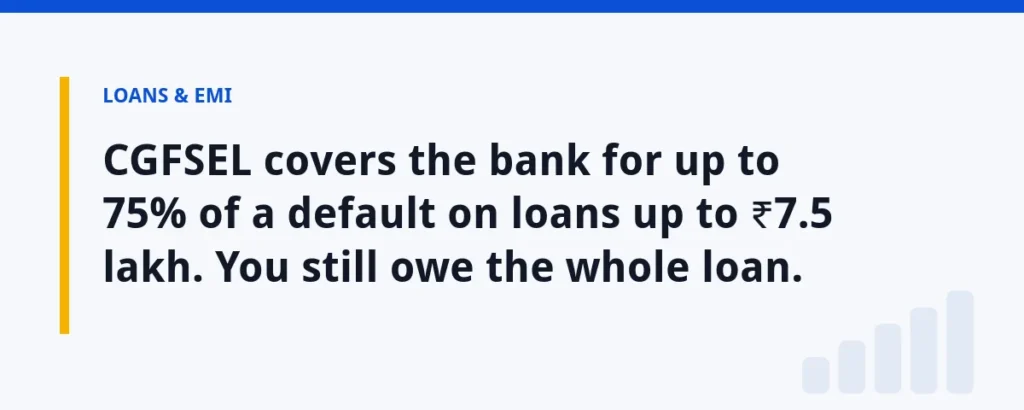
CGFSEL is run with the National Credit Guarantee Trustee Company (NCGTC) as trustee. It guarantees education loans up to ₹7.5 lakh that scheduled banks give without collateral security and without a third-party guarantee. If such a loan goes bad, the fund covers the bank for up to 75% of the amount in default.
The guarantee protects the bank, not you
This is the part families often misunderstand. CGFSEL is not insurance for the borrower and it is not a waiver. If you stop paying, the bank can claim part of its loss from the fund, but you still owe the whole loan. Your credit record still takes the hit, and the bank can still pursue recovery. Think of the guarantee as the reason the bank is willing to lend without collateral, nothing more.
Who signs along with you
Under the scheme, parents or guardians are co-borrowers or joint borrowers. For a married student, the spouse or the parents or parents-in-law can play that role. So even a collateral-free loan is not a solo loan. Your co-borrower is responsible for the full amount too, which is worth discussing openly at home before you sign.
The moratorium and interest during study
The IBA scheme gives a moratorium of the course period plus one year before EMIs begin. Paying interest during the study and moratorium period is optional, but interest keeps running, so paying even part of it keeps the final amount smaller.
PM-Vidyalaxmi: collateral-free above ₹7.5 lakh for top institutes
The Union Cabinet approved PM-Vidyalaxmi on 6 November 2024. Under it, students admitted to QHEIs can get collateral-free, guarantor-free loans from banks and financial institutions covering the full tuition fee and other course expenses. That is the route that can take a collateral-free loan past ₹7.5 lakh.
What counts as a QHEI
- Government and private higher education institutions in the top 100 of the NIRF overall, category or domain rankings.
- State government institutions ranked 101 to 200.
- All central government institutions.
The scheme started with 860 QHEIs covering more than 22 lakh students. For loans up to ₹7.5 lakh under the scheme, the Government gives the bank a 75% credit guarantee on any outstanding default.
How to check your institute
The QHEI list is updated every year from the latest NIRF ranking. An institute that qualified last year may not qualify this year, and a new one may join. So check the list for your admission year, not a list a senior forwarded two years ago. You can apply for the loan and for interest subvention on the common PM-Vidyalaxmi portal (pmvidyalaxmi.co.in), where one application is used by all participating banks.
The interest help that comes with it
If your family income is up to ₹8 lakh a year and you are not eligible under any other government scholarship or interest subvention scheme, you can get 3% interest subvention during the moratorium on loans up to ₹10 lakh. This goes to one lakh students a year, with preference to government institutions and technical or professional courses.
Your situation and your likely collateral position
Here is a quick way to see where you probably stand. It is a general guide based on the rules above; the bank’s assessment and its own terms decide the final answer, and no scheme guarantees approval.
| Your situation | Likely collateral position |
|---|---|
| Loan needed is ₹7.5 lakh or less, regular seat at an approved institution | Usually no collateral; CGFSEL cover, parent or guardian as co-borrower, future income assigned |
| Admitted to a QHEI, cost above ₹7.5 lakh | Can apply for a collateral-free, guarantor-free loan for full fees and course costs under PM-Vidyalaxmi |
| Not a QHEI, cost above ₹7.5 lakh | Tangible collateral of at least 100% of the loan is the usual bank requirement |
| Management-quota seat | Collateral may be asked for even on a small loan |
| Studying abroad, loan above ₹7.5 lakh | Collateral is usually needed at banks; some NBFCs and fintech-led lenders focus on study abroad, often at higher rates |
| Family income up to ₹4.5 lakh, technical or professional course | Collateral rules unchanged, but full interest subvention during the moratorium on loans up to ₹10 lakh under the central interest subsidy scheme |
The small print that changes how much you get
Margin money
Banks expect you to pay part of the cost yourself. On Canara Bank’s terms, the margin is nil for loans up to ₹4 lakh. Above ₹4 lakh, it is 5% for studies in India and 15% for studies abroad. Other banks may set it differently.
For example, say your course in India costs ₹7 lakh in all. With a 5% margin, the family puts in ₹35,000 and the bank lends ₹6.65 lakh, which stays under the ₹7.5 lakh line. Now say the course costs ₹8 lakh. Even after a 5% margin of ₹40,000, the loan is ₹7.6 lakh, just over the line, and outside a QHEI that small excess can bring the collateral question into play. In a case like this, paying a little more yourself to keep the loan at or below ₹7.5 lakh can be worth it.
Management-quota seats
Banks can treat management-quota admissions differently and may ask for collateral even for small loans. If you are choosing between a merit seat and a management seat, ask the bank about security before you pay the admission fee.
What the loan can pay for
Under the IBA scheme, banks can finance college and hostel fees; exam, library and lab fees; travel for studies abroad; the student’s insurance premium if applicable; refundable deposits backed by receipts; books, equipment and uniforms; a computer at reasonable cost if the course needs it; and other necessary expenses up to a ceiling. Every item you add pushes the total towards or past ₹7.5 lakh, so list only what you will really spend.
Priority sector is not a borrowing limit
You may read that education loans up to ₹25 lakh count as priority sector lending under RBI’s 2025 directions. That is how banks classify their lending. It is not a cap on what you can borrow and it does not remove the need for collateral.
When the course costs more than ₹7.5 lakh and you have no property
This is the situation many families dread. It is not hopeless, but it needs planning. Work through these options in order.
- Check the QHEI route first. If your institute is on the current QHEI list, a collateral-free, guarantor-free loan for the full fees is possible under PM-Vidyalaxmi. This is the single biggest lever.
- Apply for scholarships before borrowing. The National Scholarship Portal (scholarships.gov.in) is the single window for central and state government scholarships. Every rupee of scholarship is a rupee you do not need to borrow.
- Split the costs. Take a collateral-free loan up to ₹7.5 lakh for tuition, and meet the rest (say hostel, travel or a laptop) from savings, family help or part-time income. As an illustration, a ₹9 lakh course could be covered by a ₹7.5 lakh loan plus ₹1.5 lakh spread over the course years from family.
- Cut the cost list. A cheaper hostel, used books or the computer you already own can bring the total under the line.
- Look at NBFCs and other lenders carefully. Banks are not the only education lenders. NBFCs and some fintech-led lenders also lend, especially for study abroad, but often at higher rates, and their loans may not qualify for some government schemes. Read the full terms, including security, before you sign.
For study abroad, one extra point: since 1 April 2025, no TCS applies when the education remittance is paid out of an education loan from a financial institution. Self-funded remittances above ₹10 lakh a year do attract TCS, though it can be adjusted against your tax.
How much you should borrow, not just how much you can
The limit on an education loan without collateral is not a target. The right amount is what the course needs, and the right check is whether the EMI fits the salary you are likely to earn.
Say you borrow ₹7.5 lakh. Assume 10% a year for illustration, repaid over 10 years after the moratorium. The EMI comes to roughly ₹9,900 a month, and more if unpaid interest from the study years is added to the balance. If you expect a starting take-home salary of ₹35,000, that EMI is close to 30% of it. Repayment can stretch up to 15 years under the IBA scheme, which lowers the EMI but increases the total interest. Try a few combinations on the EMI calculator before you settle on a figure.
Two more points help later. Interest paid on an education loan can be deducted under Section 129 of the Income-tax Act, 2025 (which replaced Section 80E from 1 April 2026) for the year you start paying interest and the next seven years, with no upper limit, but only under the old tax regime and only by the person who pays the interest. And for floating-rate loans sanctioned on or after 1 January 2026, RBI rules bar banks and NBFCs from charging pre-payment penalties, so you can clear the loan early when your income allows.
This is general information, not personal advice. Your bank’s terms and your family’s circumstances decide what is right for you.
Key takeaways
- Up to ₹7.5 lakh, banks under the IBA scheme usually give an education loan without collateral, backed by CGFSEL.
- CGFSEL covers the bank for up to 75% of a default; you and your co-borrower still owe the whole loan.
- A QHEI admission opens a collateral-free, guarantor-free loan for full fees under PM-Vidyalaxmi; check the list for your admission year.
- Management-quota seats can need collateral even for small loans, and margin applies above ₹4 lakh.
- With no property and a bigger bill, combine scholarships, cost-cutting and split funding before turning to higher-rate lenders.
- Borrow what the course needs and check the EMI against a realistic starting salary.