
What it is
A waiting period is a stretch of time after you buy a health policy during which some or all claims are not paid. It exists so that people cannot buy cover only when they already need treatment.
The insurance regulator, the Insurance Regulatory and Development Authority of India (IRDAI), explains the main kinds on its policyholder website. They are an initial waiting period, a waiting period for pre-existing conditions and a waiting period for certain named diseases. Read the policy wording, because the exact terms sit there.
How it works
The initial waiting period
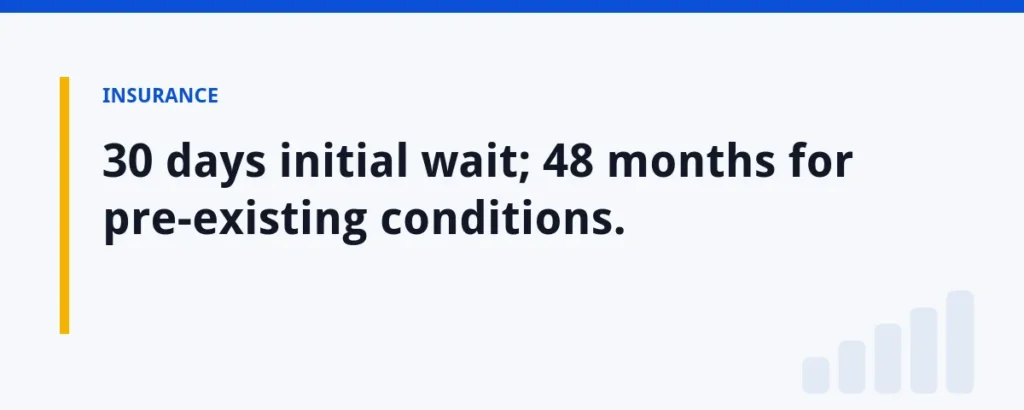
According to IRDAI’s policyholder page, a new policy generally has a 30-day waiting period from the policy start date. Hospitalisation charges in that window are not payable. Emergency hospitalisation caused by an accident is excluded from this rule.
The page also says this waiting period does not apply to subsequent policies under renewal. So it is a one-time wait at the start of cover with an insurer.
Pre-existing diseases
A pre-existing condition is a medical condition or disease that existed before you took the policy. IRDAI says insurers do not cover such conditions within 48 months of the first policy. In other words, they can be considered for payment after 48 months of continuous cover.
The page tells readers to check how each policy defines a pre-existing disease, since that definition decides what gets caught by the wait.
Specific illnesses
IRDAI says that, as a rule, insurers keep some named diseases out of cover during the first year and attach a waiting period to them. The page does not list the diseases or the length of the wait, so check the exclusions section of your policy for both.
Separately, IRDAI has issued guidelines that standardise 42 commonly used terms and conditions in health policies, which is meant to make wording more consistent across insurers.
What it means for you
The waiting periods affect when you can realistically rely on a policy. A hospital admission for a planned procedure in the first month, or for a long-standing condition in the first four years, may not be paid.
- Check the definitions. Look at how the policy defines pre-existing disease and which illnesses carry their own wait.
- Keep cover continuous. The 48 months are counted on continuous insurance. IRDAI says a policy renews if you pay within a 15-day grace period after expiry, but there is no cover for the gap, and the policy lapses if you miss the grace period.
- Think about switching carefully. A circular effective 1 October 2011 lets you port from one insurer to another, or one plan to another, without losing renewal credits for pre-existing conditions. The credit is limited to the sum insured, including bonus, under the previous policy. Confirm details with the insurer.
- Plan the sum insured early. IRDAI notes it may not be easy to raise the sum insured after a claim.
A simple illustration: if you buy a policy on 1 January, a non-accident hospitalisation within the first 30 days would not be payable under the generally applicable initial wait. The same admission after that period could be assessed under the rest of the policy terms.
Premiums also respond to health history. IRDAI says age and previous medical history are major factors, and no prior history means a lower premium. Premiums paid by a non-cash mode qualify for a deduction under Section 80D of the Income Tax Act, and the health insurance explainer covers the basics of how cover works.
Common mistakes to avoid
- Assuming every hospital bill is payable from day one.
- Not reading the standard exclusions, such as dental treatment unless it needs hospitalisation, or pregnancy-related treatment.
- Letting a policy lapse past the grace period and losing continuity.
- Treating the cashless facility as universal. IRDAI says it is not available at hospitals outside the insurer’s network, and amounts beyond limits or sub-limits must be paid by you.