
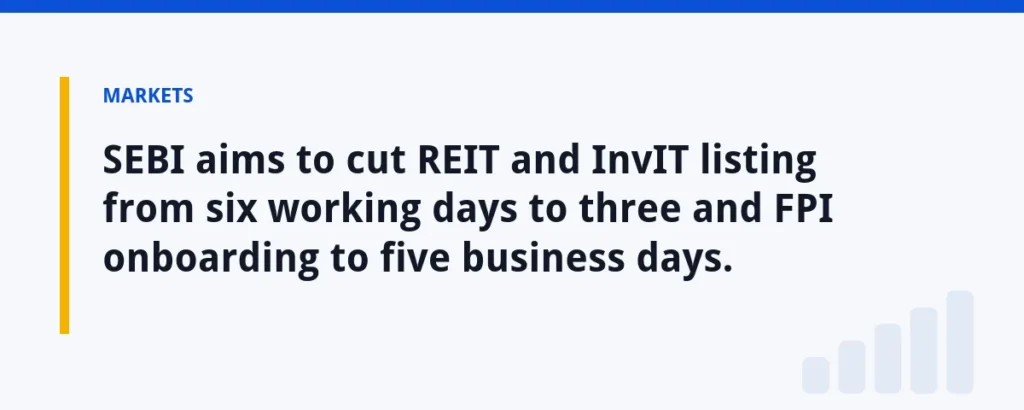
SEBI chairman Tuhin Kanta Pandey on 27 November 2026 laid out a long list of planned SEBI reforms, from a five-business-day onboarding target for foreign portfolio investors (FPIs) to a cut in the REIT and InvIT listing window from six working days to three. The address was given at the 17th Capital Markets Conference organised by ASSOCHAM, and SEBI’s own speeches page lists it under that date.
Most of what he described is work in progress, not a rule already in force. If you hold shares, mutual funds or bonds, nothing in your account changes today. But the direction tells you where market rules are heading, so it is worth knowing which of the SEBI reforms are plans, which are proposals and which are already running.
What the chairman announced on 27 November
Reports of the speech in Millennium Post (28 November) and on the AIR News site cover broadly the same list. The table below sorts the main items by what was actually said.
| Area | What was said | Stage |
|---|---|---|
| FPI onboarding | Cut from several months to as little as five business days using digital workflows | Aim |
| FPI additional disclosures | Removal of the additional disclosure framework proposed, to match global practice | Proposal |
| REITs and InvITs | Listing timeline to fall from six working days to three; rights issues to be simplified | Aim |
| Corporate bonds | Market-making framework being developed with the RBI and the Finance Ministry, with wider repo access for brokers | Under development |
| Short selling and securities lending | Rules under review to improve liquidity and price discovery | Review |
| Listing rules (LODR) | Remove filings duplicated with the Ministry of Corporate Affairs; one penalty per lapse instead of several from different exchanges | Review |
Other SEBI reforms in the speech were a rewrite of the issue-of-capital rules covering IPOs, rights issues, preferential allotments and SME IPOs, graded compliance for stock brokers based on their size and risk, and an AI sandbox for testing models before use. According to the same reports, companies raised about ₹9 lakh crore through equity and debt in the first seven months of the financial year, including roughly ₹1.45 lakh crore from 235 IPOs and over ₹5 lakh crore from bonds.
Plans, proposals and rules are not the same thing
A speech is not a circular. SEBI usually issues a consultation paper, invites public comments, takes the matter to its board and only then notifies a rule with an effective date. Words such as “aims”, “proposed” and “reviewing” in the reports mean that process is still ahead or in progress. No circular or consultation paper dated 28 November 2026 has been reported for these items, so the details can still change.
- Aim: a target the regulator wants to reach, with no notified rule yet.
- Proposal: a specific change put forward for comment.
- Review: SEBI is studying the rules and has not said what will change.
- In force: a circular or regulation with an effective date. Only these change what you must do.
Foreign investors: faster onboarding and SWAGAT-FI
Foreign money matters to ordinary savers because it shapes how deep and steady the market is. SEBI’s aim is to cut the time a foreign fund needs to register from months to as little as five business days. An earlier report in Business Today on 30 September 2026 said SEBI and the RBI had tested five-working-day onboarding for certain jurisdictions with custodians and depositories. That is a test, not a general promise for every applicant.
The chairman also spoke about SWAGAT-FI, the single-window route for trusted foreign investors. SEBI issued the framework by circular on 16 January 2026 for FPIs and foreign venture capital investors. Reports of the 27 November speech say about 740 FPIs have registered under it, holding nearly 17% of foreign portfolio assets under custody, with simpler compliance and longer KYC review cycles. Those two numbers come from news reports of the speech, not from a SEBI table.
REITs, InvITs and the corporate bond market
A REIT or InvIT pools money to own income-producing property or infrastructure, and units trade on the exchanges like shares. In April 2022, a Business Standard report said SEBI had cut the time for allotment and listing after an issue closes from 12 working days to six. The new aim is three. Faster listing means investors who apply to a REIT or InvIT issue wait less for units to reach their demat account, and the issuer carries less market risk while waiting.
On bonds, SEBI is working with the RBI and the Finance Ministry on a market-making framework. In simple terms, a market maker quotes both a buy and a sell price so that a bond can be traded when you want to exit. In February 2026 the chairman had described this as aimed mainly at secondary-market liquidity. For a retail buyer of corporate bonds, thin trading is the real problem: you can buy easily, but finding a buyer before maturity can be hard.
Fixed Income Channel Partners, which will distribute debt securities through regulated digital platforms, and a second phase of the Demat 2.0 pilot for trading tokenised corporate bonds were also mentioned as coming steps.
Short selling, securities lending and broker rules
Short selling means selling a share you do not own, by borrowing it first, and buying it back later. Securities lending and borrowing (SLB) is the system that lets that borrowing happen. SEBI said it is reviewing both sets of rules to improve liquidity and intraday price discovery. No change was announced, and the review does not tell you whether rules will loosen or tighten.
For brokers, the reports describe a graded approach where supervision depends on trading volume, client-related exposure and reliance on in-house technology. Smaller firms could in theory face lighter requirements than the largest ones.
What the SEBI reforms mean for your money
Most of these changes work at the plumbing level, so the effect on a household is indirect and slow. Still, a few points are worth keeping in mind.
- If you invest through SIPs, nothing here changes your instalment, your fund or your tax.
- If you own REIT or InvIT units, faster listing affects new issues, not units you already hold.
- If you buy corporate bonds, a market-making framework could make exit easier, but only after it is notified and firms take it up.
- If you read a headline about a five-day or three-day target, check whether it is an aim, a proposal or a notified rule.
Key takeaways
- The SEBI reforms were announced on 27 November 2026 and are mostly plans and reviews.
- Check sebi.gov.in under circulars and consultation papers for the binding text before acting on any headline.
- Do not change your investments because of a regulatory plan; use it to understand how the market is evolving.
This article is general information and not personal advice. To see how regular investing grows over time, try our SIP calculator with your own figures.