
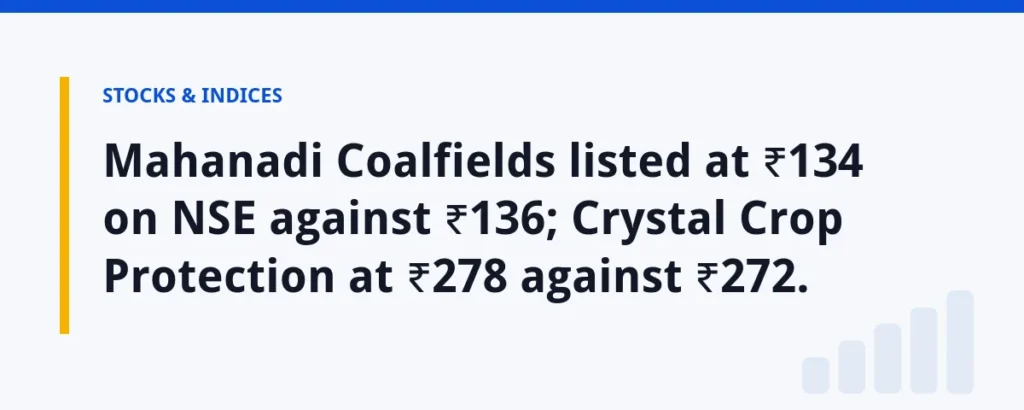
Two issues reached the stock exchanges in the last week and gave the IPO market a mixed picture. The Mahanadi Coalfields offer, a sale of 10% of the company by its parent Coal India, closed on 23 November 2026 at 1.52 times subscription and listed on 27 November at ₹134 on NSE, below the ₹136 issue price. A day earlier, on 26 November, Crystal Crop Protection listed at ₹278 on NSE against an issue price of ₹272, after an issue that drew roughly 17 times the shares on offer.
For a household investor the numbers matter less than what they show about how these offers work. One issue was a pure sale by an existing shareholder, the other mixed new shares with a sale. This article reports the outcomes, explains the difference and lists what to check before you ever bid. It is general information, not a recommendation on any issue.
What happened to the Mahanadi Coalfields issue
Bidding ran from 19 to 23 November 2026 at a price band of ₹129 to ₹136 per share. Coal India sold about 66.18 crore shares, 10% of the company, and the size of the issue was reported at about ₹8,981 crore. According to a Business Today report on 23 November, bids on the final day covered 1.52 times the shares offered to the public. Qualified institutional buyers bid 4.95 times their portion, while non-institutional investors filled 66% of theirs and retail investors 46%. In other words, institutions carried the issue and the household portions were not fully covered.
Ahead of the public bidding, the company raised about ₹2,295 crore from anchor investors on 18 November, according to a report by HDFC Sky. Shares listed on 27 November. Data compiled by Chittorgarh showed an opening price of ₹134 on NSE and ₹133.15 on BSE, which is 1.47% and 2.10% below the issue price. A listing report published that day put the market value at about ₹88,124 crore at listing, and said the NSE price moved between ₹132.28 and ₹137.89 until about 10:55 am.
What happened to the Crystal Crop Protection issue
This issue ran from 18 to 20 November at ₹259 to ₹272 per share, and the issue price was fixed at ₹272. Trackers differ slightly on the final multiple. Chittorgarh showed about 17.7 times and Groww about 17.1 times, so it is safest to say roughly 17 times. Non-institutional investors bid for more than 37 times their quota, institutions about 15 times and retail investors about 9 times, according to the same trackers.
The total issue was about ₹455 crore. Of that, about ₹355 crore was fresh issue and about ₹101 crore was an offer for sale by existing holders, per Groww and Kotak Neo. On 26 November the shares listed at ₹278 on NSE, 2.21% above the issue price, and at ₹280 on BSE, 2.94% above, according to Groww and Chittorgarh.
Offer for sale versus fresh issue
This is the single most useful distinction in the IPO market. In a fresh issue, the company creates new shares and the money goes into the company. In an offer for sale, or OFS, existing shareholders sell shares they already own, and the money goes to them, not to the company.
| Feature | Mahanadi Coalfields | Crystal Crop Protection |
|---|---|---|
| Bidding window | 19 to 23 November | 18 to 20 November |
| Issue price | ₹136 | ₹272 |
| Structure | 100% offer for sale by Coal India | About ₹355 crore fresh issue and ₹101 crore OFS |
| Overall subscription | 1.52 times | About 17 times |
| NSE listing price | ₹134 on 27 November | ₹278 on 26 November |
| Lot size | 110 shares | 55 shares |
Business Today reported that Mahanadi Coalfields itself receives nothing from its issue, and the proceeds after expenses go to Coal India. In the Crystal Crop issue, Kotak Neo listed the uses of the fresh portion as repaying certain borrowings, investing in a subsidiary to repay its debt, and general corporate purposes. Do the split yourself: about 78% of the Crystal Crop issue was new money for the company and about 22% was existing holders selling.
An OFS is not a red flag by itself. Promoters and government-owned parents often sell to widen public ownership. But it does mean your money does not fund growth in the company you are buying into, so the price you pay has to be justified by the business as it already stands.
Reading subscription numbers in the IPO market
A big subscription multiple says that many people asked for shares at that price. It does not say the shares are worth that price, and it does not guarantee a listing gain. The two issues this week show it. The one with about 17 times demand listed about 2% above its issue price. The one with 1.52 times listed about 1.5% below on NSE, though it traded above the issue price at points in early trade, per the listing report.
The categories also carry different weight. Institutional demand shows what large investors were willing to bid. Retail demand shows how many households applied. Allotment to retail applicants follows the lot system, so check your allotment status on the registrar’s page instead of assuming.
A simple illustration
Say you bid for one lot of Mahanadi Coalfields at ₹136. That is 110 shares and ₹14,960. Had you been allotted the lot, the NSE opening price of ₹134 would have shown a paper difference of ₹220 (110 shares times ₹2). For one lot of Crystal Crop at ₹272, which is 55 shares and also ₹14,960, the NSE listing price of ₹278 gives ₹330 (55 times ₹6). These are illustrations on opening prices only. The price keeps moving after listing, and you do not gain or lose anything until you sell.
What to check before bidding in any IPO
- Read the split between fresh issue and offer for sale in the offer document, and the stated uses of any new money.
- Look at the price band and lot size. Retail bids are made in whole lots, so the minimum is the lot size times the price.
- Check the subscription by category after the issue closes, not just the headline multiple.
- Remember that listing day and long-term outcomes are different things, and that grey market premiums are unofficial.
- Use only money you will not need soon. Prices can fall below the issue price, as one of these two did on day one.
What is coming next in the IPO market
The small and medium enterprise segment keeps a steady flow of new issues. According to a Univest report, the Airpro Technology India issue on the NSE SME platform opens on 27 November and closes on 1 December at a fixed price of ₹99 per share, with allotment on 2 December and listing on 4 December. The issue is about ₹35.64 crore, of which about ₹28.91 crore is fresh issue and the rest an offer for sale. SME issues carry higher risks, with thinner trading and larger price swings, so read the offer document with extra care.
If you plan to invest through monthly instalments instead of bidding in issues, you can test different amounts with the SIP calculator, or see how a one-time amount grows with the lumpsum calculator.
Key takeaways
- Mahanadi Coalfields (1.52 times, listed 27 November at ₹134 on NSE against ₹136) and Crystal Crop Protection (about 17 times, listed 26 November at ₹278 against ₹272) listed a day apart with modest moves in opposite directions.
- An offer for sale pays existing shareholders; a fresh issue pays the company.
- Subscription multiples describe demand at the issue price, not future returns.
- The IPO market moves with sentiment, so listing prices and later trading change daily. Check the latest on the exchanges before making any decision.