Your fixed deposit matured, but the interest credited was less than the bank’s statement promised. Your salary slip shows “income tax” taken out every month even though you think you owe little. In both cases the missing money is TDS, tax deducted at source. The payer cuts a part of what it owes you, deposits it with the government against your PAN, and you get credit for it when you file your return.
This deduction is not an extra tax. It is an advance payment of your own income tax, and if too much is cut you get it back as a refund. This guide explains how it works on salary, fixed deposit interest and rent under the Income-tax Act, 2025, how to read Form 16, Form 16A, Form 26AS and the Annual Information Statement, how to fix a mismatch, and when Form 15G or 15H can stop the deduction altogether.
What TDS is and why it is not your final tax
The law asks the person paying you, whether an employer, a bank or a tenant, to deduct tax at a set rate before paying, once the payment crosses a threshold. Under the new Act most of these rules sit in section 393, with salary covered by section 392. The deducted amount is deposited with the government and reported quarterly in TDS statements, which is how it reaches your tax record.
When you file your return, your actual tax is calculated on your total income under the regime you choose. All tax deducted during the year is then set off against that tax:
- If the amount deducted is more than your tax, the difference is refunded.
- If it is less than your tax, you pay the balance as self-assessment tax before filing.
- If your income is below the taxable limit, all of it comes back as a refund, provided you file a return.
That last point is why retired people and students with deposit interest should file even when they owe nothing.
TDS on salary
Your employer deducts tax every month at the average rate of tax on your estimated salary for the whole year. It works out what your tax will be for the year, using the slabs of the regime you have declared, and spreads that over your pay cheques.
The regime matters. At the start of the year, tell your employer whether you want the new or the old regime. If you say nothing, the employer applies the default new regime. If you choose the old regime, submit proof of HRA rent, home loan interest and tax-saving investments in Form 12BB so the employer can reduce the deduction. If you join a new job mid-year, give your new employer the salary and tax details from the old one, or your total tax may be under-deducted and you will face a bill at filing time.
At the end of the year your employer gives you Form 16, which shows salary paid, exemptions and deductions allowed, and the tax deposited.
Common TDS rates and thresholds
The Finance Act, 2026 kept TDS rates for 2026-27 the same as for 2025-26. These are the cases most families meet:
| Payment | Who deducts | Threshold (TDS applies above this) | Rate |
|---|---|---|---|
| Salary | Employer | When estimated salary is taxable | Average rate on estimated annual salary |
| Interest on deposits (FD, RD) | Bank, co-operative bank, post office | ₹50,000 a year; ₹1 lakh for senior citizens | 10% for residents |
| Other interest (not on securities) | Businesses and other specified payers | ₹10,000 a year | 10% for residents |
| Rent paid by an individual or HUF not covered below | Tenant | ₹50,000 for a month or part of a month | 2% |
| Rent for land, building or furniture, paid by a company, firm or large business | Tenant | ₹50,000 for a month or part of a month | 10% (2% for plant and machinery) |
A higher rate applies if you have not given your PAN to the payer, so always share it.
TDS on fixed deposit interest
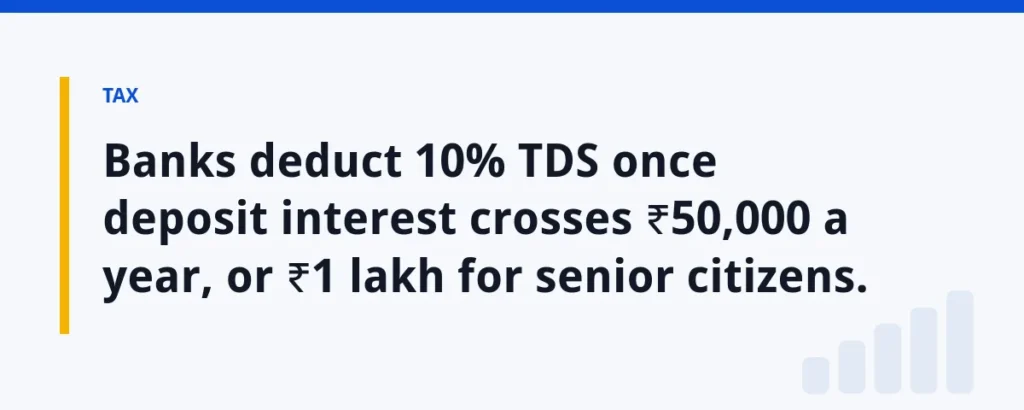
Banks, co-operative banks and post office schemes deduct tax at 10% once the interest they pay you in a year crosses ₹50,000, or ₹1 lakh if you are a senior citizen, meaning a resident aged 60 or more. The Budget 2025-26 doubled the senior citizen limit from ₹50,000 to ₹1 lakh.
Two practical points. First, the threshold is per payer, so interest from three different banks is counted separately at each bank. Second, tax is deducted when interest is credited or paid, whichever is earlier. On a cumulative deposit, interest accrued each year can attract the deduction even though you receive nothing until maturity.
A worked example
As an illustration, say you are 45 and earn ₹80,000 interest in a year from one bank. ₹8,000 is deducted. If you are in the 30% slab, you owe ₹24,000 plus cess on that interest, so you pay the balance when you file. If your total income is below the taxable limit, the ₹8,000 comes back as a refund. You can estimate interest in advance with the FD calculator.
TDS on rent
Many salaried tenants do not realise they may have to deduct TDS. If you pay rent above ₹50,000 for a month or part of a month, you must deduct TDS at 2%, unless you fall in the “specified person” category (a company, firm or other non-individual, or an individual or HUF whose business turnover crossed ₹1 crore, or professional receipts ₹50 lakh, in the previous year). Individuals deduct once, when paying or crediting rent for the last month of the tax year or the last month of the tenancy, whichever applies.
As an illustration, rent of ₹60,000 a month comes to ₹7.2 lakh a year. The deduction at 2% is ₹14,400, deducted from the rent for March. From 1 October 2026, under a Budget 2026-27 change, a resident individual buying property from a non-resident can deposit the tax through a PAN-based challan instead of needing a separate TAN; the deduction itself still applies.
Landlords receiving rent from companies or large businesses see tax deducted at 10% for buildings once rent crosses ₹50,000 for a month or part of a month.
Form 16 and Form 16A: your TDS certificates
A TDS certificate is the payer’s proof that it deducted and deposited your tax.
- Form 16 is issued by your employer at the end of the financial year. It shows your income, the deductions and exemptions the employer allowed, and the tax deducted, for computing what you owe or get back.
- Form 16A covers TDS on income other than salary, such as deposit interest. It is issued quarterly and shows the amount deducted, the nature of payment and the deposit details.
These are the form names for income of 2025-26 under the 1961 Act. The Income-tax Rules, 2026 renumbered many forms for the new Act, so certificates for tax year 2026-27 may carry new numbers. What they show stays the same.
How to check TDS credits in Form 26AS and AIS
A certificate is only useful if the tax actually reached your PAN. Check it yourself on the e-filing portal:
- Log in to the e-filing portal and open Form 26AS (from the e-File menu, under Income Tax Return). From assessment year 2023-24 it shows only TDS and TCS data, deductor by deductor.
- Open the Annual Information Statement (AIS) from the dashboard. Its TDS/TCS section lists each deduction with an information code, and the Taxpayer Information Summary adds up each category such as salary and interest.
- Match every TDS figure in Form 16 and Form 16A with Form 26AS, and every interest and salary figure with AIS.
Do this before you file, and again in May or June when the last quarter’s TDS statements have been processed.
TDS mismatches and how to fix them
A mismatch happens when the deduction in your records does not appear, or appears differently, in Form 26AS. The usual reasons are a wrong PAN quoted by the deductor, a TDS statement not yet filed, or tax deducted but not deposited.
- TDS missing or short in Form 26AS: contact the employer, bank or tenant. The deductor must file a revised TDS statement with the correct details. Keep the certificate and correspondence.
- Do not claim more than Form 26AS shows. The department limits the credit in your return to the amount reflected there, so an unmatched claim leads to a demand.
- Your own tax payment not showing: for advance or self-assessment tax, check the challan number and PAN you used.
- Wrong entry in AIS: submit feedback on that entry, for example if interest is duplicated or the income is not yours.
- After an intimation: if processing has already happened, you can file a rectification request once the deductor corrects its statement.
Form 15G and Form 15H: stopping TDS when you owe no tax
If your income is below the taxable limit, you can ask the bank not to deduct TDS on interest by giving it a declaration at the start of the year:
- Form 15G is for resident individuals below 60, and HUFs, whose estimated income is below the basic exemption limit.
- Form 15H is for resident individuals aged 60 or more.
Under the new Act these declarations fall under section 393(6). Reports of the Income-tax Rules, 2026 say both forms have been merged into a single Form 121 from tax year 2026-27, so ask your bank which form it now accepts. From 1 April 2027, a Budget 2026-27 change will also let investors give one such declaration to their depository for dividends, interest on securities and mutual fund income, instead of filing separately with every company. A false declaration is an offence, so file one only if your income genuinely qualifies.
If your income is taxable but your actual tax will be lower than the TDS rate, a lower or nil deduction certificate is the route. Budget 2026-27 proposed a rule-based online process for small taxpayers to obtain one.
Key takeaways
- TDS is advance tax on your own income; it is adjusted against your final tax and any excess is refunded when you file.
- Banks deduct 10% TDS once deposit interest crosses ₹50,000 a year, or ₹1 lakh for senior citizens.
- Tenants who are individuals deduct 2% when rent exceeds ₹50,000 a month, once a year.
- Check Form 26AS and AIS before filing; credit is limited to what Form 26AS shows.
- If your income is below the taxable limit, Form 15G or 15H (or its replacement) can stop TDS on interest.
This guide is general information. For complex cases such as property sales or foreign income, take advice from a tax professional.