Every April your employer asks the same question: old regime or new? Pick the wrong one and you either pay more tax than you need to, or you lose deductions you planned around all year. For tax year 2026-27 the new tax regime is the default. It charges lower slab rates and, through a rebate, leaves income up to ₹12 lakh free of tax, but it takes away most deductions. The old regime keeps those deductions and taxes you at higher rates.
This guide sets out the slabs for both regimes under the Income-tax Act, 2025, which replaced the 1961 Act from 1 April 2026. It explains the rebate and standard deduction, lists which deductions survive in each regime, runs worked comparisons at four salary levels and shows how salaried people and business owners switch. The rates come from the Budget 2026-27 documents, which made no change to slabs for tax year 2026-27, and from the Income Tax Department’s own pages.
New tax regime slabs for tax year 2026-27
Section 202 of the new Act sets the default rates for individuals, Hindu undivided families and a few other groups. You are taxed at these rates unless you choose the old regime in the manner the law prescribes. The same slabs apply whatever your age.
| Total income | Rate | Tax at top of slab (before cess) |
|---|---|---|
| Up to ₹4 lakh | Nil | Nil |
| ₹4 lakh to ₹8 lakh | 5% | ₹20,000 |
| ₹8 lakh to ₹12 lakh | 10% | ₹60,000 |
| ₹12 lakh to ₹16 lakh | 15% | ₹1,20,000 |
| ₹16 lakh to ₹20 lakh | 20% | ₹2,00,000 |
| ₹20 lakh to ₹24 lakh | 25% | ₹3,00,000 |
| Above ₹24 lakh | 30% | ₹3,00,000 plus 30% of the excess |
On top of the tax, you pay a 4% health and education cess. High earners also pay a surcharge on the tax: 10% when total income crosses ₹50 lakh, 15% above ₹1 crore and 25% above ₹2 crore. In the new regime the surcharge stops at 25%, however large the income.
Old regime slabs, by age
The old regime has three sets of slabs. The tax-free band is wider for older residents, and the jump to 20% comes much earlier than in the new regime.
| Total income | Below 60 | 60 to 79 (resident) | 80 and above (resident) |
|---|---|---|---|
| Up to ₹2.5 lakh | Nil | Nil | Nil |
| ₹2.5 lakh to ₹3 lakh | 5% | Nil | Nil |
| ₹3 lakh to ₹5 lakh | 5% | 5% | Nil |
| ₹5 lakh to ₹10 lakh | 20% | 20% | 20% |
| Above ₹10 lakh | 30% | 30% | 30% |
The same 4% cess applies. Surcharge rates match the new regime up to ₹5 crore, but above ₹5 crore the old regime surcharge rises to 37%. That difference alone settles the question for very high earners.
Rebate and standard deduction: why a ₹12.75 lakh salary pays no tax
Two features do most of the work for ordinary salaried families.
The rebate. Section 156 gives a resident individual a rebate that wipes out tax of up to ₹60,000 when total income under the new regime does not exceed ₹12 lakh. Tax on exactly ₹12 lakh works out to ₹60,000, so the bill falls to nil. Just above ₹12 lakh there is marginal relief: your tax cannot exceed the amount by which your income crosses ₹12 lakh. In the old regime the rebate is far smaller, up to ₹12,500, and only if total income is ₹5 lakh or less. The Budget speech that introduced the ₹12 lakh limit made clear it covers normal income, not special-rate income such as capital gains.
The standard deduction. Section 19 lets salaried people and pensioners subtract a flat amount from salary without any proof: ₹75,000 in the new regime and ₹50,000 in the old.
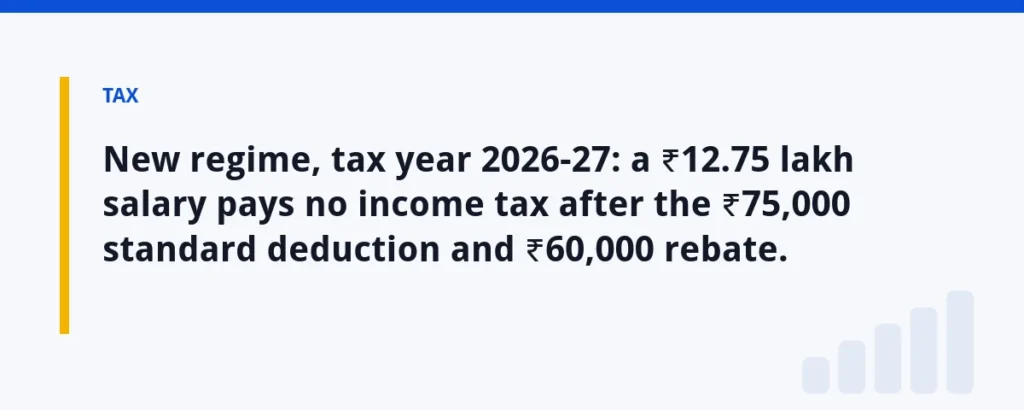
Put the two together. Say your salary is ₹12.75 lakh. Take off ₹75,000 and your taxable income is ₹12 lakh, so the rebate covers the full ₹60,000 and you pay nothing. Now say your salary is ₹13 lakh. Taxable income is ₹12.25 lakh and slab tax is ₹63,750, but marginal relief caps it at ₹25,000, the amount above ₹12 lakh. With 4% cess you pay ₹26,000.
Which deductions each regime allows
This is where the choice is really made. The new regime strips out most exemptions and deductions; section 202 lists what must be left out when your income is computed under it.
| Item | Old regime | New regime |
|---|---|---|
| Standard deduction on salary or pension | ₹50,000 | ₹75,000 |
| House rent allowance (HRA) exemption | Yes | No |
| Leave travel concession | Yes | No |
| Professional tax paid | Yes | No |
| Section 123 (old 80C): PPF, EPF, life cover, ELSS, home loan principal, tuition fees | Up to ₹1.5 lakh | No |
| Health insurance premium (old 80D) | Yes | No |
| Your own extra NPS contribution | Up to ₹50,000 | No |
| Employer’s contribution to your NPS account | Yes, within a salary-linked limit | Yes, within a salary-linked limit |
| Home loan interest, self-occupied house | Up to ₹2 lakh | No |
| Home loan interest, let-out house | Yes; loss set off up to ₹2 lakh | Yes, but a loss cannot be set off against salary |
| Education loan interest (section 129) | Yes | No |
| Interest on savings account (section 153) | Up to ₹10,000; seniors up to ₹50,000 on deposits | No |
A few points people miss:
- Your EPF and PPF still work in the new regime. The money grows the same way; you only lose the deduction on what you put in.
- Employer NPS contribution is one of the few tax breaks that survives in both regimes, which makes it worth asking HR about if your employer offers it.
- Let-out property is treated differently. In the new regime, interest is deducted from rent, but a resulting loss cannot reduce your salary income and cannot be carried forward.
Who benefits: new tax regime vs old in worked examples
The table below compares total tax, including 4% cess, for a resident under 60 with only salary income. These are illustrations with round numbers, not advice for your case. “Old regime A” assumes ₹2.25 lakh of deductions: the ₹50,000 standard deduction, ₹1.5 lakh under section 123 and a ₹25,000 health insurance premium. “Old regime B” adds ₹2 lakh of home loan interest on a self-occupied house, ₹50,000 of own NPS contribution and an HRA exemption of ₹1.5 lakh, for ₹6.25 lakh in all.
| Annual salary | New regime | Old regime A (₹2.25 lakh deductions) | Old regime B (₹6.25 lakh deductions) |
|---|---|---|---|
| ₹10 lakh | Nil | ₹70,200 | Nil |
| ₹15 lakh | ₹97,500 | ₹2,02,800 | ₹91,000 |
| ₹18 lakh | ₹1,50,800 | ₹2,96,400 | ₹1,71,600 |
| ₹25 lakh | ₹3,19,800 | ₹5,14,800 | ₹3,90,000 |
What the numbers say
- If your deductions are the usual set of PF, insurance and a health policy, the new regime wins clearly at every level shown.
- The old regime only pulls ahead when deductions are large. By our illustrative arithmetic, the break-even point (counting the ₹50,000 standard deduction) is roughly ₹5.9 lakh of deductions at a ₹15 lakh salary, about ₹6.9 lakh at ₹18 lakh and about ₹8.5 lakh at ₹25 lakh.
- The people who still gain from the old regime are typically those paying both rent (with HRA in their salary) and a home loan, or those with heavy home loan interest plus full use of section 123 and NPS.
To run your own numbers, use the income tax calculator, and the HRA calculator if you rent.
How salaried people switch between regimes
If you have no business or professional income, you choose your regime every year, and the choice is made in your income tax return. Section 202(4) says the option must go with the return filed by the due date under section 263(1), which is 31 July for most salaried people.
Your employer is a separate step. At the start of the year you tell your employer which regime you intend to use, so that tax deducted from salary matches. If you say nothing, the employer assumes the default new regime. The Income Tax Department’s FAQ is clear that what you tell your employer is not the final choice. You can, for example, let TDS run under one regime and then pick the other in your return, paying any balance or claiming a refund.
The trap is the deadline. Because the old regime can only be chosen in a return filed on time, missing the due date means your belated return is computed under the new tax regime. If you depend on HRA or home loan deductions, file before the due date.
Rules for people with business or professional income
Business owners, consultants and freelancers declaring business or professional income get far less flexibility. Under section 202(4):
- You opt out of the new regime by the due date for that year’s return, in the form and manner set by the Income-tax Rules.
- Once you opt for the old regime, it continues for later years.
- You can withdraw that option, and return to the new regime, only once.
- After that withdrawal you can never opt for the old regime again, unless you stop having business or professional income. Then the year-by-year choice open to salaried people becomes available.
Under the 1961 Act this option was exercised through Form 10-IEA. The Income-tax Rules, 2026 renumbered many forms, so check the e-filing portal for the current form before your due date rather than relying on an old form number.
A simple way to decide
- List the deductions you will genuinely claim this year, with proof: section 123 investments, health insurance, own NPS, home loan interest and HRA exemption.
- Work out your tax both ways, including cess, using your expected salary.
- If the old regime saves only a small amount, weigh that against the paperwork and the lock-in of investing just to save tax.
- Tell your employer your choice early so TDS is right, and file your return before the due date if you want the old regime.
Key takeaways
- The new tax regime is the default for tax year 2026-27, with slabs from nil up to ₹4 lakh to 30% above ₹24 lakh.
- A rebate of up to ₹60,000 makes income up to ₹12 lakh tax-free in the new regime; with the ₹75,000 standard deduction, a salary of ₹12.75 lakh pays nothing.
- The old regime keeps HRA, section 123, health insurance and self-occupied home loan interest, but taxes you at higher rates.
- Salaried people can switch every year in a return filed on time; business owners can leave the old regime only once.
This is general information, not personal tax advice. If your income includes capital gains, rent or business income, a tax professional can check which regime suits your full picture.