Priya works in Pune and pays ₹30,000 a month in rent. She has also just bought a flat in her hometown with a home loan, which her parents live in. Can she claim the HRA exemption on her rent and the home loan deductions at the same time? Yes, she can, provided she uses the old tax regime and meets the conditions. Most people who give up one of these benefits do so because they assume the two cannot go together.
This guide explains how the HRA exemption is calculated, which cities get the higher 50% limit, what you can claim on a home loan for interest and principal, how joint loans are split, and when claiming both is allowed. It also shows which of these breaks survive in the new tax regime, which is the default from tax year 2026-27 under the Income-tax Act, 2025.
How the HRA exemption is calculated
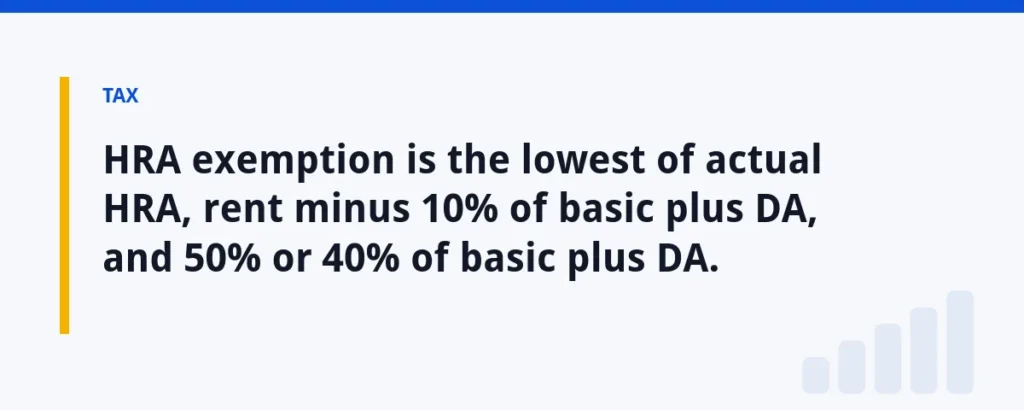
House rent allowance is part of many salaries. Under the new Act it is covered by Schedule III (serial number 11), and the exempt amount is set by the Income-tax Rules. The method is the same one the e-filing utilities use: the exemption is the lowest of three amounts.
- The actual HRA you received from your employer.
- Rent actually paid, minus 10% of your salary.
- 50% of your salary if you live in one of the specified metro cities, or 40% anywhere else.
“Salary” here means basic pay plus dearness allowance, not your full gross pay. That is why people with a high gross but a low basic often get a smaller HRA exemption than they expect. The calculation is done for the period you actually paid rent and received HRA.
Four conditions apply: the allowance must be granted to meet rent, you must actually pay rent, the house you live in must not be owned by you, and the HRA exemption is available only in the old regime.
Which cities get the 50% limit
For years, only Delhi, Mumbai, Kolkata and Chennai qualified for the 50% limit. According to news reports of the Income-tax Rules, 2026, notified on 20 March 2026 and in force from 1 April 2026, four more cities have been added.
| City | Limit until 2025-26 | Limit from tax year 2026-27 (as reported) |
|---|---|---|
| Delhi, Mumbai, Kolkata, Chennai | 50% | 50% |
| Bengaluru, Hyderabad, Pune, Ahmedabad | 40% | 50% |
| All other places | 40% | 40% |
If you live in one of the four newly added cities, check that your employer has applied the 50% limit in your payroll for 2026-27, and confirm the final list with your employer or the e-filing portal.
A worked example of the HRA exemption
As an illustration, take Priya’s numbers. Her basic pay plus dearness allowance is ₹50,000 a month, or ₹6 lakh a year. Her employer pays HRA of ₹25,000 a month, or ₹3 lakh a year.
| Step | Rent ₹22,000 a month | Rent ₹30,000 a month |
|---|---|---|
| 1. Actual HRA received | ₹3,00,000 | ₹3,00,000 |
| 2. Rent paid minus 10% of salary (₹60,000) | ₹2,04,000 | ₹3,00,000 |
| 3. 50% of salary (Pune, as reported for 2026-27) | ₹3,00,000 | ₹3,00,000 |
| HRA exemption (lowest of the three) | ₹2,04,000 | ₹3,00,000 |
| Exemption if the 40% limit applied | ₹2,04,000 | ₹2,40,000 |
At lower rent, the rent test decides the answer and the city limit makes no difference. At ₹30,000 rent, the 50% limit is worth an extra ₹60,000 of exemption over the 40% limit, which saves ₹18,000 plus cess for someone in the 30% slab. You can test your own figures with the HRA calculator.
Paperwork for claiming HRA, and what to do without it
To get the HRA exemption through payroll, give your employer rent receipts and the rental agreement, and declare it in Form 12BB along with your other claims. Keep your landlord’s PAN ready, since employers ask for it once rent crosses a set level. Reports of the 2026 rules say employees must now also disclose their relationship with the landlord. If your employer did not allow the exemption, you can still claim it in your return under the old regime, but keep proof of rent payments, preferably by bank transfer.
If you pay rent but your salary has no HRA, or you are self-employed, the old regime offers a smaller deduction under section 134 (the old 80GG). It is the lowest of rent paid minus 10% of total income, ₹5,000 a month, or 25% of total income. It is not available if you, your spouse or minor child own a house in the place where you live or work, and you cannot claim it for any period in which you received HRA.
Home loan interest deduction
Interest on a loan taken to buy, build, repair or reconstruct a house is deducted under section 22 of the new Act, which replaces section 24 of the old one.
- Self-occupied house: up to ₹2 lakh a year, if the loan was taken to buy or build the house and construction is completed within five years from the end of the tax year in which you borrowed. You need an interest certificate from the lender. In other cases, such as a repair loan, the limit is ₹30,000. You can treat up to two houses as self-occupied, but the ₹2 lakh cap is for both together.
- A house you cannot occupy: the new Act also treats a house as self-occupied if you cannot actually live in it for any reason, so a flat in your hometown can still qualify.
- Let-out house: the full interest is deductible from rent. In the old regime, a resulting loss can be set off against salary up to ₹2 lakh a year and the rest carried forward for up to eight years, against house property income only.
- Interest before possession: interest paid before the year of purchase or completion is deducted in five equal instalments from that year. The Finance Act, 2026 made it clear that for a self-occupied house these instalments fall within the same ₹2 lakh limit.
Principal repayment and stamp duty
The principal part of your EMI qualifies under section 123 (the old 80C), within the overall ₹1.5 lakh limit shared with PPF, EPF, life insurance and other items. Stamp duty, registration fee and transfer expenses for the house also count, in the year you pay them.
There is a catch. If you sell the house within five years from the end of the tax year in which you got possession, the principal deductions you claimed are reversed. The EMI calculator shows how each EMI splits between interest and principal.
Claiming both HRA exemption and home loan benefits
The law does not stop you from claiming both. The HRA test is about the house you live in: it must be rented, and not owned by you. The home loan test is about the house you own. The two often apply to different houses:
- Own house in another city: like Priya, you rent where you work and own a home elsewhere. You claim the HRA exemption on your rent and interest up to ₹2 lakh on the other house as self-occupied (or full interest if it is let out), plus principal under section 123.
- Own house in the same city, let out: you rent a home and let out the flat you own. HRA applies to your rent and the let-out rules apply to the flat.
- House under construction: you keep claiming HRA while you wait. Interest for the construction period is deducted in five instalments once construction is complete.
Keep the rent agreement, rent receipts and lender certificates for each year, so you can answer any query on the claims quickly.
Putting Priya’s numbers together
As an illustration, say Priya’s gross salary is ₹18 lakh: ₹6 lakh basic plus DA, ₹3 lakh HRA and ₹9 lakh of other allowances. She pays ₹30,000 a month in rent, ₹2 lakh a year in interest on the hometown flat she cannot live in because she works in Pune, and ₹25,000 for health insurance. Her EPF and loan principal fill the ₹1.5 lakh section 123 limit.
- Old regime: standard deduction ₹50,000, HRA exemption ₹3 lakh, section 123 ₹1.5 lakh, home loan interest ₹2 lakh and health insurance ₹25,000 bring taxable income to ₹10.75 lakh. Tax with cess is ₹1,40,400.
- New regime: only the ₹75,000 standard deduction applies, so taxable income is ₹17.25 lakh. Tax with cess is ₹1,50,800.
In this example the old regime saves Priya about ₹10,400. Take away the home loan, or move her to a city with the 40% limit, and the new regime comes out ahead. That is why the comparison has to be redone whenever rent, salary structure or the loan changes.
Joint home loans
When a couple or family members buy a house together with a definite share each, section 24 of the new Act taxes each co-owner separately and gives each the self-occupied relief as if they owned it alone. In practice:
- Each co-owner who is also a co-borrower can claim interest up to ₹2 lakh for a self-occupied house, so two co-owners can claim up to ₹4 lakh between them.
- Each can claim their share of principal within their own ₹1.5 lakh section 123 limit.
- Claims should follow the share of the loan each person actually repays, supported by the lender’s certificate.
Which regime allows what
| Benefit | Old regime | New regime |
|---|---|---|
| HRA exemption | Yes | No |
| Section 134 rent deduction (no HRA) | Yes | No |
| Interest on self-occupied house | Up to ₹2 lakh | No |
| Interest on let-out house | Yes; loss set off up to ₹2 lakh | Yes, against rent only; loss cannot be set off or carried forward |
| Principal and stamp duty (section 123) | Within ₹1.5 lakh | No |
If your HRA exemption and home loan deductions together run into several lakh rupees, the old regime may still cost you less. Compare both with the income tax calculator before you tell your employer your choice.
Checklist
- HRA exemption is the lowest of actual HRA, rent minus 10% of basic plus DA, and 50% or 40% of basic plus DA.
- From 2026-27, check whether your city now gets the 50% limit.
- Self-occupied home loan interest is capped at ₹2 lakh; principal and stamp duty share the ₹1.5 lakh section 123 limit.
- You can claim HRA and home loan benefits together when you rent the home you live in.
- None of the self-occupied benefits apply in the new regime.
This is general information, not personal tax advice.