
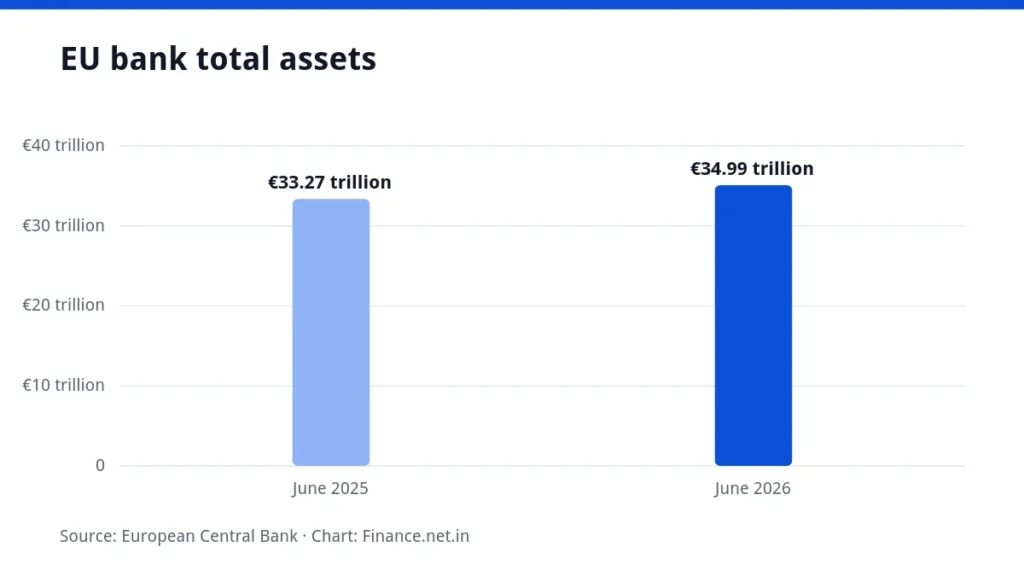
The European Central Bank (ECB) on 6 November 2026 published consolidated banking data for end-June 2026. Total assets of credit institutions headquartered in the EU rose 5.18% year on year, from €33.27 trillion in June 2025 to €34.99 trillion in June 2026.
What happened
The ECB released a quarterly dataset on the EU banking system, compiled on a group consolidated basis. Consolidated means a banking group’s figures are combined across its subsidiaries rather than reported entity by entity.
The headline readings for June 2026:
- Total assets: €34.99 trillion, up 5.18% from a year earlier.
- Non-performing loans (NPL) ratio: 1.99%, up 0.03 percentage points year on year. This is the share of bad loans, those where borrowers have stopped paying as agreed, in total loans. The ECB’s definition includes cash balances at central banks and other demand deposits.
- Return on equity: 5.31%. This is profit for the first six months of 2026 divided by total equity. The ECB says the figure is not annualised, so it covers only half a year.
- Common Equity Tier 1 (CET1) ratio: 16.43%. This compares a bank’s highest-quality capital with its total risk exposure amount, and is a common gauge of how much of a cushion a bank holds against losses.
All figures relate to the EU27.
What the dataset covers
The release draws on 336 banking groups. It also includes 2,283 other reporters: individual banks that stand alone, along with branches and subsidiaries operating in the EU that are controlled from outside the bloc. The ECB says together they represent nearly 100% of the EU banking sector’s balance sheet.
The indicators range across how much banks earn and how efficiently they run, what their balance sheets are made of, how they fund themselves and manage liquidity, and the quality of their loans. They also look at assets pledged as security (asset encumbrance), capital strength and solvency. The quarterly release is a subset of the fuller year-end dataset.
Most reporters use International Financial Reporting Standards and the European Banking Authority’s technical standards on supervisory reporting. Some small and medium-sized reporters may use national accounting standards, so parts of the aggregates rest on those. The release also includes a few revisions to past data.
What it means for you
The release is a statistical snapshot, not a policy decision, so it does not change any interest rate or rule. It gives a view of how large and how well capitalised EU banks are. If you hold euro deposits, work with European banks or follow global finance, it shows the sector’s bad-loan level remained below 2% and its capital ratio stood well above 16%.
The bad-loan ratio edged up only slightly, by 0.03 percentage points, over the year.
Background
The ECB publishes these banking statistics regularly as part of its work on central banking and statistics. For related ECB coverage, see our report on the ECB wage tracker and the lessons Isabel Schnabel drew from years of inflation shocks. The data are available in the ECB Data Portal and may change with later revisions.