What happened
The European Central Bank (ECB) published an update of its wage tracker on 4 November 2026. It suggests negotiated pay growth in the euro area will be slightly higher in the first three quarters of 2027 than in 2026 as a whole.
The tracker follows active collective bargaining agreements, which are pay deals between employers and unions. It now includes agreements signed up to the middle of October 2026, and its forward-looking horizon has been extended to the end of September 2027.
The headline numbers
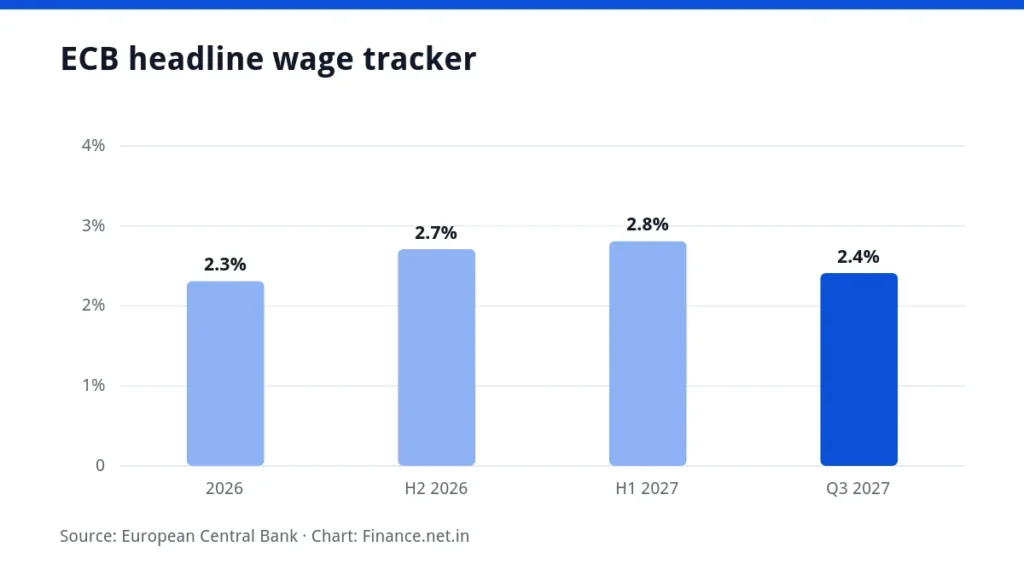
- Headline tracker, 2026: 2.3%, covering 46.2% of employees in participating countries.
- Second half of 2026: 2.7%.
- First half of 2027: 2.8%, covering 31.8% of employees.
- Third quarter of 2027: 2.4%, covering only 23.3% of employees.
The headline measure spreads one-off payments, such as inflation compensation, bonuses or back-dated pay, over 12 months. The ECB explains that the low reading for the first half of 2026 is still dragged down by one-offs that were paid in the second half of 2024 and not repeated the following year. By the second half of 2026 that drag disappears completely.
Compared with the September 2026 release, the headline tracker was revised up by around 0.1 percentage points on average for the second half of 2026 and the first half of 2027.
Excluding one-off payments
The version that strips out one-offs shows permanent, structural pay rises. It averaged 2.6% in 2026 and 2.8% across the first three quarters of 2027. It eases to 2.5% in the third quarter of 2027 from 2.9% in the first half. The ECB says this points to limited scope for one-off payments in recently signed agreements.
A further version leaves one-offs unsmoothed, which the ECB considers better for yearly comparisons. It shows 2.4% for the third quarter of 2027, compared with 2.7% for both the first half of 2027 and the whole of 2026.
What it means for you
Wages are one input that central banks watch when judging price pressures. The ECB says the tracker can help assess wage pressures in the euro area. It is not a rate decision and says nothing directly about interest rates.
The 2027 readings need careful handling. Coverage drops sharply for later periods because many deals have not yet been signed, so the 2.4% for the third quarter of 2027 rests on a small share of workers. The ECB stresses the forward-looking part should not be read as a forecast, and the data may be revised. It adds that the turn of the year is a sensitive point, because in some countries a large number of deals are signed or renewed in the first quarter.
For a broader view, the ECB points to its September 2026 staff projections, which show compensation per employee growing 3.3% in 2026. For readers new to the topic, our guide on what inflation is explains why pay and prices are linked, and our explainer on what the ECB does gives wider context.
Background
The wage tracker is a Eurosystem partnership between the ECB and nine national central banks. It covers Belgium, Germany, Greece, Spain, France, Italy, the Netherlands, Austria and Finland. It combines country data using weights based on total employee compensation.
The share of workers covered for 2026 and for the first half of 2027 is close to what the ECB recorded at this point a year ago, in its November 2025 release. For related reading, see ECB forecasters raise 2026 euro area inflation outlook to 3.0%.
What to watch next
The next release, after the ECB Governing Council’s December 2026 meeting, will exceptionally be published on 18 December 2026. The ECB expects to extend the horizon to the full year of 2027 then, as more agreements are signed.