What it is
FCNR(B) stands for Foreign Currency Non-Resident (Bank). It is a category of deposits that banks in India take from the diaspora, meaning people of Indian origin living abroad. The reports we draw on describe these as deposits from the diaspora, collected by banks under a special window run by the Reserve Bank of India (RBI).
The term has returned to headlines because of the sheer size of the money raised this year.
How it works
According to PTI reports carried by ThePrint and CNBC-TV18, the RBI offered a special concessional swap for these deposits. Through it, banks raised a record sum of nearly $133 billion. A swap, in simple terms, is an arrangement in which two parties exchange one currency for another and agree to reverse it later.
The foreign currency that came in boosted the country’s foreign exchange reserves, the stock of foreign currency, gold and other assets the RBI holds. You can read more in our forex reserves explainer. It also pushed up rupee liquidity, the amount of ready money available in the banking system.
Why it is in the news
Reserves touched an all-time high of $785.706 billion in the week ended 4 September, driven by the swap flows, according to PTI. They have declined since. On Friday, 30 October, the RBI reported that reserves fell by $1.269 billion to $719.748 billion. In the previous reporting week they had dropped $5.011 billion to $721.016 billion, as covered in our report on India’s forex reserves falling.
Experts quoted in the reports attribute the fall to the deployment of FCNR(B) resources and to dollar sales by the RBI to defend the rupee. Gold reserves dropped by $2.65 billion to $103.15 billion in the week, while foreign currency assets stood at $593.205 billion after a $1.358 billion rise in the week to 23 October. The reports differ on how they label the week for some of these figures.
The inflows also changed domestic liquidity. The RBI’s Liquidity Adjustment Facility (LAF) is the window through which it absorbs surplus short-term money from banks or lends to them. Liquidity measured by the net LAF position averaged a daily surplus of ₹5.9 lakh crore since the Monetary Policy Committee (MPC) meeting in August 2026, according to the data reported. Average daily net absorption rose from ₹1.2 lakh crore in July to ₹5.8 lakh crore in August and ₹7.8 lakh crore in September.
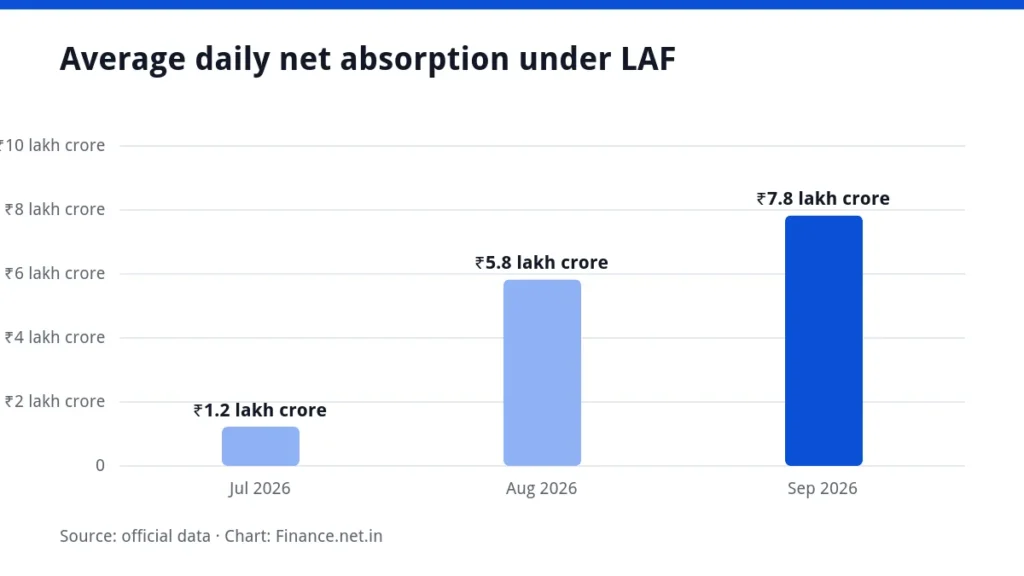
The surplus stayed between ₹2 lakh crore and ₹4.5 lakh crore from 1 to 15 October. BusinessLine, citing RBI data, linked the higher credit growth to this surplus and to festive demand. The paper said the system was flush with liquidity after the large FCNR(B) deposits garnered by banks under the concessional window.
RBI data showed bank credit up 17.94% year on year to ₹232.54 lakh crore as of 15 October 2026, against ₹197.17 lakh crore a year earlier. Deposits grew 16.60% to ₹284.37 lakh crore. Bank investments in central and state government securities rose 9.64% to ₹77.32 lakh crore. See our bank credit coverage for details.
What it means for you
If you are an NRI, the news does not change the terms of any deposit you hold, and the sources give no deposit rates, tenures or tax treatment. Check those directly with your bank before deciding anything. The NRE vs NRO FD calculator can help you compare other NRI deposit options.
If you live in India, the effect shows up indirectly. Plentiful liquidity and festive demand coincided with faster lending this month, though the sources do not say what this means for loan rates.
Background
Forex reserves act as a buffer the RBI can draw on, for instance when it sells dollars to steady the rupee. Reserves are also reported in dollar terms, so movements in the euro, pound or yen against the dollar change the reported value of foreign currency assets. Special Drawing Rights, the IMF’s reserve asset, were up $27 million to $18.605 billion in the latest data.