What happened
ECB Vice-President Boris Vujčić said on 2 November 2026 that Europe should respond to a more fragmented world by building resilience, not by pulling back from open trade. He was speaking at the Central Bank of Ireland’s Financial System Conference in Dublin.
His central argument: the EU cannot control other countries’ trade policy, but it can control how open and integrated its own Single Market is.
Geopolitics and inflation
Vujčić said geopolitical shocks are becoming more frequent and can hit growth, inflation and financial stability. He pointed to Russia’s war against Ukraine, the conflict in the Middle East, tariffs, export restrictions and higher defence spending.
He said inflation is now more often driven by supply shocks, which played a role in three major episodes in the past six years: 2020, 2022 and 2026.
Energy as an example
The EU imports 57% of its energy, he said, and almost all of its oil and gas. Europe diversified supply after 2022, but that alone did not shield it when tensions erupted in the Middle East this year.
He said Europe’s energy supply is sturdier than in 2022. With more power coming from low-carbon sources, wholesale electricity prices now react less strongly to movements in gas prices.
The cost of fragmentation
Differences in national rules and procedures act like internal tariffs, Vujčić said. ECB estimates put them at around 67% for goods and 95% for services, which he described as the upper bound of estimates.
He also noted that cross-border share ownership has become easier, though unevenly. Since 2014, the tariff-equivalent friction for euro area investors holding each other’s shares has dropped by about 12 percentage points, while for holdings between the euro area and the United States the drop is about 25 points. US venture capital funds invest around six times as much as EU-based funds.
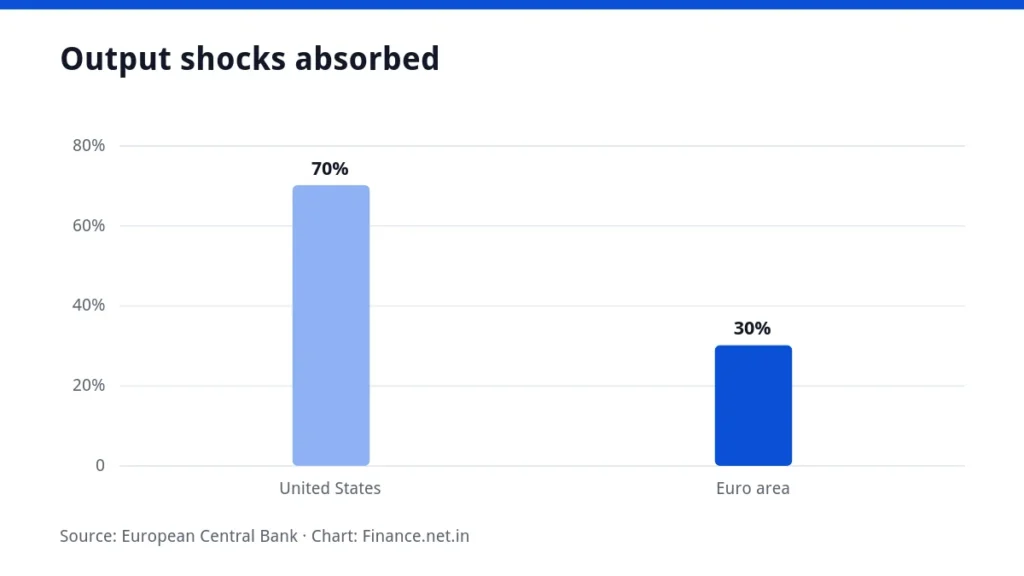
On risk sharing, ECB research finds that around 70% of US state-level output shocks are absorbed through markets and fiscal transfers. In the euro area the share is around 30%, with capital markets absorbing only 5 to 10%.
He said a modest 2% reduction in the barriers facing goods and services within the EU could, over the long run, make up for the expected damage to euro area GDP from higher US tariffs, put at around 0.7 percentage points between 2025 and 2027.
What he wants done
- Complete the savings and investments union, which brings together the banking union and the capital markets union.
- Add the one element the banking union still lacks, a European deposit insurance scheme, backed by a sound framework for handling bank crises.
- Harmonise withholding taxes to help capital flow across the EU.
- Build resilient European payments infrastructure, including the digital euro and wholesale digital payments. He called the September launch of Pontes an important milestone.
What it means for you
The speech is a statement of policy direction, not a decision on interest rates. It contains no rate guidance, and it does not change any rule today.
For savers and investors in Europe, the themes are cross-border banking, deposit protection and capital markets that work across borders. Deposit insurance is a guarantee that protects bank deposits up to a limit; India’s version is explained in our DICGC guide.
Indian readers can read it as a view from a major central bank on how trade tensions and energy shocks feed into prices. The speech does not discuss India.
Background
The ECB is the central bank for the euro area. Our explainer covers what the ECB does. On payments, see ECB board member Cipollone’s remarks on the digital euro pilot planned for 2027. Recent survey data on credit conditions is in our report on tighter bank lending in Q3 2026.