Say your daughter has a seat in a two-year master’s programme. The bank has sanctioned ₹6 lakh, but when you add up fees, hostel, books, exam charges and the laptop her course demands, the real bill is closer to ₹10 lakh. You can usually close a good part of that gap. If you are working out how to get more student loans (most Indian banks call them education loans) for a course like this, the amount is not fixed. Education loans in India are need-based, which means the amount depends on the cost of the course you can show on paper, plus the institution, the co-borrower, the security and the government support you bring to the table.
This guide takes those levers in the order most families should try them, starting with the ones that cost nothing (a complete cost sheet, scholarships) and moving to the ones that cost you something (collateral, a pricier lender, a longer EMI). Terms vary from bank to bank and nobody can promise a sanction, so treat this as general information rather than personal advice.
Start with the full cost of the course, not just the tuition fee
A common reason a sanction falls short is that the family only showed the tuition fee. Under the IBA Model Education Loan Scheme that banks follow, the loan is meant to cover the cost of completing the course, and the list of expenses that can be financed is wider than most people expect:
- Fees payable to the college and the hostel
- Examination, library and laboratory fees
- Travel or passage money for studies abroad
- Insurance premium for the student borrower, where applicable
- Caution deposit, building fund or refundable deposit, backed by receipts
- Books, equipment, instruments and uniforms
- A computer at a reasonable cost, if it is needed for the course
- Other expenses needed to complete the course, subject to a ceiling set by the bank
If your first application listed only tuition, you may have left a lakh or two on the table without realising it.
Build a cost sheet the bank can check
Ask the college for a year-wise fee schedule on its letterhead, including hostel and mess charges. Add the deposit receipts, the official list of books and equipment, and a quotation for the laptop if the course requires one. For study abroad, include the travel cost. As an illustration, a two-year course might break down like this: tuition ₹5.6 lakh, hostel and mess ₹2.4 lakh, books and equipment ₹60,000, laptop ₹70,000, exam and lab fees ₹40,000 and a refundable deposit ₹30,000. That comes to ₹10 lakh, and every line has a document behind it. A bank can argue with a vague estimate. It is much harder to argue with a stamped fee schedule.
Pick an institution that opens the PM-Vidyalaxmi route
Where your child studies can change how much you can borrow without pledging property. The PM-Vidyalaxmi scheme, approved by the Union Cabinet on 6 November 2024, lets students admitted to “quality higher education institutions” (QHEIs) get collateral-free and guarantor-free loans from banks and financial institutions covering the full tuition fee and other course expenses.
QHEIs are government and private institutions in the top 100 of the NIRF rankings (overall, category or domain), state government institutions ranked 101 to 200, and all central government institutions. The list is refreshed every year from the latest NIRF ranking. It started with 860 institutions covering more than 22 lakh students. For loans up to ₹7.5 lakh, the government gives the bank a 75% credit guarantee on the outstanding amount if the loan goes bad, which makes banks more willing to lend without security.
If your child has offers from two colleges and one is on the QHEI list, that is worth weighing alongside fees and placements. It is not a reason to pick a weaker course, but it can decide a close call.
Apply through the common portal
The scheme runs through a unified portal, PM-Vidyalaxmi (pmvidyalaxmi.co.in), where one common application is used by all participating banks. You can apply for the loan and for the interest subvention there. Keep the admission letter, the fee schedule and income documents ready before you start.
Add a co-borrower with a steady income
Banks grant education loans jointly with a parent or guardian. Under the scheme rules, parents or guardians are the co-borrowers, and for a married student it can be the spouse or the parents or parents-in-law. The co-borrower signs for the whole loan and is equally liable for it.
A co-borrower with a regular, documented income gives the bank comfort that EMIs will be paid even if the student takes time to find a job. If the parent named on the first application has an irregular income, ask the bank whether the other parent, or the spouse in the case of a married student, can be the co-borrower instead. Bring salary slips or income tax returns, bank statements for the last several months and proof of address. A clean repayment record on existing loans and credit cards helps too.
Be honest with the family about what co-borrowing means. If the student cannot pay, the bank will look to the co-borrower. That is a serious commitment, not a formality.
Offer collateral to cross ₹7.5 lakh
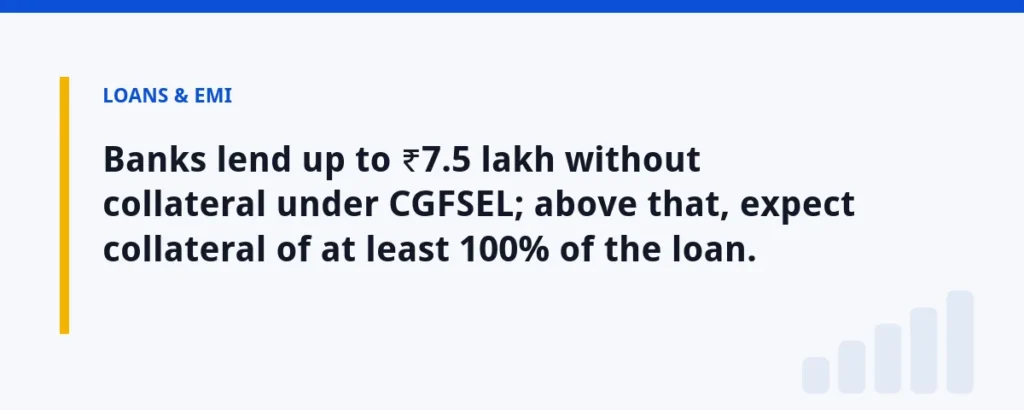
For most families, ₹7.5 lakh is the line that matters. Banks lend up to that amount without collateral because the Credit Guarantee Fund Scheme for Education Loans (CGFSEL) covers them. Above it, banks such as Canara Bank ask for tangible collateral worth at least 100% of the loan, along with an assignment of the student’s future income, which is taken in all cases. Seats under the management quota can need collateral even for small loans. Terms vary, so check your bank’s policy in writing.
Collateral usually means property, a fixed deposit or other securities the bank accepts. If you own a flat worth well above the loan amount, offering it can lift the sanction from ₹7.5 lakh to the full ₹10 lakh in our example. The trade-off is plain: if the loan is not repaid, the bank can enforce its claim on that asset.
Plan for the margin money
Banks also expect your own contribution, called margin. On Canara Bank’s terms it is nil up to ₹4 lakh. Above ₹4 lakh it is 5% for studies in India and 15% for studies abroad. For example, if the bank applies 5% to a ₹10 lakh course in India, you need about ₹50,000 of your own. On a ₹30 lakh course abroad, 15% is ₹4.5 lakh. Keep this money ready, because a bigger loan comes with a bigger margin.
Use government schemes to make a bigger loan cheaper
Schemes rarely raise the sanction by themselves, but they reduce what the loan costs you, which makes borrowing the full amount easier to carry.
PM-Vidyalaxmi interest subvention
If family income is up to ₹8 lakh a year and the student is not eligible under any other government scholarship or interest subvention scheme, PM-Vidyalaxmi pays 3% interest subvention during the moratorium on loans up to ₹10 lakh. It goes to one lakh students a year, with preference for government institutions and technical or professional courses. It is paid through e-vouchers and CBDC wallets.
CSIS for families earning up to ₹4.5 lakh
Under the Central Sector Interest Subsidy (CSIS), part of PM-USP, families with income up to ₹4.5 lakh a year get full interest subvention during the moratorium on education loans up to ₹10 lakh, for technical and professional courses at approved institutions. For a lower-income family, this can make a ₹10 lakh loan far less frightening.
Scholarships before the last rupee of loan
The National Scholarship Portal (scholarships.gov.in) brings central and state government scholarships into one place. Apply there before you borrow. Every rupee of scholarship is a rupee you do not repay with interest. Do check how a scholarship interacts with the PM-Vidyalaxmi subvention, since that subvention is meant for students not eligible under other government scholarship or subvention schemes.
One point of confusion is worth clearing up. RBI counts education loans up to ₹25 lakh as priority sector lending from 1 April 2025. That is a classification rule for banks, not a cap on what you can borrow, and not a promise that a bank will lend you that much.
Compare lenders, including NBFCs
If your bank will not go higher, you are not stuck with one answer. Public and private banks, NBFCs and some fintech-led lenders all give education loans, especially for study abroad. NBFCs can be more flexible on the amount or on security, but they often charge higher rates, and their loans may not qualify for some government schemes. Before you switch, check whether you would lose CSIS or PM-Vidyalaxmi benefits.
When comparing offers, look past the headline amount:
- Is the rate fixed or floating? For floating-rate loans to individuals for non-business purposes sanctioned or renewed on or after 1 January 2026, regulated lenders cannot charge pre-payment charges, so such a loan can be cleared early without a penalty.
- What processing fee, insurance and other charges apply?
- Does the moratorium cover the course plus one year, as under the IBA scheme?
- What security and co-borrower does the lender want?
For study abroad there is one more reason to keep the loan with a financial institution. Since 1 April 2025, there is no TCS when the remittance for education abroad is paid out of an education loan from a financial institution. Self-funded education remittances above ₹10 lakh a year attract TCS, which you can later adjust against your tax.
How to get more student loans: every lever on one page
Here is how the options compare. The amounts are illustrative and depend on your bank, the course and your documents.
| Lever | What it can add | What it costs you |
|---|---|---|
| Full cost sheet | Hostel, books, laptop, deposits and travel that were left out | Time to collect documents |
| QHEI admission (PM-Vidyalaxmi) | Collateral-free, guarantor-free loan for full tuition and course expenses | Limits your choice of college to the yearly list |
| Earning co-borrower | Bank confidence for a higher, smoother sanction | The co-borrower is fully liable for the loan |
| Collateral | A loan above ₹7.5 lakh | Asset at risk; valuation and legal charges |
| Margin money | Meets the bank’s condition for loans above ₹4 lakh | 5% (India) or 15% (abroad) from savings, on Canara Bank’s terms |
| Interest subvention (CSIS, PM-Vidyalaxmi) | Lower interest during the moratorium on loans up to ₹10 lakh | Income limits and eligibility conditions |
| Scholarships (NSP) | Money you never repay | Applications and deadlines |
| NBFC or second lender | A higher amount or less security in some cases | Often a higher rate; may lose scheme benefits |
Keep the EMI within reach
Knowing how to get more student loans is only half the job. The other half is making sure the student can repay it. Borrow what the course genuinely needs, not the largest figure a lender will approve. Then test the EMI against a realistic starting salary for the course, not the best-case placement figure.
Assume 10% a year for illustration and take a ₹10 lakh loan repaid over 10 years. The EMI works out to about ₹13,200 a month. On ₹6 lakh it would be about ₹7,900. If the expected first salary is ₹40,000 a month, the larger EMI takes about a third of it, which is tight but possible. If the expected salary is ₹25,000, it is not. You can try your own numbers on our EMI calculator.
A few things soften the load. Under the IBA scheme, EMIs can run up to 15 years after the moratorium, which is the course period plus one year. Paying interest during the study and moratorium period is optional, but if you can afford even the interest, the balance will not grow while the student studies. And interest paid on the loan can be claimed as a deduction under Section 129 of the Income-tax Act, 2025, which replaced Section 80E from 1 April 2026. There is no upper limit, it runs for up to eight years, only the person paying the interest can claim it, and it is available only under the old tax regime, not the new default regime.
Key takeaways
- Show the full cost of the course with documents. Hostel, books, a laptop, deposits and travel are all financeable.
- Check whether the college is on the QHEI list and apply through the PM-Vidyalaxmi portal.
- Name a co-borrower with a steady, documented income.
- Above ₹7.5 lakh, expect to offer collateral of at least 100% of the loan, and keep margin money ready above ₹4 lakh.
- Apply for scholarships and interest subvention before you settle on the final loan amount.
- Compare banks and NBFCs on total cost and scheme eligibility, not just the amount.
- Borrow only what the course needs, and check the EMI against a realistic first salary.