
Lakshmi needs ₹1.5 lakh in a hurry for her son’s college fees, and the family’s gold bangles sit in a locker doing nothing. A gold loan can put money in her account the same day, often with little paperwork, because the gold itself secures the loan. That speed is why the gold loan is one of the most common ways Indian households raise short-term cash.
But pledging jewellery is still borrowing, and the rules matter. The Reserve Bank of India (RBI) rewrote them in its Lending Against Gold and Silver Collateral Directions, 2025, which lenders had to adopt by 1 April 2026. This guide explains how much you can borrow, how interest and repayment work, what happens if you cannot repay, and how banks and NBFCs compare.
How a gold loan works
You take your gold jewellery, ornaments or coins to a bank or non-banking financial company (NBFC). The lender tests the purity, weighs the gold, values it and lends you a percentage of that value. The gold stays in the lender’s vault until you repay the loan with interest, and is then returned to you.
Under RBI’s directions, only jewellery, ornaments and coins of gold or silver are accepted. Lenders cannot lend against primary gold such as bars or bullion, or against gold exchange-traded fund units or gold mutual fund units, and cannot give a loan to buy gold in any form. The lender must also be satisfied that you own the gold; it will ask for a document or declaration saying you are the rightful owner and will refuse a loan where ownership is doubtful.
There are weight limits too. For all loans to one borrower taken together, pledged gold ornaments cannot exceed 1 kilogram and gold coins cannot exceed 50 grams. For silver, the limits are 10 kilograms of ornaments and 500 grams of coins.
How your gold is valued
Only the gold content counts. RBI’s rules say the lender must value the collateral on its intrinsic gold value; stones, gems and making charges add nothing. The price used is the lower of two figures for gold of that purity: the average closing price over the previous 30 days, or the previous day’s closing price. These prices must come from the India Bullion and Jewellers Association or a commodity exchange regulated by SEBI.
The assaying has to happen in front of you when the loan is sanctioned, and the lender must explain deductions for stones, fastenings and the like. You then get a certificate, or e-certificate, recording the purity in carats, gross weight, net gold weight, deductions, any damage noticed, a photograph of the items and the value at sanction. Keep this paper safe: it is your proof when the gold comes back.
The loan agreement itself must spell out the auction procedure, the notice period you will get before any auction, the timeline for returning your gold and how any auction surplus will be refunded. RBI also says the terms and other important communication must be in the language of the region or a language you choose. If a borrower cannot read, the key terms must be explained in front of a witness who is not the lender’s employee.
So a heavy necklace studded with stones may fetch far less than you expect. A plain 22-carat chain of the same weight will usually be valued higher because more of its weight is gold.
Gold loan LTV limits under RBI rules
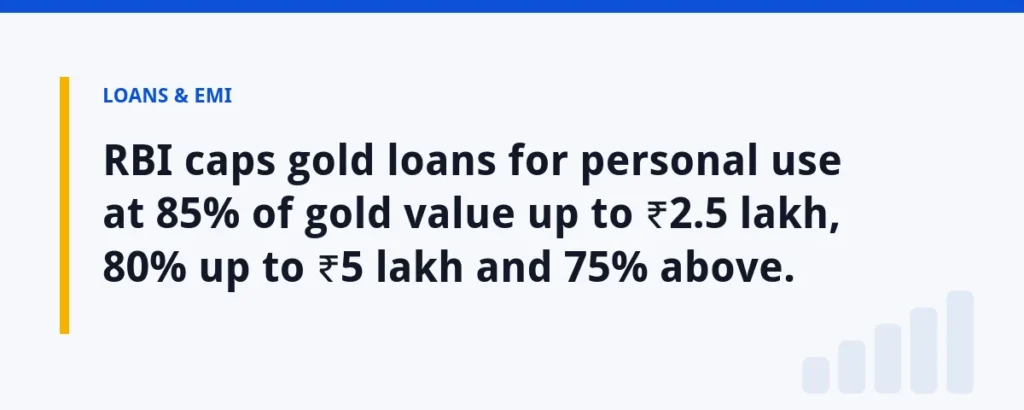
The loan-to-value (LTV) ratio is the loan as a percentage of the gold’s value. For consumption loans, which means loans that are not for business, farming or other income-generating activity, RBI sets these ceilings based on the total consumption loan per borrower:
| Total consumption loan per borrower | Maximum LTV |
|---|---|
| Up to ₹2.5 lakh | 85% |
| Above ₹2.5 lakh and up to ₹5 lakh | 80% |
| Above ₹5 lakh | 75% |
The LTV must be maintained throughout the loan, not just on day one. If gold prices fall sharply, your loan can cross the limit, and the lender’s policy will say what happens next. Usually you will be asked to repay part of the loan or pledge more gold.
Loans above ₹2.5 lakh also need a detailed credit assessment, including a check of your ability to repay. Smaller loans can be sanctioned more simply.
Interest and repayment options: EMI vs bullet
RBI does not fix gold loan interest rates; each lender sets its own. Rates differ widely between lenders and between schemes of the same lender, so compare the annual percentage rate (APR) in the Key Facts Statement (KFS). RBI requires all charges, including assaying and auction charges, to be listed in the loan agreement and the KFS, and lenders cannot add fees that are not in the KFS without your explicit consent.
There are two common ways to repay:
- EMI or regular payment loans: you pay interest, or interest plus principal, every month. The balance falls over time, and so does the risk of crossing the LTV limit.
- Bullet repayment loans: you pay nothing during the loan, and the principal and all interest fall due together at maturity. RBI caps the tenure of bullet consumption loans at 12 months.
Bullet loans are convenient but come with a catch. For them, RBI says the LTV must be worked out on the total amount repayable at maturity, interest included, not just the amount you receive. As an illustration, say the lender values Lakshmi’s gold at ₹2.5 lakh. On an EMI loan within the 85% band, she could borrow up to ₹2,12,500. On a 12-month bullet loan, the principal plus a year’s interest must stay within ₹2,12,500. Assume 10% a year simple interest for illustration: she could then borrow only about ₹1,93,000, because about ₹19,300 of interest will be added by maturity.
Use our EMI calculator to see what a regular-payment gold loan would cost each month.
Renewals and top-ups
Many borrowers roll a gold loan over year after year. RBI now allows renewal or a top-up only on your formal request, after a credit assessment, within the permitted LTV and only if the loan is a standard, performing account. A bullet loan can be renewed only after you pay the interest accrued on it. This stops interest from quietly piling up on old loans while the gold sits in the vault.
If you renew every year without reducing the principal, you are paying interest on the same money indefinitely. Treat a gold loan as short-term money and plan the repayment before you borrow.
What happens if you do not repay
If you miss payments or fail to settle a bullet loan at maturity, the lender can auction your gold. RBI’s directions add several protections:
- Notice first: the lender must give you, or your legal heirs, adequate notice to repay before starting the auction, and keep a record of the notice. If it cannot trace you even after a public notice, it may auction only after one month from that public notice.
- Public announcement: the auction must be advertised in at least two newspapers, one in the regional language and one national daily.
- Reserve price: the reserve price cannot be less than 90% of the gold’s current value. Only if two auctions fail can it drop, and then to no less than 85%.
- Location: the first auction must be held physically in the same district as your branch. Only after it fails can the lender move to an adjoining district or an online auction.
- No insider buying: the lender and its related parties cannot bid.
- Full accounting: you must get details of the price fetched and the dues adjusted, and any surplus must be refunded within seven working days of the lender receiving the full auction proceeds. If the auction fetches less than you owe, the lender can recover the shortfall under the loan agreement.
The simplest protection is to talk to the lender as soon as you see trouble. Paying the interest, or part of the principal, can keep the loan in order and the gold out of auction.
Getting your gold back and compensation
Once you repay in full, the lender must return the gold the same day if possible and in any case within seven working days. Check it against the certificate you received at the start. If the delay is the lender’s fault, RBI’s directions require it to pay you ₹5,000 for every day of delay beyond seven working days.
If your gold is damaged while in the lender’s custody, the lender bears the cost of repair. If it is lost, or found short in weight or purity at return or auction, the lender must compensate you suitably. Gold left with a lender for more than two years after the loan is fully repaid is treated as unclaimed, and the lender must run drives to trace the owner or heirs.
Banks vs NBFCs for a gold loan
RBI’s gold lending directions apply to commercial banks (including small finance banks, local area banks and regional rural banks, but not payments banks), urban and rural co-operative banks, and all NBFCs including housing finance companies. So the LTV caps, valuation method, auction rules and compensation apply whoever lends to you.
The differences are practical:
- Speed and access: NBFCs that specialise in gold lending often have many branches and quick processing. Many banks also offer quick disbursal, especially to existing customers.
- Cost: rates and fees vary by lender and scheme, so compare the APR in the KFS rather than the advertised rate.
- Storage: RBI says gold can be handled only by the lender’s own employees and stored only in its branches that have vaults fit for the purpose.
- Prepayment: if your gold loan is on a floating rate and is for personal use, RBI’s Pre-payment Charges on Loans Directions, 2025 bar prepayment charges on loans sanctioned or renewed from 1 January 2026. On fixed rate loans, charges depend on the lender’s policy and must be disclosed upfront.
Key takeaways before you pledge
- You can borrow up to 85%, 80% or 75% of the gold’s value, depending on the total loan size.
- Only the gold content is valued, at the lower of the 30-day average or the previous day’s price.
- Bullet loans are capped at 12 months, and their LTV includes the interest due at maturity.
- Insist on the assay certificate and the Key Facts Statement, and check every charge.
- Before any auction you must get notice; the reserve price starts at 90% of current value, and any surplus comes back within seven working days.
- Gold must be returned within seven working days of full repayment, or the lender pays ₹5,000 a day for its delay.
This is general information, not personal advice. Your loan agreement and the lender’s policy govern your specific loan.