
Ravi and Meena have found a two-bedroom flat for ₹50 lakh and have about ₹10 lakh saved. The rest will come from a home loan, the largest and longest debt most Indian families ever take. Before they sign anything, they want to know three things: how much a bank will actually lend, how the interest rate will move over 20 years, and what the loan will cost beyond the EMI.
This guide answers those questions in plain terms. It covers who qualifies, the Reserve Bank of India (RBI) limits on how much of the property price a lender can fund, floating and fixed rates, repo-linked loans, how tenure changes your total interest, the fees you will meet and the papers to keep ready. Rates and offers change often, so treat the examples here as illustrations, not quotes.
How a home loan works
A home loan is a secured loan. The bank or housing finance company pays the seller or builder, and you repay the money with interest in equated monthly instalments (EMIs) over an agreed tenure. Until the last rupee is repaid, the property stays mortgaged to the lender, and the original title documents usually sit with it.
Each EMI has two parts: interest on the outstanding balance and a slice of principal. In the early years most of the EMI goes towards interest, because the balance is at its highest. As the balance falls, the principal share grows. This is why extra payments made early in the loan save far more interest than the same payments made near the end.
You will see three numbers on every offer: the loan amount, the interest rate and the tenure. Change any one and the EMI and total interest change too. Our EMI calculator lets you try different combinations before you talk to a lender.
Who is eligible and how much you can borrow
There is no single eligibility rule across lenders. Each bank and housing finance company sets its own policy, but they all look at the same broad things:
- Income and its stability: salary slips and Form 16 for salaried people, income tax returns and business financials for the self-employed.
- Existing EMIs: lenders check what share of your monthly income already goes into other loans. The more you already owe, the smaller the new loan.
- Age and remaining working years: the tenure offered usually has to end around your expected retirement age, which limits how long a loan an older borrower can get.
- Credit history: your credit report shows past repayment behaviour. Late payments and many recent loan enquiries can mean a lower amount or a higher rate.
- The property itself: clear title, approved building plans and a legal and technical check by the lender.
Adding an earning spouse or parent as a co-applicant can raise the amount you qualify for, because both incomes are counted. Remember that a co-applicant is equally responsible for repayment.
Loan-to-value limits set by RBI
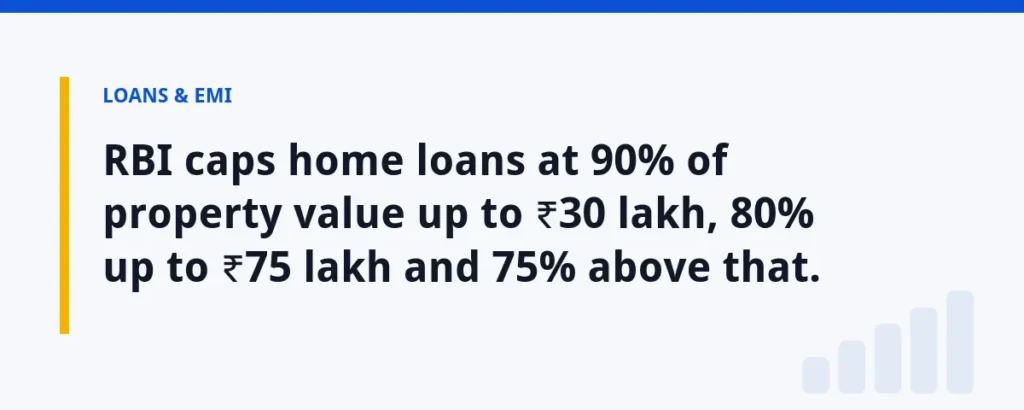
Even if your income supports a large EMI, a bank cannot fund the whole property price. RBI caps the loan-to-value (LTV) ratio, which is the loan as a percentage of the property value. Under the RBI circular of 7 June 2017 on individual housing loans, the ceilings are:
| Loan amount | Maximum LTV | Minimum you fund yourself |
|---|---|---|
| Up to ₹30 lakh | 90% | 10% of the property value |
| Above ₹30 lakh and up to ₹75 lakh | 80% | 20% |
| Above ₹75 lakh | 75% | 25% |
For Ravi and Meena’s ₹50 lakh flat, a loan of ₹40 lakh falls in the middle band, so 80% is the ceiling and the ₹10 lakh down payment is the minimum. Lenders can offer less than these limits, never more. Your own contribution also has to cover registration, stamp duty and furnishing, which lenders often do not fund, so plan your savings with that in mind.
Floating vs fixed interest rates
A floating rate moves with a benchmark during the loan. When the benchmark falls, your rate falls; when it rises, your rate rises. A fixed rate stays the same for an agreed period, which may be the full tenure or only the first few years, after which many loans convert to floating.
A typical home loan in India is on a floating rate. Fixed rates are usually priced higher at the start because the lender is taking the risk of rates rising. RBI’s master direction on interest rates defines a fixed rate loan as one where the rate stays fixed for the entire tenor, so read the offer carefully: a loan described as fixed for three years is really a hybrid.
Two rules make floating loans friendlier than they once were. First, lenders cannot charge prepayment penalties on floating rate loans to individuals taken for non-business purposes; this has applied to floating rate term loans since 2014, and the RBI Pre-payment Charges on Loans Directions, 2025 restate it for loans sanctioned or renewed from 1 January 2026. Second, when the rate is reset, RBI’s 2023 instructions say a lender may, at its option, offer a switch to a fixed rate under its board-approved policy, with all switching charges disclosed in the sanction letter.
Repo-linked home loans and rate resets
Since 1 October 2019, every new floating rate retail loan from a bank, including a home loan, must be linked to an external benchmark. RBI allows four choices: the RBI policy repo rate, the 3-month or 6-month Government of India Treasury bill yield published by Financial Benchmarks India (FBIL), or another FBIL benchmark. A bank has to use one benchmark for a whole loan category, and most have picked the repo rate. The RBI website showed the repo rate at 5.50% on 27 October 2026.
Your rate is the benchmark plus a spread. Under RBI’s rules, the rate on an external benchmark loan must be reset at least once in three months. The credit risk part of the spread can change only if your credit assessment changes substantially, as agreed in the loan contract, and the other spread components can be altered only once in three years. So if RBI raises the repo rate by 0.25 percentage point, your rate should rise by about the same at the next reset, and the reverse applies when it cuts.
When rates rise, many lenders keep the EMI unchanged and stretch the tenure. RBI’s instructions say you must be given the choice of a higher EMI, a longer tenure or a mix of both, and that stretching the tenure must never lead to negative amortisation, where the EMI no longer covers the interest. You should also receive a statement each quarter showing principal and interest paid so far, the EMI, the number of EMIs left and the annual percentage rate.
EMI and tenure: how the home loan cost adds up
A longer tenure lowers the EMI but raises the total interest sharply. As an illustration, take a ₹40 lakh loan and assume 8.5% a year:
| Tenure | Monthly EMI | Total interest paid |
|---|---|---|
| 20 years | ₹34,713 | About ₹43.3 lakh |
| 30 years | ₹30,757 | About ₹70.7 lakh |
Stretching from 20 to 30 years saves about ₹4,000 a month but adds roughly ₹27 lakh of interest. Now suppose the rate rises by a quarter point to 8.75% soon after the loan starts and the lender keeps the ₹34,713 EMI unchanged. The 20-year loan would stretch to about 252 months, so you would pay roughly a year of extra EMIs. Choosing a higher EMI instead, about ₹35,348, keeps the original end date.
The practical lesson: pick the shortest tenure whose EMI you can carry comfortably, keep an emergency fund aside, and prepay when you have spare money. Run your own numbers in the EMI calculator.
Processing fees and other costs
The interest rate is only part of the cost. Expect some or all of these:
- Processing fee: a one-time charge, often a percentage of the loan or a flat amount, set by each lender.
- Legal and technical fees: for checking the title and valuing the property.
- Stamp duty on the loan agreement or mortgage: set by your state government, separate from the stamp duty on buying the property.
- Insurance: lenders insist on property insurance and may offer loan protection cover. You can compare cover elsewhere instead of buying the lender’s bundled policy.
RBI’s Key Facts Statement (KFS) rules help here. For retail loans sanctioned from 1 October 2024, the lender must give you a KFS in a standard format, showing the annual percentage rate (APR), which includes interest and all charges levied by the lender. Charges collected for third parties, such as insurance and legal fees, also go into the APR and must be shown separately. Any fee not listed in the KFS cannot be charged at any stage without your explicit consent. Compare offers on APR, not on the headline rate.
Documents to keep ready
Lists vary by lender, but a typical home loan file needs:
- Identity and address proof, such as PAN and Aadhaar or another document the lender accepts.
- Income proof: recent salary slips, Form 16 and bank statements for salaried applicants; income tax returns, audited accounts and business proof for the self-employed.
- Property papers: sale agreement, title deeds and chain of ownership, approved building plan, and for a new flat, the builder’s allotment letter and project approvals.
- Details of existing loans and their statements.
- Passport-size photographs and a cheque for the processing fee, if asked.
Keep copies of everything you hand over and ask for an acknowledgement. At closure, you should get back every original document you deposited.
PMAY-Urban 2.0 interest subsidy
The Union Cabinet approved Pradhan Mantri Awas Yojana-Urban (PMAY-U) 2.0 in August 2024. Its Interest Subsidy Scheme vertical, as described by the government in its official note, gives a 4% interest subsidy on home loans up to ₹25 lakh for economically weaker section (EWS), lower income group (LIG) and middle income group (MIG) families. The subsidy is worked out on the first ₹8 lakh of the loan, for a house worth up to ₹35 lakh. The subsidy is paid in five yearly instalments, up to a maximum of ₹1.80 lakh.
Income limits, property value caps and the list of participating lenders are set in the scheme guidelines and can change. Before you count on the subsidy, check your eligibility and the scheme’s current status on the PMAY-Urban portal and with your lender, and apply at the time of taking the loan.
Key takeaways before you sign
- Before applying for a home loan, save at least 10% to 25% of the property value, depending on the loan size, plus stamp duty and registration.
- Ask which benchmark your floating rate follows, what the spread is and how often it resets.
- Choose the shortest tenure you can manage and keep six months of EMIs as a buffer.
- Compare lenders on the APR in the Key Facts Statement, and refuse charges not listed there.
- Floating rate home loans for personal use carry no prepayment penalty, so prepay whenever you can.
- When rates rise, ask for a higher EMI rather than a longer tenure if your budget allows.
This is general information, not personal advice. Your lender’s sanction letter and KFS are the documents that govern your loan.