What happened
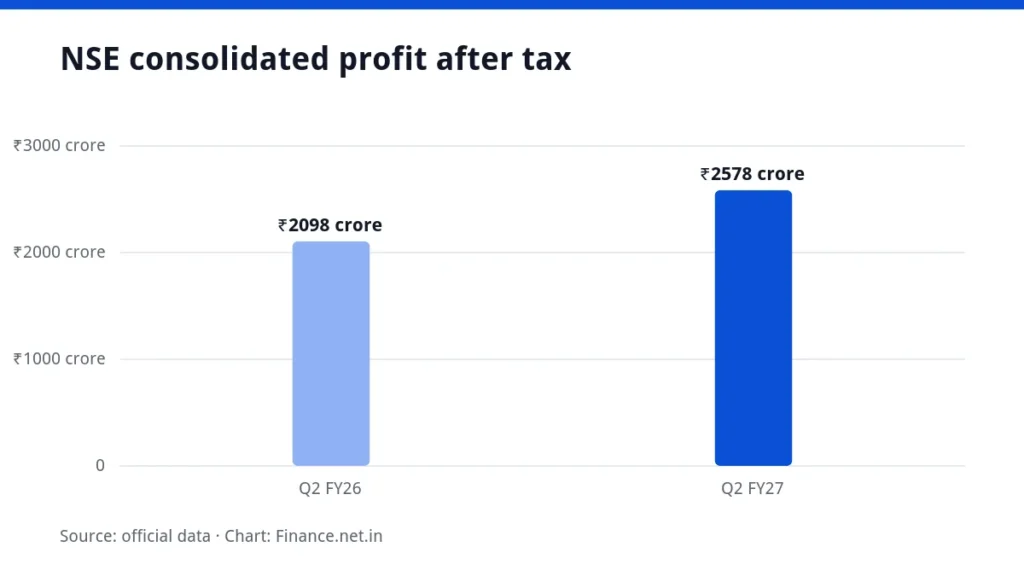
NSE, India’s largest stock exchange, posted consolidated profit after tax of ₹2,578 crore for the September quarter of FY27. That is 23% higher than the ₹2,098 crore of a year earlier. It is the exchange’s first set of quarterly numbers since it listed in September 2026.
Consolidated total income rose 9% to ₹4,554 crore from ₹4,160 crore. Transaction charges, its largest revenue stream, rose 9% to ₹3,035 crore from ₹2,789 crore. Reports say the rise came from higher activity in the cash market and equity options segments.
Trading volumes
- Cash market average daily traded volume (ADTV): ₹1,18,377 crore, up 24% year-on-year.
- Equity options ADTV, measured by premium value: ₹47,977 crore, up 3%.
- Equity futures ADTV: ₹1,24,574 crore.
Why costs fell and EBITDA doubled
Total expenditure dropped 51% to ₹1,161 crore from ₹2,354 crore. The year-ago quarter included a one-time provision of ₹1,297 crore for settlement fees to SEBI over the colocation and dark fibre matters. Management said that, excluding this provision, expenses would have risen 10%, according to BusinessLine.
Operating EBITDA (earnings before interest, tax, depreciation and amortisation, a measure of core operating profit) rose 107% to ₹3,079 crore, a margin of 76%. Earnings per share were ₹10.41, against ₹8.48.
Other lines grew faster. Listing services revenue rose 70% to ₹150 crore, and data feed and terminal services revenue rose 43% to ₹165 crore.
Standalone and half-year numbers
On a standalone basis, profit after tax rose 16% to ₹2,164 crore and total income rose 8% to ₹3,956 crore. For the first half of FY27, consolidated net profit rose 13% to ₹5,698 crore on total income of ₹9,807 crore, up 9%.
NSE said its contribution to the exchequer in the half was ₹41,234 crore, including ₹34,788 crore of securities and commodities transaction taxes, ₹2,885 crore of income tax and ₹1,926 crore of stamp duty.
What it means for you
The profit jump looks larger than the underlying business growth. Income grew 9%, and much of the profit gain comes from the absence of last year’s one-off provision.
BusinessLine also reported that transaction charge revenue fell 16% from ₹3,623 crore in the June quarter, and net profit fell 17.4% from that quarter. Quarter-on-quarter comparisons show how trading activity can swing.
On the outlook for trading, NSE’s management pointed to two things it thinks will help cash market activity: lower upfront margin requirements and planned changes to securities lending and borrowing rules. Asked whether weekly futures and options expiries could shift to fortnightly or monthly, it said there were “no current plans” for that.
Shareholders can read the numbers alongside the share price. NSE shares closed on Tuesday up 1.35% from a previous close of ₹1,779.70, trading between ₹1,782 and ₹1,814.50. The stock listed at ₹1,800 against an issue price of ₹1,785 in an offer worth ₹22,562 crore.
Background
NSE’s board also approved selling up to 40% of its wholly owned subsidiary, National Coal Exchange of India Limited, through a secondary sale in one or more tranches. NSE said it will make further disclosures once terms are finalised.
Managing Director and CEO Ashishkumar Chauhan called the quarter “momentous”, citing the listing. He said NSE facilitated India’s first tokenised bond issuances, totalling ₹1,000 crore. The exchange also received regulatory approvals for new contracts, among them derivatives linked to the Nifty India FPI 150 Index and futures on a corporate bond index.
BusinessLine reported that NSE has added close to 800 full rack equivalents of co-location capacity since January 2025, taking the total to around 1,870 racks, and has surplus capacity for now.
Related: Stocks in news: ITC profit falls 18.5%, Marico profit rises 31%.