
Your father transfers ₹5 lakh to help with a home loan down payment. A close friend gives you ₹1 lakh on your birthday. Your aunt leaves you her flat in her will. Which of these is taxed? Only one: the friend’s gift. India has no separate gift tax, but tax on gifts still exists. Gifts are taxed in the hands of the person who receives them, as income from other sources, unless an exemption applies, and the most important exemption covers gifts from relatives.
The rules carried over almost unchanged into the Income-tax Act, 2025, which applies from tax year 2026-27. The main provision is now section 92(2)(m), with the exemptions in section 92(3). This guide explains who counts as a relative, the ₹50,000 limit, marriage gifts, inheritance, gifts of property and shares, clubbing, and what changes when the giver or receiver is an NRI.
How tax on gifts works
Under section 92(2)(m), three kinds of receipts are taxed when they come without adequate payment and are not covered by an exemption:
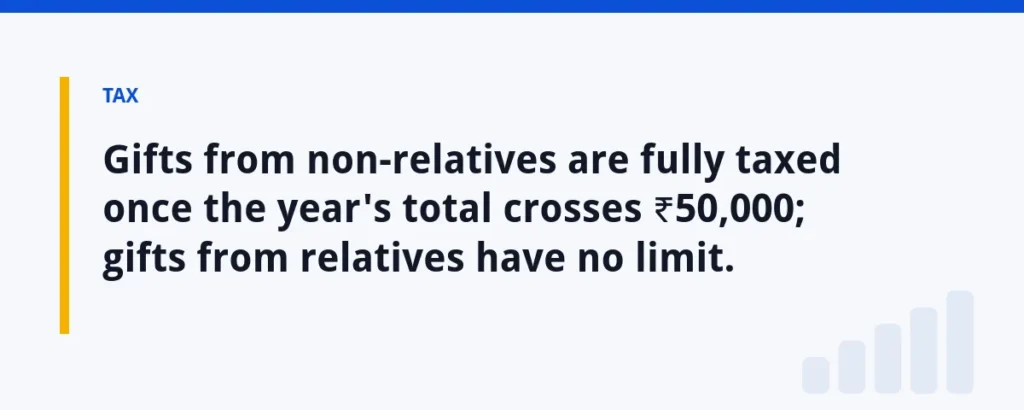
- Money: if the total sum received in a tax year from people other than relatives exceeds ₹50,000, the whole amount is taxed, not just the excess.
- Immovable property received free: if the stamp duty value exceeds ₹50,000, that whole value is taxed.
- Other specified property received free: shares and securities, jewellery, bullion, paintings, sculptures, drawings, works of art, archaeological collections and virtual digital assets. If their total fair market value exceeds ₹50,000, the whole value is taxed.
The taxed amount is added to your income and taxed at your slab rate. Note what is not on the list: a car, a phone or household furniture gifted to you is not “property” for this rule, so it is not taxed as a gift.
The ₹50,000 limit works like a cliff. As an illustration, if three friends give you ₹15,000 each in a year, the total of ₹45,000 is not taxed. If a fourth gives ₹10,000, the total becomes ₹55,000 and the entire ₹55,000 is taxable.
Gifts from relatives are fully exempt
Section 92(3) says the rule does not apply to money or property received from a relative. There is no upper limit. A parent can gift a child ₹50 lakh or a flat, and the child pays no income tax on receiving it.
For an individual, the law defines a relative as:
- your spouse;
- your brother or sister;
- your spouse’s brother or sister;
- a brother or sister of either of your parents, that is your uncles and aunts;
- any lineal ascendant or descendant, on both the mother’s and father’s side, such as parents, grandparents, children and grandchildren;
- any lineal ascendant or descendant of your spouse;
- the spouse of anyone in items 2 to 6.
For a Hindu undivided family, any member counts as a relative. Notice who is missing: cousins, nephews and nieces, and friends. A gift from your cousin is treated like a gift from a stranger, and counts towards the ₹50,000 limit.
Marriage gifts, inheritance and other exemptions
Section 92(3) lists other situations where gifts are not taxed, whoever gives them.
| Situation | Taxed? |
|---|---|
| Gift from a relative (as defined above) | No, any amount |
| Gift received on the occasion of your own marriage | No, any amount and from anyone |
| Property received under a will or by inheritance | No |
| Gift made in contemplation of the giver’s death | No |
| Money from a local authority, or from certain registered non-profits | No |
| Gifts from friends or cousins on a birthday, anniversary or festival | Yes, if the year’s total exceeds ₹50,000 |
The marriage exemption is for the marriage of the person receiving the gift. Gifts you receive at your own wedding are exempt in full, even from friends and colleagues. Gifts on your child’s wedding, an anniversary or a housewarming do not get this exemption. Keep a simple list of large wedding gifts with the giver’s name, in case you are asked later.
Gifts of property and shares
Receiving a flat or land
If you receive a house or land free from a non-relative, the stamp duty value is taxed as your income if it exceeds ₹50,000. If you buy property for less than its stamp duty value, the difference is taxed if it is more than the higher of ₹50,000 and 10% of the price you paid. As an illustration, if you pay ₹60 lakh for a flat with a stamp duty value of ₹64 lakh, the gap of ₹4 lakh is less than 10% of ₹60 lakh (₹6 lakh), so nothing is taxed. If the stamp duty value were ₹70 lakh, the full ₹10 lakh gap would be taxed.
Where the agreement date and registration date differ, the stamp duty value on the agreement date can be used, provided at least part of the payment was made by a bank or online mode on or before that date.
Receiving shares or mutual fund units
Shares and securities received free from a non-relative are taxed on their fair market value if the total for the year exceeds ₹50,000. From a relative, they are exempt.
What happens when you later sell
A gift is not treated as a “transfer” for capital gains, so the giver pays no capital gains tax when gifting. When you sell, your cost is the price the previous owner paid, plus any improvement cost. The period the previous owner held the asset also counts towards your holding period. So if your mother bought a flat in 2010 and gifts it to you in 2026, it is already a long-term asset in your hands. Our guide on capital gains on property explains how that sale is taxed.
Clubbing: gifts to your spouse or minor child
A gift to your spouse is exempt in your spouse’s hands, but the income it earns may be taxed in yours. Section 99 of the new Act, like section 64 before it, adds to your income any income from assets you transfer to your spouse without adequate consideration, other than under an agreement to live apart. The same applies to assets transferred to your son’s wife.
As an illustration, say Ravi gifts his wife ₹10 lakh and she puts it in a fixed deposit. Assume it earns 7% a year for illustration, so ₹70,000 of interest. That ₹70,000 is added to Ravi’s income, not hers. You can estimate such interest with the FD calculator.
A minor child’s income is also added to the income of the parent with the higher income (where the parents are separated, the parent who maintains the child), except income from the child’s own work or skill, or where the child has a specified disability. You can exclude up to ₹1,500 a year for each minor child whose income is clubbed. If you gift a house to your spouse or minor child (other than a married daughter), you are treated as its owner for house property income.
Clubbing does not stop gifts within the family. It just means the giver keeps paying tax on the income from the gifted asset. Gifts to adult children, parents or siblings are not clubbed.
Tax on gifts involving NRIs
The relative exemption works across borders. A resident who receives a gift from an NRI parent or sibling pays no tax on it, and an NRI who receives a gift from a resident relative is also exempt.
Gifts from residents to non-relatives abroad are a different matter. Section 9(8) of the new Act treats a gift of money or property from a resident to a non-resident (or to a person not ordinarily resident) as income that arises in India. So if a resident friend sends an NRI more than ₹50,000 in a year, the NRI can be taxed on it in India, unless an exemption such as the marriage exemption applies.
Foreign exchange rules apply as well. The RBI’s Liberalised Remittance Scheme lets a resident individual remit up to USD 2,50,000 a financial year. Its FAQ says a resident can make a rupee gift to an NRI or PIO close relative by crossed cheque or electronic transfer, credited to the relative’s NRO account, and this counts within the USD 2,50,000 limit. To check what a dollar gift is worth in rupees, try the currency converter.
Common mistakes with tax on gifts
Most problems come from a few misunderstandings. Watch for these.
- Thinking ₹50,000 is a per-person limit. It is the total from all non-relatives in a tax year. Five friends giving ₹12,000 each adds up to ₹60,000, and all of it is taxable.
- Treating cousins, nephews or a best friend as relatives. They are outside the legal list, however close you are.
- Routing money through a relative. If a friend’s money is passed through your brother to look like a family gift, the department can look at the real source. Keep gifts genuine and documented.
- Forgetting clubbing. A gift to your spouse is tax-free to receive, but the interest, rent or dividends it earns are still taxed in your hands.
- Losing the giver’s purchase records. When you sell a gifted flat or shares, you need the original cost and date. Without them, you may pay more capital gains tax than necessary.
- Accepting large cash gifts. Cash is hard to trace and invites questions. A bank transfer with a gift letter is the safer route.
Getting these right means tax on gifts rarely becomes a problem for ordinary families. The rules are generous within the family and strict outside it.
Paperwork that protects you
Gifts from relatives are tax-free, but the department may still ask where a large deposit came from. A little paperwork saves trouble later.
- For large money gifts, use a bank transfer rather than cash, and keep a short gift letter or deed signed by the giver, stating the relationship and that nothing was paid in return.
- For property, a registered gift deed is the normal route. Stamp duty on it is fixed by your state, so check the local rate.
- For shares, the transfer happens through the depository; keep the giver’s purchase records, because you will need the original cost when you sell.
- Report taxable gifts in your return under income from other sources.
Key takeaways
- Tax on gifts falls on the receiver, at slab rates, under section 92(2)(m) of the Income-tax Act, 2025.
- Gifts from relatives, gifts at your own wedding and inheritances are exempt with no limit.
- From non-relatives, gifts are fully taxed once the year’s total crosses ₹50,000.
- Property received below stamp duty value is taxed on the gap if it exceeds the higher of ₹50,000 and 10% of the price.
- Income from gifts to your spouse or minor child is clubbed with yours.
- Gifts from a resident to a non-relative NRI above ₹50,000 can be taxed in India.