You buy a new 43-inch TV, a box of chocolates and a bottle of shampoo, and the bill shows three different tax lines. Then the restaurant next door adds GST to your dinner, and a small shop down the road charges “GST” without printing any number at all. Since September 2025, GST rates on most everyday goods have changed, so it pays to know what you should be charged and how to check.
This guide covers what GST is, the new rate structure after the 2025 rationalisation, how to read a GST bill line by line, how to check that a seller’s GSTIN is genuine, and where to complain if you think you have been overcharged. It is written for shoppers, not businesses.
What GST is, in one minute
The Goods and Services Tax (GST) came into force on 1 July 2017 and replaced a long list of central and state taxes such as excise duty, service tax and VAT. It is a tax on consumption, collected at each stage of supply, with businesses getting credit for tax paid on their inputs. You, as the final buyer, bear the tax that is left at the end.
India has a dual GST. When a seller in your state sells to you, the Centre collects central GST (CGST) and the state collects state GST (SGST), or UTGST in a Union territory. When goods or services move from one state to another, the Centre levies a single integrated GST (IGST). The total rate is the same either way. Only the way it is shown on your bill changes.
The new GST rates after the 2025 rationalisation
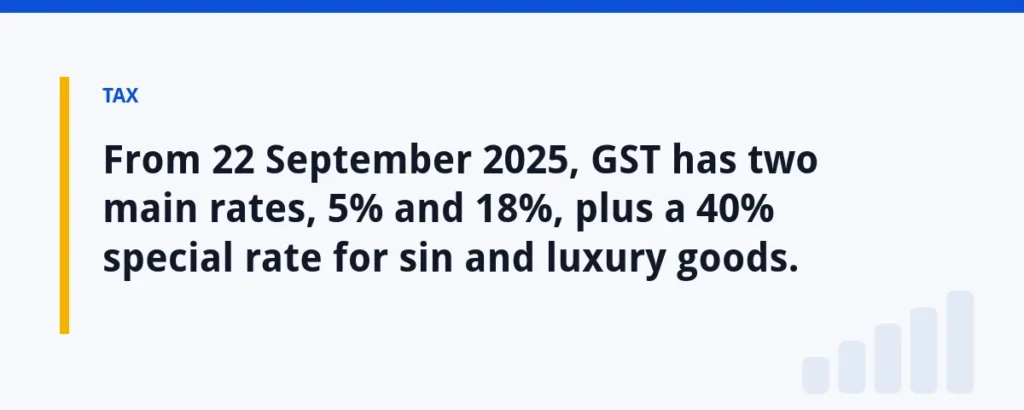
At its 56th meeting in September 2025, the GST Council recommended what the government called next-generation GST reform. The old four-tier structure of 5%, 12%, 18% and 28% gave way to two main rates, 5% and 18%, with the 12% and 28% slabs removed. A special rate of 40% applies to a short list of sin and luxury goods. Many essentials are taxed at nil.
The new GST rates on services and on most goods took effect from 22 September 2025. Pan masala, gutkha, cigarettes, chewing tobacco, unmanufactured tobacco and bidis were put on a separate timeline. They kept their old rates and compensation cess for a few more months. That changed on 1 February 2026. Since then, pan masala, cigarettes and similar tobacco products attract 40% GST and bidis 18%, and the compensation cess on them has been replaced by an additional excise duty on tobacco products and a new Health Security se National Security Cess on pan masala.
| Rate | What it covers (examples from the Council’s decisions) |
|---|---|
| Nil | UHT milk, pre-packaged and labelled paneer, Indian breads such as roti, chapati and paratha, 33 lifesaving drugs, exercise books, pencils and erasers, individual life and health insurance policies |
| 5% (merit rate) | Soap, shampoo, toothpaste, toothbrushes, bicycles, kitchenware, packaged namkeens, chocolates, coffee, butter and ghee, most other medicines, tractors, hotel rooms up to ₹7,500 a night |
| 18% (standard rate) | Air-conditioners, all TVs, dishwashers, small cars, motorcycles up to 350cc, cement, auto parts, most other services |
| 40% (special rate) | Pan masala, cigarettes and most tobacco products (bidis are at 18%), aerated and caffeinated drinks, motorcycles above 350cc, high-end cars, yachts and private aircraft |
Exact rates depend on the precise product description and HSN code in the official notifications, so treat the table as a guide. The Council’s FAQs, for instance, separate motorcycles by engine size, and admission to sporting events is exempt only where the ticket is ₹500 or less; above that it is taxed at 18%. The Council’s next meeting, its 57th on 8 October 2026, dealt mainly with process changes such as registration, returns and refunds rather than new rates.
What changed for households
For most families the 2025 changes cut the tax on the monthly grocery and toiletries list. Items like hair oil, soap, toothpaste and packaged foods moved down from 12% or 18% to 5%, and several dairy items and Indian breads moved to nil. Big-ticket items fell too: air-conditioners, TVs, small cars and two-wheelers up to 350cc moved from 28% to 18%.
As an illustration, take an air-conditioner with a pre-tax price of ₹40,000. At the old 28% the tax was ₹11,200, making ₹51,200. At 18% the tax is ₹7,200, making ₹47,200, a saving of ₹4,000 if the seller passes on the full cut. Similarly, a household item with a pre-tax price of ₹200 that moved from 18% to 5% now carries ₹10 of GST instead of ₹36.
Insurance is another big change. GST on all individual life insurance policies, whether term, ULIP or endowment, and on individual health insurance policies, including family floaters and senior citizen plans, was exempted. Check your next renewal notice to see that no GST has been added to the premium.
Health costs also came down. GST on 33 lifesaving drugs went from 12% to nil, and on three more drugs used for cancer, rare diseases and other severe chronic conditions from 5% to nil. Almost all other medicines, including Ayurveda, Unani and homoeopathy medicines, moved from 12% to 5%. Many medical devices and diagnostic apparatus dropped from 18% to 5%. If you buy regular medicines for an elderly parent, compare a new bill with an old one; the difference should show up in the tax line.
School supplies got cheaper as well. Exercise books, pencils, erasers, crayons and sharpeners moved to nil, while geometry boxes moved from 12% to 5%.
Some things went up. Aerated and caffeinated drinks moved from 28% to 40%, and so did motorcycles above 350cc.
How to read a GST bill
Under the GST invoice rules, a registered seller’s tax invoice must show certain details. Use this list to check any bill above a token amount:
- Seller’s name, address and GSTIN. No GSTIN on the bill, but GST charged? That is a red flag.
- Invoice number and date. A consecutive serial number unique for the financial year.
- Your name and address, if you ask for it or the purchase needs it, such as for warranty claims.
- Description, HSN or service code, quantity and value of each item, after any discount.
- Rate and amount of tax, shown as CGST and SGST for a local purchase, or IGST for an inter-state one.
- Place of supply, with the state name, for inter-state sales.
Here is a simple local bill, as an illustration:
| Item | Taxable value | CGST | SGST | Total |
|---|---|---|---|---|
| 32-inch TV (18%) | ₹20,000 | 9%: ₹1,800 | 9%: ₹1,800 | ₹23,600 |
| Shampoo (5%) | ₹300 | 2.5%: ₹7.50 | 2.5%: ₹7.50 | ₹315 |
If you bought the same TV online from a seller in another state, you would see one IGST line of 18%, or ₹3,600, instead of the two halves. The total is the same.
Also check the arithmetic. The invoice rules say the taxable value is shown after any discount, so GST should be worked out on the discounted price, not the original tag. If a shop gives you 10% off a ₹10,000 item taxed at 18%, the tax should be ₹1,620, not ₹1,800. Small errors like this add up across a big shopping trip.
Composition dealers: when a shop cannot charge GST
Small businesses can opt for the composition scheme, where they pay a low tax on turnover instead of regular GST. The trade-off is that they cannot collect GST from you at all. The rules require such a seller to print “composition taxable person, not eligible to collect tax on supplies” at the top of its bill, which is called a bill of supply, and to display “composition taxable person” on signboards at its place of business.
So if a shop has a composition board outside but adds GST to your bill, it is charging tax it is not allowed to collect. You can check a seller’s status on the GST portal, which also has a search for composition taxpayers.
How to check a GSTIN
Every GST-registered seller gets a 15-character Goods and Services Tax Identification Number (GSTIN). The format is fixed by the GST registration rules:
- First 2 characters: the state code
- Next 10 characters: the seller’s PAN
- Next 2 characters: an entity code
- Last character: a checksum
A quick visual check catches obvious fakes. The state code should match the state on the bill, and characters 3 to 12 should look like a PAN (five letters, four numbers, one letter).
For a proper check, use the Search Taxpayer option on the GST portal at gst.gov.in. You do not need to log in. Enter the GSTIN and the captcha, and the portal shows the legal name of the business, its trade name, date of registration, principal place of business, whether the registration is active or cancelled, and its return filing history. If the name does not match the shop, or the GSTIN is cancelled or shows no result, ask the seller to explain before you pay.
Overcharged? How to complain
Start with the seller. Ask for a proper tax invoice and point out the rate you expected, using the table above or the latest notification. Many disputes end here, especially where an old price tag or billing software was not updated after the rate change.
If that fails, you have official routes:
- National Consumer Helpline: call the toll-free number 1915, available from 8 am to 8 pm, or message on WhatsApp or SMS at 8800001915. You can also lodge a grievance online at consumerhelpline.gov.in.
- Consumer commission: for larger disputes, you can file a complaint with the district consumer commission. Keep your bill, payment proof and any messages with the seller.
- GST authorities: if a seller collects GST without a valid GSTIN, or a composition dealer charges tax, it is a tax matter as well as a consumer one. Report it to the GST department of your state or the CBIC.
Always pay digitally or insist on a bill. Without an invoice you have no proof of what you were charged.
Common myths about GST rates
“Every hotel stay is taxed at 18%.” Not after the 2025 changes. The Council’s FAQs say hotel accommodation priced up to ₹7,500 per unit per day attracts 5%, without input tax credit for the hotel.
“A cheaper bill without GST is a good deal.” It may mean the seller is not recording the sale, and you lose your proof of purchase for warranty or returns.
“Air tickets carry one GST rate.” Economy class air travel is taxed at 5%, while other classes are taxed at 18%, according to the Council’s FAQs.
Key takeaways
- Since 22 September 2025, most goods and services fall into two GST rates, 5% and 18%, with 40% for sin and select luxury goods and nil for many essentials.
- Individual life and health insurance premiums are exempt from GST.
- A valid GST bill shows the seller’s GSTIN, invoice number, item values and the CGST/SGST or IGST charged.
- Check any GSTIN free on the GST portal’s Search Taxpayer page, without logging in.
- Composition dealers cannot charge GST. For overcharging, call the National Consumer Helpline on 1915.