Every April, ordinary taxpayers meet the same quiet nuisance: the form you filed last year has a new number, or a new name, or no longer exists. This time the shake-up is bigger than usual. The Income-tax Rules 2026 took effect on 1 April 2026 and replaced the Income-tax Rules, 1962, which had been patched for more than sixty years. If your employer gave you a salary certificate with a different name, or your bank asked for a form you have never heard of, this is why.
The good news is that the Rules are procedure, not a new tax. They tell you and your employer, bank or tenant which form to use, who signs it and by when. Below we explain what changed, which rules apply to which year, how the old and new form numbers line up, and what a salaried person, a senior citizen, a landlord or an NRI actually has to do differently. This is general information, not tax advice, so check the form itself before you file.
What the Income-tax Rules 2026 are and why they exist
Think of the Income-tax Act as the law and the Rules as the manual that makes it work. The Act says tax must be deducted on your salary. The Rules say which certificate your employer gives you, in what format and by which date. When Parliament passed the Income-tax Act, 2025 to replace the Income-tax Act, 1961, the old manual stopped fitting. Section numbers had changed, so every rule and form that pointed to an old section needed to be rewritten.
The Central Board of Direct Taxes issued the new Rules on 20 March 2026 as Notification 22/2026 (G.S.R. 198(E)), just before the Act came into force. The Income Tax Department’s own FAQ says the 1961 Act stands repealed from 1 April 2026 and that the new Act applies from that date. It also says plainly that the Act does not impose any new tax. The same logic applies to the Rules: the aim was fewer rules, fewer forms and plainer wording, not a higher bill.
The numbers: fewer rules and far fewer forms
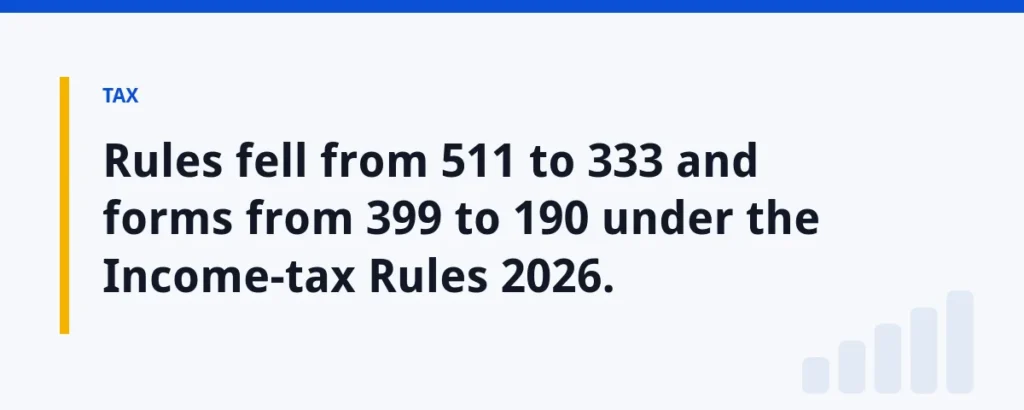
The Income Tax Department says the Rules shrank from 511 rules and 399 forms to 333 rules and 190 forms. The Act itself went from 819 sections and 14 schedules to 536 sections and 16 schedules. Explanations and provisos were folded into the main text, and tables and formulas replaced long paragraphs wherever possible.
| Item | Old position | New position |
|---|---|---|
| Law | Income-tax Act, 1961 (819 sections, 14 schedules) | Income-tax Act, 2025 (536 sections, 16 schedules) |
| Rules | Income-tax Rules, 1962: 511 rules | New Rules: 333 rules |
| Forms | 399 forms | 190 forms |
| Time frame | “Previous year” and “assessment year” | “Tax year”; assessment year dropped |
Fewer forms does not always mean fewer steps for you. Several forms were merged, and a few are new. Two examples from the department’s own mapping guide: the declaration you used to give a bank to stop TDS on interest is now one form instead of two, and four separate challan-cum-statement forms for TDS on property and similar payments are now a single Form 141. If you buy property from a resident seller or pay rent above the TDS threshold, that single form is the one you will meet.
Which rules apply to which year
This is where most confusion starts. The new Rules do not erase the old ones overnight. The Income Tax Department’s FAQ explains that tax years beginning before 1 April 2026 continue to be governed by the old Act, including notices, assessments, rectifications, penalties and appeals that begin after that date. So a notice about an older income year is still handled under the 1961 Act and the 1962 Rules.
For filing, the FAQ gives a clear example: returns for assessment year 2026-27, filed in July 2026, used the old Act’s forms. Income earned from 1 April 2026 falls in tax year 2026-27, which is the first year under the new Act, and advance tax for that year follows the new Act. Your first return under the new framework will be for tax year 2026-27, filed after 31 March 2027.
Some things carry over without any action from you. The FAQ says an option exercised under the old Act is treated as made under the equivalent new provision, and it gives the new tax regime election as an example, so you need not opt in again. Registrations, approvals, your PAN and the faceless assessment schemes continue too.
Old forms and their new numbers
The department has published a form mapping guide that lists each new form against its 1961 Act equivalent. The forms most ordinary taxpayers meet are in the table below. Form numbers on the new side are the Income-tax Act, 2025 numbers.
| Old form | New form | What it is for |
|---|---|---|
| 15G and 15H | Form 121 | Declaration under section 393(6) to receive certain income without TDS |
| 26QB, 26QC, 26QD, 26QE | Form 141 | Challan-cum-statement for TDS under section 393(1) on specified payments |
| 10F | Form 41 | Information under section 159(8) to claim treaty relief |
| 15CA | Form 145 | Information for payments to a non-resident |
| 15CB | Form 146 | Accountant’s certificate for payments to a non-resident |
| 27C | Form 127 | Buyer’s declaration under section 394(2) to buy goods without tax collection |
The same mapping guide lists Form 121 against both 15G and 15H, which means a single form now serves taxpayers of every age.
Salaried taxpayers: Form 130 and the declaration to your employer
Your annual salary TDS certificate has a new identity. Rule 215 of the new Rules says the certificate for tax deducted on salary under section 392 is Form 130, and it must reach you by 15 June after the tax year in which the salary was paid. For tax year 2026-27, which ends on 31 March 2027, the due date is 15 June 2027. It is generated and downloaded from the department’s portal, and the employer may use a digital signature.
The rule also covers job changes, which trip up many people. If you worked for more than one employer in the year, each employer issues Parts A and B of Form 130 for the months you worked there. Part C can be issued by each employer or by the last one, at your option. If you lose the certificate, the deductor can issue a duplicate on request, marked as a duplicate.
The other certificates under the same rule follow a similar pattern. Form 131 covers most deductions other than salary and is due within 15 days of the due date for the TDS statement. Form 132 is for the property-related deductions reported on the challan-cum-statement, and Form 133 is for tax collected at source. Practically, the paper trail you may remember as Form 16 and Form 16A now arrives under different numbers, but you still match it with your tax credit statement before filing.
The HRA declaration
The employee’s declaration of rent, home loan interest and investments, earlier called Form 12BB, is reported by news coverage to have become Form 124 under the new Rules, with a line asking you to state if the landlord is a relative. News reports also say the 50% of salary HRA limit now covers eight cities instead of four, adding Bengaluru, Hyderabad, Pune and Ahmedabad. We could not read the official text of these particular provisions, so confirm them with your employer or against the Rules before you rely on them. Our HRA calculator shows how the exemption works, and the income tax calculator lets you test the effect on your tax.
Savers and seniors: Form 121 replaces 15G and 15H
If you give your bank a form every April so that no TDS is cut on FD interest, this one is for you. Under the new Rules the declaration is Form 121, filed under section 393(6) for receiving certain incomes without deduction of tax. The department’s mapping guide shows it replaces both 15G and 15H. The e-filing portal also carries a user manual for Form 121 with step-by-step screens, so the form can be filed online through the portal.
What does not change is the principle. A declaration of this kind only makes sense if your total income for the year is within the tax-free limit, so that no tax is payable anyway. As an illustration, say a retired person has only ₹1.5 lakh of FD interest and no other income. If tax on that income would be nil, a valid declaration stops the bank from deducting TDS and tying up money until you claim a refund. If your total income is higher, a declaration is not the answer, and a wrong one can lead to trouble. Our guide on tax on FD interest covers the TDS limits in detail.
NRIs and anyone paying abroad: Forms 41, 145 and 146
If you send money abroad or earn income from India as a non-resident, the form numbers matter more, because banks will not process the transaction without the right paperwork. Form 41 replaces the old Form 10F, the information a non-resident gives to claim relief under a tax treaty. The section it sits under is 159(8) of the new Act.
For payments to a non-resident, the old Form 15CA becomes Form 145 and the accountant’s certificate, 15CB, becomes Form 146. If your bank or authorised dealer asks for these on a remittance, use the new numbers and the portal’s current version. Our guide on LRS and TCS covers the money side of such transfers, and you can convert amounts with the currency converter before you start.
The Rules are still being amended
A set of Rules this large is never finished on day one. The e-filing portal’s news page lists amendments through the year. As of early November 2026 these include:
- The Sixth Amendment Rules, Notification 134/2026 dated 8 October 2026, which revised Form 161.
- The Eighth Amendment Rules, Notification 139/2026 dated 30 October 2026, which added Rule 189A and Form 112A for mergers of registered non-profit organisations.
- A proposed Seventh Amendment, listed on 27 October 2026, which would add Rule 281A and Form 173A for claiming exemption on interest and capital gains from Government securities. It is only a proposal until notified.
Most of these touch businesses, trusts and non-residents more than salaried families. The lesson for you is simple: forms can be revised mid-year, so always download the current version from the portal rather than reusing an old PDF from a friend or a previous year.
A simple way to handle the change
You do not need to read all 333 rules. A short routine is enough.
- Treat income of tax years before 1 April 2026 under the old rules, and income from 1 April 2026 under the new ones.
- When an employer, bank or buyer quotes a form number, match it against the table above or the department’s mapping guide.
- Download forms and utilities only from the e-filing portal, and look for the current version.
- If you are an NRI or send money abroad, ask your bank which version of Form 145 or 146 it needs before the day you transfer.
Key takeaways
- The Income-tax Rules 2026 replaced the 1962 Rules from 1 April 2026, cutting rules from 511 to 333 and forms from 399 to 190.
- No new tax was introduced; the change is mostly in numbers, names and structure.
- Tax years that began before 1 April 2026 stay under the old law, and tax year 2026-27 is the first under the new one.
- Form 121 replaces 15G and 15H, Form 130 is the salary TDS certificate due by 15 June, and Forms 41, 145 and 146 matter for non-residents.
- Amendments keep arriving, so use the latest form from the portal and keep your acknowledgements.