Your payslip for April 2026 probably looked the same as March, yet the law behind it had changed. The Income-tax Act 2025 came into force on 1 April 2026 and replaced the Income-tax Act, 1961. For most salaried people the sums did not move. The slabs, the rebate and the standard deduction you already knew carried over, but they now sit under new section numbers and a new vocabulary.
This guide is for employees who want to know what actually differs in tax year 2026-27, what stays put, and what to do before the next return. It is general information, not personal advice, and every rule below comes from the text of the Act or the Income Tax Department’s own pages.
What the Income-tax Act 2025 changes in plain terms
The Act says it may be called the Income-tax Act, 2025, extends to the whole of India and, unless a provision says otherwise, comes into force on 1 April 2026. Section 536 repeals the Income-tax Act, 1961, while saving anything already done and any liability that arose under the old law. So an old return, a pending notice or an assessment for an earlier year is still handled under the 1961 rules.
The change you will notice first is language. The Act defines a “tax year” as the twelve months of the financial year starting on 1 April. The old pair of “previous year” and “assessment year” is gone. Income earned from April 2026 to March 2027 is simply tax year 2026-27.
The second change is numbering. Provisions you knew by heart have moved. The rebate that was section 87A is now section 156. The new regime’s slab section, 115BAC, is now section 202. TDS on salary, once section 192, is section 392. Many rules that used to be scattered across the law now sit in tables.
What did not change is the core design for employees. The new regime is the default, you can choose the old one, and the amounts you deal with each year are the ones you already know. Think of it as the same house with the rooms renumbered.
Old section numbers and new ones for common salary items
Here is a quick map, built from the contents page and text of the Act. The middle column is what your old Form 16, payslips and articles used. Use the new numbers when you talk about tax year 2026-27 onwards.
| Item | Old section | Under the 2025 Act |
|---|---|---|
| Standard deduction for salary | 16(ia) | Section 19, Table item 2 |
| New regime slabs | 115BAC | Section 202 |
| Rebate for lower incomes | 87A | Section 156 |
| Employer pension (NPS) contribution | 80CCD(2) | Section 124 |
| Health insurance premium | 80D | Section 126 |
| Education loan interest | 80E | Section 129 |
| Rent paid, where no HRA | 80GG | Section 134 |
| TDS on salary | 192 | Section 392 |
| Return of income | 139 | Section 263 |
If you read an article that still says 80C or 87A, it is describing the same idea under the earlier numbering. The idea, not the number, is what decides your tax.
New tax regime slabs and standard deduction in 2026-27
Section 202(1) of the Act gives the slab table for individuals under the new regime. The Income Tax Department’s e-filing guidance lists the same bands for assessment year 2026-27.
- Up to ₹4 lakh: nil
- ₹4 lakh to ₹8 lakh: 5%
- ₹8 lakh to ₹12 lakh: 10%
- ₹12 lakh to ₹16 lakh: 15%
- ₹16 lakh to ₹20 lakh: 20%
- ₹20 lakh to ₹24 lakh: 25%
- Above ₹24 lakh: 30%
These rates apply slice by slice. A taxable income of ₹10 lakh is not taxed at 10% on the whole amount. The first ₹4 lakh is nil, the next ₹4 lakh bears 5% (₹20,000) and the last ₹2 lakh bears 10% (₹20,000), so the tax before any rebate is ₹40,000. A 4% health and education cess is then added to the tax.
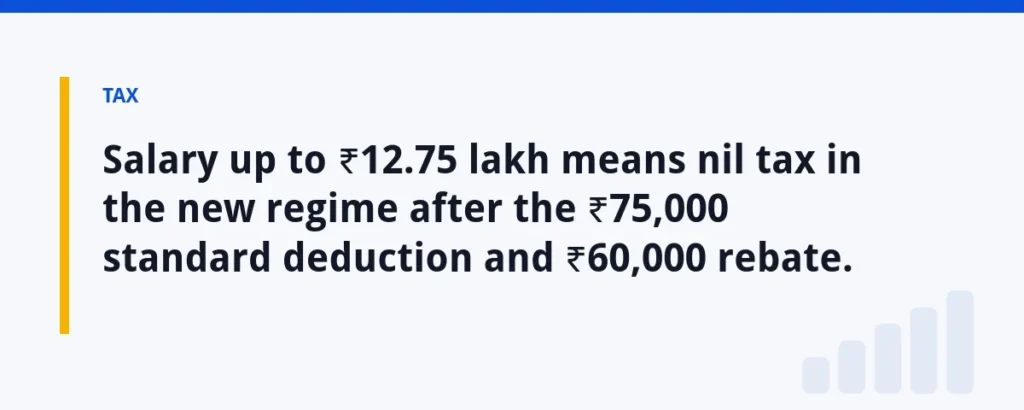
The standard deduction sits in section 19. It is ₹75,000 or your salary, whichever is less, where tax is computed under the new regime, and ₹50,000 or salary, whichever is less, in any other case. You get it without producing a single bill. It comes off your salary to reach taxable income, so a salary of ₹12.75 lakh becomes ₹12 lakh of taxable income in the new regime.
The rebate under section 156 and why ₹12 lakh is the line
Section 156 carries the rebate. In the new regime, a resident individual whose total income does not exceed ₹12 lakh gets a deduction from tax of 100% of the tax or ₹60,000, whichever is less. Slab tax on ₹12 lakh is exactly ₹60,000, so the bill falls to zero. Cess is charged on tax, and no tax is left, so nothing is added.
Add the standard deduction and a salaried person earning ₹12.75 lakh can pay no income tax at all.
Just above the line, the Act has built-in relief. If income exceeds ₹12 lakh, the rebate equals the amount by which the slab tax is more than the income above ₹12 lakh. As an illustration, say your taxable income is ₹12.1 lakh. Slab tax is ₹61,500, the excess over ₹12 lakh is ₹10,000, so the rebate is ₹51,500 and you pay ₹10,000 plus 4% cess. At ₹12.5 lakh of taxable income you pay ₹50,000 plus cess. The relief runs out once the slab tax is no longer higher than the extra income, which happens at roughly ₹12.7 lakh of taxable income.
The old regime has its own, much smaller rebate: ₹12,500 or the tax, whichever is less, if total income is not more than ₹5 lakh.
What stays the same: the default regime and your yearly choice
The new regime remains the default. Section 202(1) applies unless you exercise the option in sub-section (4). For a person with no business or professional income, which describes most employees, the Act says the option is exercised along with the return of income. So you can pick the old regime one year and the new regime the next, simply by how you file.
The department’s guidance says the same: salaried individuals choose directly in the return. People with business or professional income have stricter rules, because they must file a prescribed option and a switch back to the new regime later is allowed only once.
One practical point. Your employer deducts TDS on the regime you tell them in April, but that does not lock you in. If the old regime suits you better, claim it when you file and any excess TDS comes back as a refund. Our guide on the new and old tax regimes compares them in full, so we will not repeat that here.
What you give up if you stay in the new regime
Section 202(2) lists the exemptions and deductions that are not available when your tax is computed under the new regime. Among them is the deduction for tax on employment, the professional tax your employer may cut from pay, which sits in the section 19 table. House property losses cannot be set off against other income. Allowances and perquisites granted under any other law in force are also not exempt, which matters if your pay package leans on tax-free allowances.
A few deductions do survive. In the chapter on deductions, sections 124(1) and 124(2), 125(2) and 146 are the ones left standing. Section 124 covers the employer’s contribution to a pension scheme notified by the Central Government, such as NPS. The text of the Act I read allows an employee in the new regime a deduction of the employer’s contribution up to 14% of salary, against 10% for employers other than the government in the ordinary case. Ask your employer how the contribution is structured, because it lowers taxable income without any bill from you.
Before choosing, run your numbers both ways. Our guide on tax-saving deductions under the old regime lists what still counts there, and the income tax calculator lets you compare regimes with your own salary.
TDS on salary and Form 16 under the new Act
Your employer deducts tax on salary under section 392. The rule is the same in substance. Tax is cut at the time of payment, at the average rate of tax worked out on the slab rates for that year and your estimated salary income for the year. That is why a bonus month or a mid-year raise changes the monthly deduction.
The same section lets the employer pay the tax on a non-monetary perquisite from its own pocket instead of cutting it from your pay. If you receive such a benefit, ask HR which method they use.
For you, this means three habits.
- Tell HR your regime choice and any pension contribution details early in the year.
- Check each quarter whether the TDS in your payslip matches the tax you expect.
- Compare Form 16 and the AIS with the TDS credit shown in your tax statement before you file.
We have separate guides on Form 16, TDS and the AIS if you want to go through each document.
Filing the return for tax year 2026-27
Section 263 requires a return if your total income, before the rebate and deductions, exceeds the maximum amount not chargeable to tax. Its due-date table gives 31 July for any other assessee, which covers the average salaried person. Companies and audit cases have 31 October, and a few transfer pricing cases 30 November.
Because the new regime’s nil band is ₹4 lakh, someone with a salary of ₹5 lakh may still need to file even though no tax is payable after the rebate. Filing also matters if you want a refund, need to carry forward a loss or must show income for a loan.
When you file, you pick the regime inside the return, so the decision is made with final numbers rather than a guess in April. If you pay rent, the HRA calculator helps you see what the old regime would give you.
A worked comparison of two salaried taxpayers
As an illustration, take two employees in tax year 2026-27, both in the new regime with no other income. The figures are round numbers chosen to show the mechanics.
| Item | Employee A | Employee B |
|---|---|---|
| Annual salary | ₹12.75 lakh | ₹18 lakh |
| Standard deduction | ₹75,000 | ₹75,000 |
| Taxable income | ₹12 lakh | ₹17.25 lakh |
| Slab tax | ₹60,000 | ₹1,45,000 |
| Rebate under section 156 | ₹60,000 | Nil |
| Tax plus 4% cess | Nil | ₹1,50,800 |
For Employee B, the first ₹12 lakh costs ₹60,000. The next ₹4 lakh at 15% adds ₹60,000. The last ₹1.25 lakh, from ₹16 lakh to ₹17.25 lakh, is taxed at 20% and adds ₹25,000. The total is ₹1,45,000, and cess of ₹5,800 takes it to ₹1,50,800.
The gap between the two shows how sharp the rebate cliff is, and why salary structure, such as the employer pension contribution, can matter more than a small investment made in March. Our guide on salary structure explains the components in detail.
Key takeaways and a short checklist
The Income-tax Act 2025 is mainly a rewrite. For employees in tax year 2026-27, the amounts you rely on are unchanged and the numbering is new.
- The Act applies from 1 April 2026 and repeals the 1961 Act, with old matters saved.
- New regime slabs: nil to ₹4 lakh, then 5%, 10%, 15%, 20%, 25% and 30% above ₹24 lakh.
- Standard deduction: ₹75,000 in the new regime and ₹50,000 otherwise.
- Rebate under section 156: up to ₹60,000 if income is not above ₹12 lakh, with relief just above it.
- Salaried taxpayers choose the regime in the return and can change it each year.
- Check the TDS in your payslip and Form 16 against the AIS before filing by 31 July.
If you remember one thing, remember that the only things that changed on 1 April 2026 were the names and numbers. Your tax depends on your slab, your deductions and your choice of regime, and you still decide that when you file.