
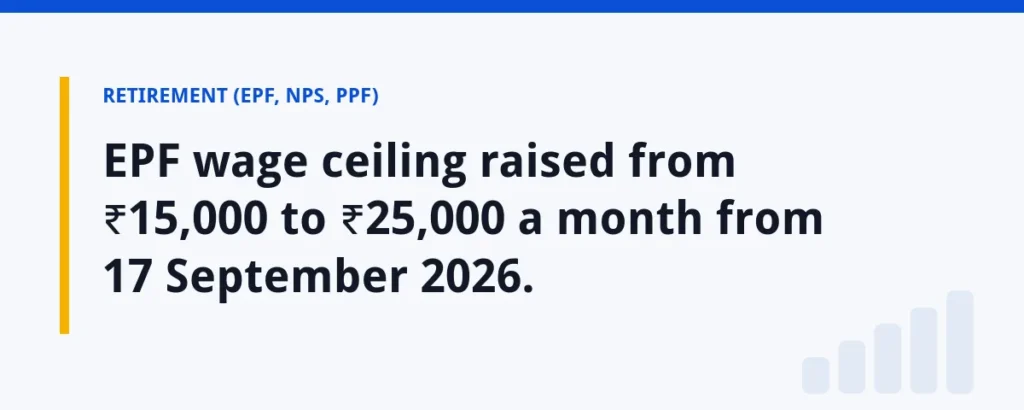
The EPF wage ceiling, the monthly pay limit up to which provident fund membership is mandatory, went up from ₹15,000 to ₹25,000 on 17 September 2026. The Union Cabinet approved the change on 16 September, and the Labour Ministry notified it the next day. It is the first revision since September 2014, and the government expects more than 51 lakh extra employees to come under mandatory EPFO coverage.
Two more EPFO items followed in the weeks after. The EPFO board met on 19 November 2026 and approved a lower minimum balance for final withdrawal and a voluntary instalment payout for retirees. Separately, a UPI-based PF withdrawal facility has been in testing, with reports pointing to a launch by the end of December, though no official date has been announced. Here is what each change means for your salary slip and your retirement savings.
What changed on 17 September
For years, an employee earning more than ₹15,000 a month in an establishment covered by the Employees’ Provident Fund could be left outside the system. The ceiling stayed unchanged from 2004 to 2014, was raised to ₹15,000 in September 2014, and has now moved to ₹25,000, according to a report by News on AIR on 16 September 2026.
The Labour Ministry’s notification, dated 17 September 2026, took effect on the day it was published in the Gazette. Law-firm and compliance alerts describe it as replacing the earlier ₹15,000 figure. Employees in the ₹15,000 to ₹25,000 band can now come under mandatory provident fund, pension and Employees’ Deposit Linked Insurance cover, subject to the scheme conditions.
| Item | Before 17 September 2026 | From 17 September 2026 |
|---|---|---|
| Wage ceiling for mandatory coverage | ₹15,000 a month | ₹25,000 a month |
| Maximum employee PF share at 12% of the ceiling | ₹1,800 a month | ₹3,000 a month |
| Extra employees expected to be covered | Not applicable | More than 51 lakh |
The government’s estimated annual outgo on the move is about ₹11,339 crore, as reported by News on AIR. The rupee limits in the table follow from the 12% contribution rate described in a BDO India alert.
How the EPF wage ceiling changes your salary slip
The 12% rate has not changed. What has changed is the pay on which it can be charged. If you were already contributing on a salary above ₹25,000, a BDO India alert says your total contribution stays the same. The people who feel the difference are those earning between ₹15,000 and ₹25,000 in PF wages, especially if their employer had not enrolled them earlier.
Take an illustration. Say Meera’s PF wage is ₹22,000 a month and she was not covered before. Her 12% share is ₹2,640 a month, which leaves her take-home pay lower by that amount. Her employer also pays in, and part of the employer’s money goes to the pension scheme rather than to her PF balance. Check your payslip to see which pay component your employer treats as PF wages.
Existing members generally stay members even if their pay later crosses the ceiling, according to the same BDO India alert. Voluntary PF choices do not change automatically either. The alert also notes that higher deductions may reduce take-home pay for newly covered staff, so a smaller monthly payout is the price of a larger retirement fund.
What it means for your retirement savings
Money lost from monthly pay is not gone. It goes into an account that earns interest set by the government each year. A report by SCC Online on 19 September 2026 gives the rate for the current financial year as 8.25%, but rates are declared annually, so do not treat any figure as fixed for the long run.
As an illustration, assume 8% a year. Meera’s ₹2,640 a month, paid in at the start of every month for 10 years, would grow to about ₹4.86 lakh, of which ₹3.17 lakh is her own contribution. This counts only her share, not her employer’s, and the real figure depends on the rate declared each year. You can test your own numbers with the PPF calculator or the compound interest calculator.
The pension side needs care. A BDO India alert and other commentary caution that the higher coverage threshold should not be read as an automatic rise in the pensionable wage under the Employees’ Pension Scheme. A larger pension is therefore not guaranteed by this change alone.
Who gains and who loses in the short run
Lower-paid workers in the new band gain a provident fund, pension eligibility and life cover that they may not have had. Employers carry extra cost as well. News coverage of the notification mentions a government incentive of up to ₹3,000 a month per eligible employee under the PMVBRY scheme, for up to two years in non-manufacturing and four years in manufacturing, subject to conditions and KYC.
The trade-off is real. Someone supporting a family on ₹20,000 a month may prefer cash in hand now. Remember that this is a mandatory rule for covered establishments, so the choice of opting out is limited. If your payslip changes, ask your employer how the PF wage was calculated.
- Check whether your PF wage is now above ₹15,000 and up to ₹25,000.
- Compare the new deduction with last month’s payslip.
- Confirm your UAN is active and your KYC is complete.
- Keep a note of the date your deductions started.
EPFO board decisions of 19 November 2026
At its 240th meeting, chaired by Labour Minister Mansukh Mandaviya, the Central Board of Trustees approved several changes. People Matters, carrying a PTI report on 20 November, listed the main ones.
| Decision | What was approved | Status |
|---|---|---|
| Minimum balance for final withdrawal | Cut from 25% to 10% | Approved by the board; notification pending |
| Waiting period for final settlement | Cut from 12 months to 2 months | Approved by the board; notification pending |
| Systematic Withdrawal Plan | Voluntary monthly, quarterly or half-yearly payouts for retirees | Needs Ministry approval and a scheme amendment |
The Labour Ministry says about 6.32 lakh members aged above 55 with balances over ₹5 lakh are the expected first beneficiaries of the instalment plan. A compliance note from SGCMS says none of the changes is operative until the amendments are notified, and that the tax treatment of instalment payouts is still being taken up with the Finance Ministry.
The board also reviewed progress on the CITES 2.0 platform. According to the ministry statement as reported, auto-processing of claims rose from 39% to 71% and the average settlement time fell from 11.15 days to 2.57 days.
UPI-based PF withdrawal: where it stands
Today you file a claim on the UAN portal and the approved amount reaches your bank account after processing. The proposed system would link PF withdrawals to UPI so that eligible members can move money without that wait. An Angel One report on 8 October 2026 said testing with banks had begun and that existing withdrawal conditions would continue to apply.
The timeline has slipped before. Earlier reports pointed to April and then June. A Business Standard report of 25 November, as relayed by Asianet Newsable, says EPFO is targeting a rollout by the end of December 2026, with some issues tied to the CITES 2.0 migration still to be resolved. The same report mentions a ₹1,000 minimum transaction that is only a proposal. Asianet adds that a wider EPFO 3.0 launch in February 2027 has been reported but not confirmed by EPFO.
So treat December as a target, not a date. Until EPFO announces it, keep using the UAN portal, and be wary of anyone offering “UPI PF withdrawal” links or apps today. Do not share your UAN password or OTP with anyone.
Key takeaways
- The EPF wage ceiling rose from ₹15,000 to ₹25,000 a month on 17 September 2026.
- The 12% rate is unchanged, so the maximum employee share is now ₹3,000 a month instead of ₹1,800.
- Newly covered workers see lower take-home pay but a larger retirement fund, with a higher pension not assured.
- The 19 November board decisions need notification before they apply to you.
- UPI withdrawal has no confirmed launch date yet; December is a reported target.
This article is general information, not personal financial advice. Check your own payslip and the EPFO website for the rules that apply to your employer.