What it is
The Capital Adequacy Ratio (CAR) tells you how much of a bank’s own money stands behind the risks it has taken. It is usually shown as a percentage. A bank with a higher CAR has a bigger cushion to absorb losses before depositors’ money is at risk.
The idea is simple. Banks lend out deposits, and some loans go bad. Capital, which comes from shareholders and retained profits, is what soaks up those losses.
How it works
CAR is capital divided by risk-weighted assets. Risk-weighted assets means a bank’s loans and other holdings, each counted according to how risky it is. A safer asset counts for less than a riskier one.
Here is an illustrative example with simple numbers. Suppose a bank has risk-weighted assets of ₹100 crore and capital of ₹18 crore. Its CAR is 18%. If it lends more and risk-weighted assets rise to ₹110 crore without new capital, CAR falls to about 16.4%.
That is why CAR can dip even when a bank is doing well. Fast loan growth uses up capital, while profits kept in the business add to it. A bank’s CAR is the net result of both forces.
CAR is also read alongside other measures, such as non-performing assets (NPAs), which are loans where borrowers have stopped paying. Lower bad loans mean less of the capital cushion is likely to be needed for losses.
Why it is in the news
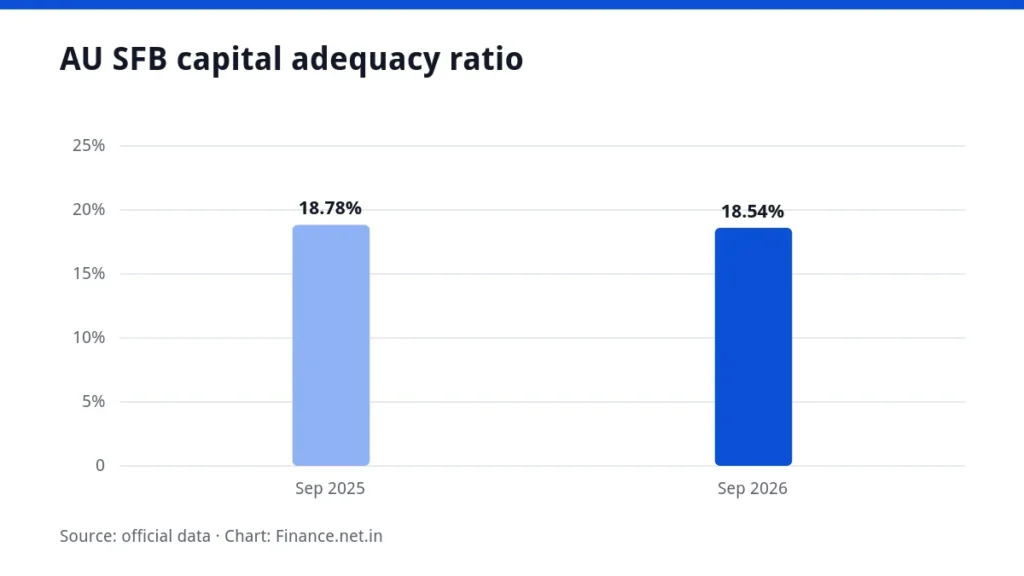
CAR has come up in the July-September 2026 results of banks. AU Small Finance Bank reported on 24 October 2026 that its CAR decreased to 18.54% from 18.78% at the end of September 2025, according to reports in BusinessLine and The Hindu. That is a fall of 0.24 percentage point.
The same reports show the bank’s profit rose 53% to ₹858 crore, and gross NPAs fell to 1.99% from 2.41% a year ago. Net NPAs, which are bad loans after setting aside provisions, moderated to 0.81% from 0.88%. So the CAR dipped in a quarter when profit and asset quality improved. You can read the full numbers in our AU Small Finance Bank Q2 coverage.
For State Bank of India, the Times of India reported on 3 November 2026 that the bank’s capital adequacy ratio increased in the quarter, alongside a 14% rise in net profit to ₹23,038 crore. The reports reviewed do not give the ratio itself. More on the quarter is in our SBI Q2 results report.
What it means for you
If you hold a deposit or shares in a bank, CAR is one indicator of how well the bank can handle shocks. It is not the only one, and no single figure tells the whole story.
- Look at the direction and the reason. A small fall can come from faster lending, as in the example above, rather than from trouble.
- Read it with asset quality. Compare CAR with gross and net NPAs and with provisions.
- Compare like with like. Check the same bank across quarters, or banks of a similar type.
The figures here come from company filings as reported by news outlets. They describe what happened and are not a view on any bank’s shares.
Background
Regulators set minimum capital levels so that banks keep a buffer against losses. The sources used here do not state the minimum CAR that applies to Indian banks, so no figure is given. For the exact requirement for a bank, check the Reserve Bank of India’s rules or the bank’s own disclosures.